
Project management


1 Characteristics of projects
Now we are going to look at project management. But before we can do that, we need to have some idea of what is meant by the term ‘Project’. We tend to recognise the project intuitively, but projects of certain important characteristics.
First of all, they are really by definition non-routine. They are different from one’s day-to-day activities. They will have specific starting and ending points.
Secondly, they are usually addressing novel or unique challenges, something which you haven’t done before and will probably never be asked to do again.
Projects usually have project teams and the team members will normally be from different departments with different backgrounds, so these people may have different priorities. They may want different things from the project. They will use different terminology. They will have different outlooks, for example, different attention to detail, different sense of urgency, different attitudes towards quality, and differ in views on costs.
Fourthly, for most projects though not all, there is no benefit until the project is finished. Usually, half a computer system, or half a factory, or half a system of quality control will be rather useless. Therefore, many projects are characterised by a period of spending and effort, and only much later, perhaps after several years, will we see whether the project works and whether the benefits we had hoped for are actually realised.
All of these characteristics of a project should worry you. Its non-routine, its novel, there are people from many backgrounds who have not worked together before. There is no benefit until the project is finished. Therefore the risk attaching to projects can often be very great. We need, carefully how to control the project and its scope otherwise we will simply have wasted the organisation’s effort and money.
2 Projects and strategic plans
A strategic plan is typically for a five year time-horizon and for whole organisations. To implement that as a single task is impossible and it must be broken down into a series of smaller tasks. Each task is a project and each will have a planned:
Start date
Duration
Finish date
A relationship to other projects: after some, before others etc
A cost
A person responsible
A closely defined set of outcomes
Stages of a project
The stages of a project can be described in a number of ways. For example:
Initiation/initial screening
Risk assessment. There are four responses to risk: transfer (eg give this part of a project to a sub-contractor; avoid (do not undertake the project); reduce (for example by running a pilot operation first to see how things work on a small scale; and accept (live with the risk as business always has some risk).
Business case
Project plan
Executing
Monitoring and controlling/project milestones
Closing: delivery/review
3 The business case
A business case should be prepared for any project. This will show how profits can be increased (in a profit-seeking organisation), or how service levels could be improved in a not-for-profit organisation
Possible techniques include:
Cost / benefit analysis
Net present value/payback/ROCE
Sensitivity analysis and risk analysis
Forecasting techniques
Expected values
Decision trees
Usually costs are easy to budget. However, often benefits are intangible (such as customer service level) and are much more difficult to quantify with any precision.
For example, how would you quantify the benefits arising from a major training project? You might firmly believe that the project is worthwhile, but could you prove it in advance?
Ward and Daniels identified four types of benefit:
Observable: impossible to measure and often unexpected. For example, a new IT system may allow staff to complete their work more efficiently will lead to better morale and lower staff turnover. The benefit can be seen but would be difficult to measure.
Measurable: can be measured but not predicted. For example, better stock-control could reduce stock-outs and so improve a company’s reputation. Sales increases can be measured, but would be very difficult to predict.
Quantifiable: measurable and predictable. For example, calculations that show that the average volume of stock held should decrease by 20% if a new stock control system is introduced.
Financial: the financial benefit can be assessed and predicted. Once a benefit has been quantified, making the last step to predicting financial benefits is relatively easy: a 20% lowering in stock volume will probably reduce stock-holding costs by 20% also.
Once the financial benefit has been assessed this can be put into a DCF calculation to appraise the project.
The benefits really begin to be more easily dealt with once they change from measurable to quantifiable because predictions are needed for DCF calculations. Methods for making this transition include:
Pilot operation. Try out the new system in one branch, measure the improvements and assume these will be available company-wide.
Simulation. Based on mathematical models.
Observing improvements found by other users. Be careful a vendor does not simply show you the most delighted user who might be completely uncritical of the new system.
4 Project risk
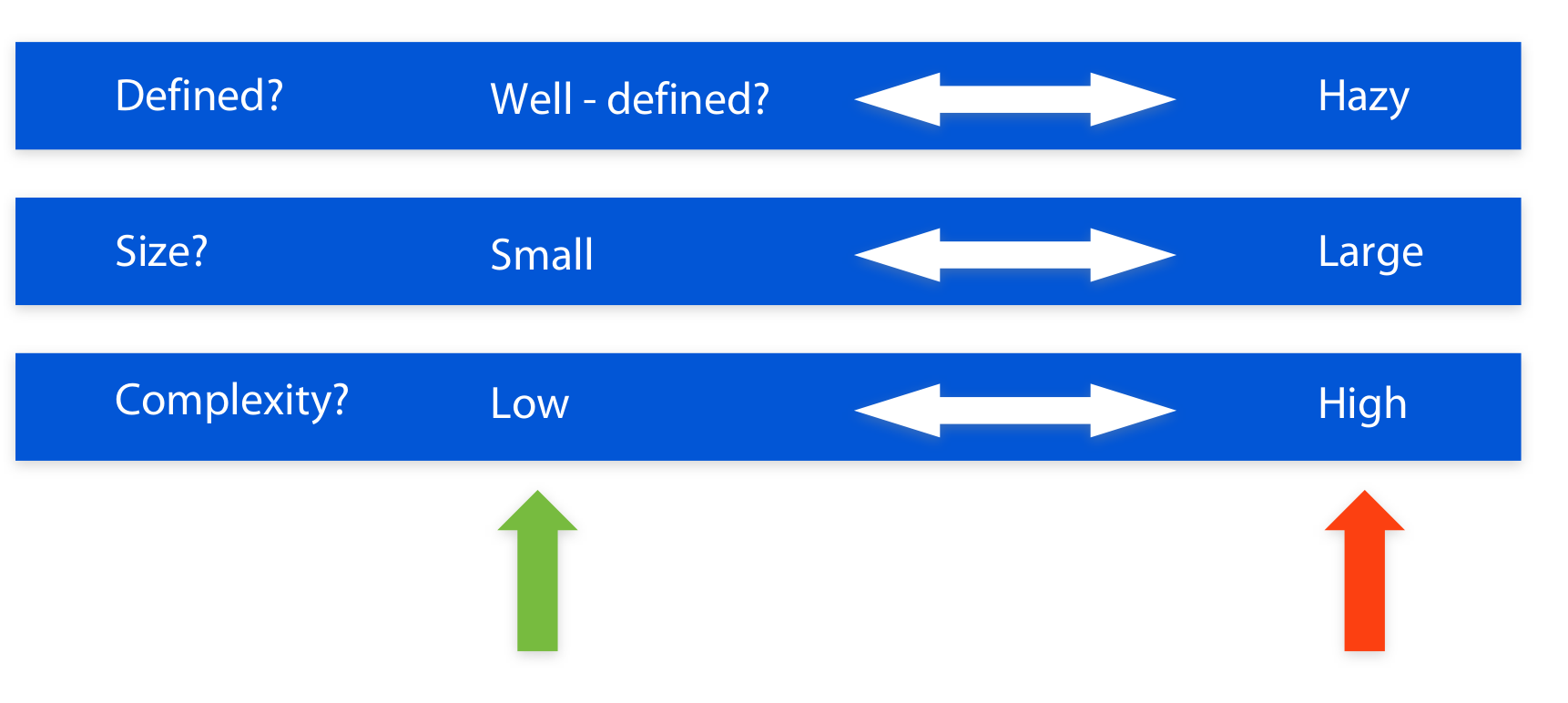
It’s important to be aware of project risk because high risk projects should be more carefully monitored for cost, time, quality, and scope. There are three obvious variables affecting project risk.
How well defined is the project? If you were to embark on a project which was defined as something like “we want to improve the inventory system”, then really, we have to ask what on earth that means. What does the word ‘Improve’ mean? Does it mean going all the way to just-in-time inventory, does it mean automatic reordering, does it mean having fewer stock-outs, does it mean lowering the average inventory value? A project defined as “improved inventory” is very hazy, and hazy projects are full of risks. Basically, we have no idea what its scope is, and if we have no idea what its scope is we will find it’s susceptible to what is called project drift. In other words the objectives and deliverables of the project are never really defined, or keep changing, and we will get hopelessly lost.
The size of the project. You can easily see that if a project were simply something to do with the receivables ledger that is relatively small. If it goes wrong, it’s only the receivables ledger which is affected. If it’s however to do with the whole of the accounting system and it goes wrong then all of the accounting system is going to be affected with large-scale disruption.
Complexity. If the technical complexity is low, it’s a fairly well-understood problem, there are well-understood solutions to those problems, and we are on pretty safe ground. If however the project is cutting-edge and rather experimental, no one has really much experience of it before, and involves many different stakeholders, you can see that the project risk is much higher.
So if you are in charge of a project which is not well-defined, is hazy, is large, is very complex, you might like to think about finding a new job.
5 Project initiation document and project plan
The project initiation document addresses : Who? Why? When? How? What?
It is an immensely important document and accomplishes the following:
Defines the project, its scope and its deliverables.
Justifies the project: cost/benefit analysis; risk analysis.
Secures funding for the project, if necessary.
Defines the roles and responsibilities of project participants: sponsor, manager team.
Gives people the information they need to be productive and effective right from the start: assignments, schedule, human resources, project control, quality control.
First, what is the project? The initiation document defines the project. It sets out the scope of the project and its deliverables. Only by setting out deliverables in advance can we possibly judge after the event whether the project has been successful or not? It justifies a project both in terms of cost benefit analysis and also risk analysis. Remember a project could potentially show substantial benefits, but if it was at very high risk we might prefer not to embark upon it. If necessary, we have to secure funding for the project to see it right the way through, bearing in mind that most projects yield no benefits whatsoever until they are completed successfully.
It defines the roles and responsibilities of the project participants. The project sponsor can be regarded as a person to whom the project belongs and very often is a person or department which is providing the funding. The project manager has got day-to-day responsibilities for looking after the progress of the project and that manager in particular will be looking after a project team. Do not underestimate the skills required of a project manager. They will probably be in charge of a diverse group of people; they will be working to time, cost, and quality standards. They have to liaise with the sponsor. They have to interpret what is wanted, from time to time they may have to reach comprises with the various stakeholders.
And finally it gives people information on a detailed project plan: they need to be productive and effective right from the start of the project. It will assign responsibilities. It will set out a schedule perhaps on a network diagram. It will ensure that the right people are there at the right time. It will establish ways of controlling the project in terms of time, money, quality, and scope.
6 The project manager
This is the person in charge of the running of the project – tracking resources, controlling, leading, inspiring, negotiating, reviewing, resolving disputes. It is an immensely challenging job and requires personal qualities such as:
Leadership abilities, including the ability to motivate
Technical ability in running projects and in the subject matter
Negotiation ability to negotiate with project sponsors (those who are paying), project team members and suppliers.
Reporting on progress and difficulties
The ability to stay calm in a crisis
Excellent communication
Ability to delegate to team members.
7 The project sponsor
The project sponsor is the person or department who wants the project to be undertaken and who will often pay for the project. Any problems with, or changes to the project have to be communicated to the sponsor, who will have to make decisions about what should be done.
For example:
Project: a new computerised accounting system.
Sponsor: finance director.
Manager: probably an IT/accounting specialist (possible hired just for this project and who has day management responsibility.
If the manager finds that the project is slipping (running behind time) the manager will present options to the sponsor as follows:
Live with the slippage and accept the project several months late.
Spend more on the project so that staff are asked to work overtime to hit the deadline.
Reduce the scope of the project (eg forgo certain elements of the project).
8 The project team
A team can be defined as:
“A group of people with a full set of complementary skills required to complete a task, job, or project.”
Teams usually work best if they:
Are fairly small
Are united in what they want out of the project
Have the right mix of complementary skills
Have the right mix of personalities
This can be difficult to achieve because they will be drawn from different backgrounds and departments and are likely to have different priorities for project outcome. It is an important task of the project manager to get the diverse team members to work well together.
9 Project management: the variables
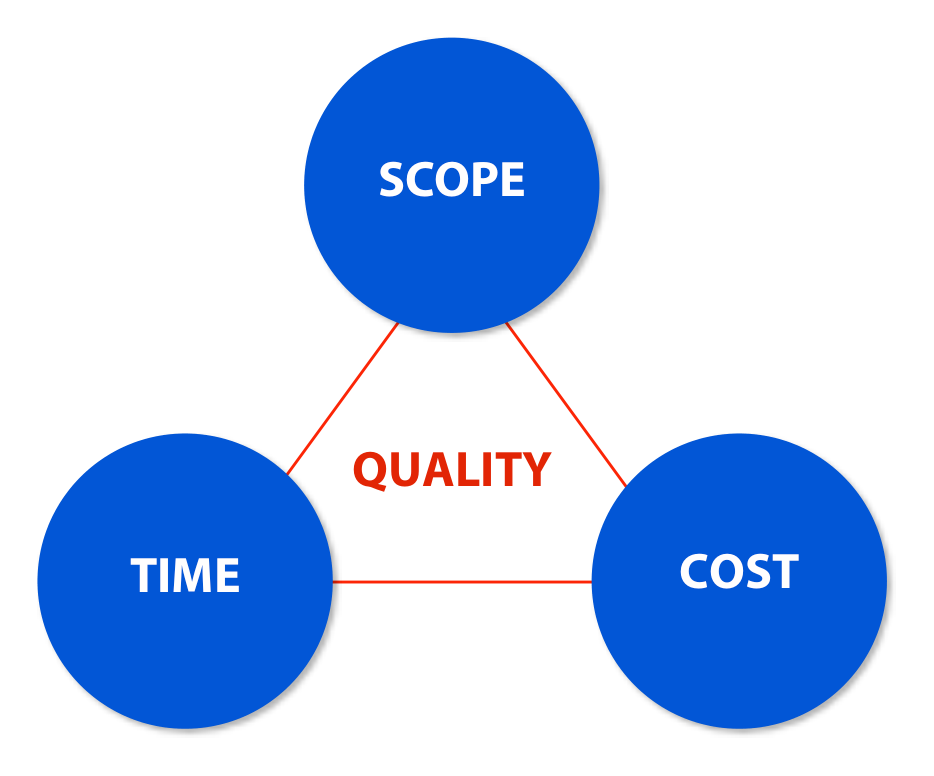
This is a useful diagram which depicts the problems of project management. It says there are four variables, the time or deadline, the cost, the scope or extent of a project, and the quality we have to achieve.
The diagram first states that if you change one of these variables we are bound to affect the others. So if you want the project to be done more quickly to avoid slippage, you may have to spend more money, you may have to limit scope, or you may cut corners and quality. If you want the project to be done more cheaply at a lower cost it may take longer, you may reduce its scope, and again you might comprise quality.
Furthermore, even if you are not adjusting one of these variables, most projects will have one of them as a priority. It might be that above all we have to have something done within a deadline and if we concentrate tremendously on getting the project done within a deadline, inevitably we may compromise costs, scope, and quality. Similarly, if the project were to do with public safety and the quality of the output was to be the highest possible standard, then we have to be aware there is a danger that the project will take too long, it will be very expensive, or we compromise on its scope.
10 Completion
10.1 The completion report
Completion involves formally accepting the project and bringing it to a close. A completion report shows the outcome of the project and is used to:
Check that everything promised by the project has been delivered ie that the project objectives have been achieved.
Check on any changes which had to be made to reach acceptance, and that there are no outstanding project issues.
Deliver the final budget report.
Arrange for post-project and post-implementation reviews.
10.2 Post project reviews and post implementation review
There are two types of review that should be carried out after the project is completed:
A post-project review. This is about the project.
A post‑implementation review. This is about what the project achieved.
10.3 Post-project review
This examines the project looking for areas that did not go smoothly and for those that did. For example, the project might have been late and that needs to be examined to see if it could have been prevented and to learn lessons for future projects. It can also look at the performance of the project team members.
Without such a review, there is little hope of improving the management of future projects
10.4 Post implementation review
This examines what the project achieved. Before the project was started there should have been hopes and ambitions for it. These would have been set out in the business case and the project initiation document.
It is now time to see if the project has delivered anything of sufficient value, at the right cost, by the right time and which people are prepared to use enthusiastically. In other words, has the project realised benefits?
If the answer is negative, then the organisation has to critically examine what went wrong so that similar waste does not happen in the future.
10.5 EMPLOYABILITY AND TECHNOLOGY SKILLS
11 Introduction
The ACCA has introduced this new section into the syllabus for all of the Applied Skills and Strategic Professional examinations now that all the examinations in all locations will be computer based.
However, it does not require the same sort of learning as for other syllabus areas because it is primarily focused on ensuring that students are capable of using the Computer Based Exam software.
The level of skill needed to be able to use the CBE software can also be beneficial for your employment.
Many students will already have a high level of skill on computers and be familiar with the use of word processors and spreadsheets. However, those provided in the exam software might not be identical to those that you are familiar with and, in addition, it is essential that you are able to navigate the software efficiently so as not to waste time in the exam.
There are many excellent resources available on the ACCA website to assist you, and so in this chapter we will direct you to some of the relevant ACCA pages and explain their importance.
12 Navigating the exam and the tools available
The exam screen has a top bar and a bottom bar.
On the top bar there are options to call up an ‘online calculator’, to call up the ‘scratch pad’, and to ‘flag for review’. You can also highlight or strikethrough text in the question or exhibits.
The online calculator is used in the normal way and can be switched at any time between a basic mode and a scientific mode. You can use your own calculator instead provided that it does not store or display text.
The scratch pad can be used to make notes and do your own rough workings, but nothing written on the scratchpad will actually be marked. You will also be provided with paper if sitting the exam in an exam centre and so you can use this for workings instead - the paper will be collected in at the end of the exam but, again, nothing on this rough paper will be marked. (Note: if you are sitting the exam remotely then paper is not allowed and you can only use the scratchpad.)
The ‘flag for review’ option enables you to put a mark against a question to enable you to quickly come back to it again later. This is for questions where you are unsure about your answer and want to do more work on it later should there be time.
On the bottom bar are the arrows for moving forwards or backwards through the questions. In addition, there is a ‘navigator’ option which when chosen displays a list of all of the questions enabling you to go straight to a particular question.
13 The exam
This comprises of a number of independent tasks and exhibits.
For calculations the program provides a spreadsheet in which to enter your calculations. For efficiency you should make use of the functions and formulae available in the spreadsheet (you do not need to type out separately the formulae used - the marker will be able to see them).
You can find details of the functions and formulae that are available in the ACCA booklet linked in section 4 of this chapter. Note that the spreadsheet provided does not have all the functionality of Excel. For example, you cannot insert or delete rows and columns and no help if given for function names and syntax. Therefore, it is essential that you become familiar with the ACCA exam spreadsheet.
For the report you are provided with a word processor and, again, details of the functions available such as underlining and ‘copy and paste’ are in the ACCA booklet.
14 ACCA Resources
You will find many resources on the ACCA website and the more you refer to the better.
On this page, under the heading “Resources” you will find a link to download “SBL essentials on one page”. Clicking on this will download a useful small chart headed up “How to approach
The Strategic Business Leader (SBL) exam”. One of the headings on this chart is ‘Links to support resources’ and clicking on each of the items listed in turn will take you to more detail. Each of these ‘Key Resources’ is worth reading.
In addition, it is important to visit the following page
On this page you will find useful information, but also towards the bottom of the page you will find a link to “CBE Guidance Document”. This will download a leaflet which details everything about the CBEs including, importantly, a list of the functions and formulae available in the spreadsheet and the word processor (and how to input the formulae in the spreadsheet).
You can watch a video illustrating the use of all these features by clicking on the link to “CBE workspace management video”.
There is also information on how to access the CBE specimen and practice exams:
You are strongly advised to make use of both the video and the practice resources so that you become familiar with the exam interface.
15 Revision Kit Live
On our main Paper SBL page you will find a link to a section called ‘Revision Kit Live’ in which you will find lectures working through several past exam questions.