
Outsourcing, shared services and disruptive technologies

1 Introduction
Outsourcing is when any operation or process that could, or would usually, be performed in-house by an organisation’s employees, is sub-contracted to another organisation for a substantial period. The outsourced tasks can be performed on-site or off-site.
Before looking at a specific scenario we will briefly explain the ‘standard’ advantages and disadvantages of outsourcing describe some common outsourcing applications.
2 Common outsourcing applications
It allows the organisation to focus on its core, value adding activities without the distraction of having to run support services. Support services can soak up both management time and financial resources and these would usually be better spent concentrating on where the business has used its resources and competences to gain competitive advantages.
Cost savings. Usually the organisations to which activities are outsourced specialise in those activities and therefore are likely to enjoy economies of scale, whether from the use of machinery or the employment of expertise. There can be additional cost savings if a process is outsourced to a foreign company operating in a cheaper labour area (off-shoring).
Cost certainty. An outsourcing contract at a fixed, or closely defined price, shifts much of the financial risk onto the provider. Costs become more predictable.
Cost restructuring. For some types of outsourcing, for example component manufacturing, there will be lower fixed costs and higher variable costs. If all components are bought in, then these costs are all variable. Had the components been made in house, there would inevitably have been associated substantial fixed overheads.
Access to cutting edge expertise and talent. In technically advanced, fast-moving industries, it can be difficult for small companies to develop or make use of new processes. Outsourcing to a specialist company can give access to the latest technologies.
Better quality. There can be an immediate improvement in quality if a process is outsourced to a world-class company and where the quality achieved is carefully defined in a service level agreement.
Risk transference. If a company perceives that one of its processes has high risks, then this can be transferred by outsourcing to another company.
Capacity management. It can be difficult for businesses to deal with variable demand: either they run out of capacity (unhappy customers), or have (expensive) unused capacity. Outsourcing to a large company can mitigate this problem.
3 Potential disadvantages of outsourcing
Unexpected costs. Although many costs become more predictable, the supplier will be very careful to define exactly what these costs cover. There are likely to be substantial additional charges for anything extra. Additionally, remember that almost certainly the supplier knows that part of the business better than the outsourcer and will ensure that the contract is carefully (and advantageously) worded.
Difficult to reverse. Once an activity is outsourced and internal knowhow gone, it can be very difficult to bring a process in-house again. This is particularly relevant when a contract comes up for renewal: the price increase might be higher than expected but it can be difficult to abandon the supplier
Damage to reputation. If the outsource company does not perform properly to the proper quality standards, then great damage can be done to the organisation’s reputation.
Non-congruent objectives and loss of managerial control. The supplier company makes money be doing things efficiently. The buying company might make money by innovation. To some extent, despite the contract, there can therefore be a difference in the objectives and core values between the two parties.
Success depends on another company’s performance. Though there is always a dependency between buyers and sellers, outsourcing shifts more responsibility for success to other companies’ performance. If an important outsource company goes bankrupt, there can be serious consequences.
Confidentiality/security. Outsourcing some processes will inevitably give the supplier information that could be valuable or sensitive. Keeping a process in-house is should increase security.
4 Examples of outsourcing
Catering facilities. For example, Compass Group UK and Ireland has a turnover of almost $3 billion and its main business is providing catering facilities for organisation such as schools, hospitals, client entertainment, businesses, and sports and leisure venues.
Document handling. Document handling is a serious problem for many companies and there are often legal requirements to preserve documents for many years. The company Ricoh offers scanning and archiving facilities (both electronic and hard copy), printing (including folding and binding), mail room (receipt, sorting delivery and despatch). Increasingly, incoming documents are scanned and stored electronically. That way, documents are instantly retrievable and can be used simultaneously by several people.
Technology services/IT. Because of the large investment, high specialist expertise needed and rapid technological changes, this one of the most common processes to be outsourced.
Accounting services. For example receivables ledger maintenance or wages and salaries administration.
HRM. Recruitment, legal considerations (for example, complying with equal opportunities legislation), appraisals, contracts, disciplinary, grievance.
Fleet management. Purchase, maintenance and disposal of vehicles.
5 What should be outsourced?
Harmon’s Process Strategy Matrix provides very useful guidance about which processes can be safely outsourced and which should be kept in-house, but subject to automation or other improvement.
It uses two axes:
Complexity/dynamism of the process. Dynamism is a measure of how frequently the process changes.
Strategic importance of the process.
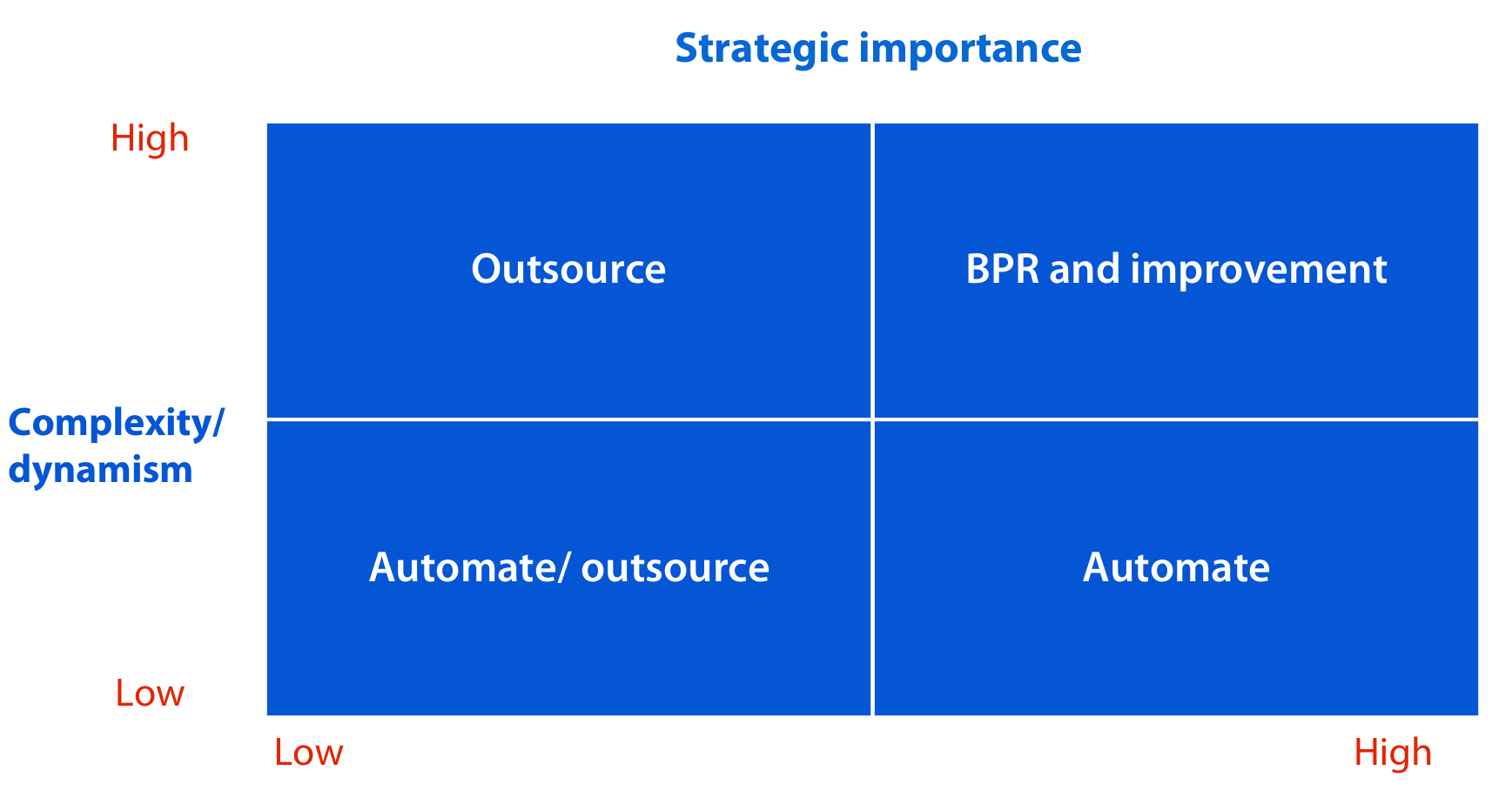
Notice that in the right-hand pair of quadrants, where strategic importance of the process is high, outsourcing is not recommended. If a process is strategically important it is likely to be a source of competitive advantage. If that were to be outsourced then the company would be telling the supplier about its most valuable secrets and competences. What would then be left for the outsourcer to do?
If a process is relatively stable and non-complex, then automation would be feasible and worthwhile. if however, the process were very complex and subject to many changes then automation will be difficult to achieve and even more difficult to keep up to date.
Of the examples given in the previous section, with the exception of technology services, all are pretty firmly not of strategic importance to most organisations. Technology services might or might not be of strategic importance. If the organisation used IT for fairly routine accounting and management purposes, it is unlikely to be strategically important. However, some organisations will use IT in a very creative way so that it becomes a source of competitive advantage. Consider Amazon.com, an on-line supplier of books, DVD, electronic equipment etc. The company has very advanced customer relationship management software which recommends books that you might like because of previous purchases you made, allows readers to enter and read reviews, uses targeted emails to market special offers. IT is the mainspring of Amazon and it is unlikely to ever outsource that foundation of its success.
6 Outsourcing and the commoditisation of business processes
When a process is going to be outsourced it is important that both parties know what is expected otherwise there will be probably be misunderstanding and trouble. However, often there is no clear mechanism for comparing the capabilities and services provided by third party organisations and those that are provided in-house. If processes are not standardised then it will be difficult for companies to decide whether outsourcing will provide value for money and to compare different potential suppliers.
There are three processing standards to consider:
Process activity and flow standards: exactly what are the process, its information flows and the movement of materials?
Process performance standards: once there is agreement about what a process consists off, this step establishes the level of performance required. This can be built into outsourcing contracts.
Process management standards: how is the process monitors, documented controlled and improved?
Once processes have been standardised this will lead to commoditisation of outsourcing leading to more competition and lower prices. Commoditisation means that buyers can largely buy on price (just as is often done nowadays when buying a laptop computer), because the services provided will be essentially the same. Some suppliers will no doubt try to escape this price competition by trying to differentiate what they do. For example, in addition to providing the basic, commoditised outsourced process they might also begin to make suggestions about how the process could be improved.
7 Shared services
Imagine a firm of accountants that has an office in every major city. Conventional arrangements would have been for each to look after its own time records, client billing and accounting. That resulted in substantial duplication of resources.
Under a shared services arrangements all the billing and accounting services would be at one location and all offices would send and receive financial information from the shared service centre. Modern IT and communications mean that transmitting and receiving data is not difficult.
Duplication of effort and machinery is reduced and the shared service centre can allow greater expertise and specialisation in providing the service.
8 Global business services
You will easily see that large diversified or international companies will have many business units and each division or subsidiary might decide itself what to outsource or for what functions it should set up shared services for its own operations. Very soon the group will be relying on a disparate set of shared service and outsource arrangements and contracts.
The first steps in rationalisation can be to:
group a number of functions in a shared service like finance and IT; and
to handle the requirements of overseas divisions and subsidiaries at a single location.
However, most advocates of global business services say that those two steps are not sufficient to create global business services. GBS requires that the services are integrated across to organisation. For example, procurement, HR accounting and IT are coordinated across functions and across regions. Note that some of these functions might be supplied in-house and some might be outsourced, but they must not be supplied on an ad hoc, stand-alone basis.
9 Disruptive technologies
This occurs when an innovation creates a new market or value network which disrupts the existing markets and networks. New companies can emerge and older ones can be displaced and can perish. The effect on businesses is quite different to strategic drift: disruptive technologies explode onto the scene.
Examples:
iTunes: radically changed the music industry and CD market.
Netflix: radically changed the TV and film industry.
Airbnb: posing severe competition to the hotel business.
Uber: radically changing the taxi business.
Fintech: a collection of hi-tech services in the financial sector. Examples include:
Cryptocurrency (eg Bitcoins)
Peer-to-peer lenders (people with money lend directly to those who need to borrow, without going through a bank as an intermediary).
Paying by smartphone
Crowd-funding (used to raise money for new products)
Currency exchange and transmission