
Organisational structure


1 Functional structure
One of the common structures found in medium-sized organisations is the functional structure. That simply means that people within the organisation are organised by a function. So there is a finance function, a manufacturing function, research and development function, sales function, and so on.
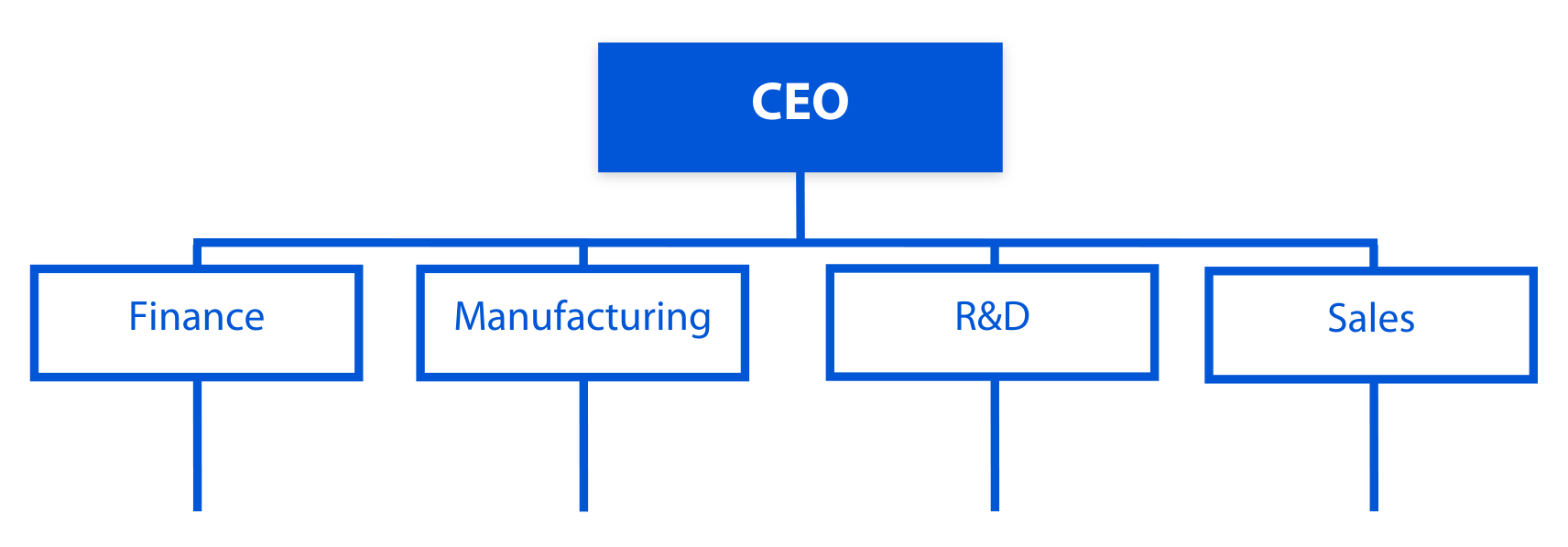
1.1 The advantages of such a structure are:
The organisation gains great economies of scale. For example, all financial recording goes through the finance department, all manufacturing goes through the manufacturing department and so on.
Each of these departments is likely to be large enough to be headed by a well-qualified manager.
There is also great comfort and satisfaction for the people within these departments. They are dealing with like-minded individuals with a similar background, similar motivation, and similar skills.
1.2 The potential disadvantages of such a structure are that:
As the organisation grows, each of the functional departments can become very powerful and can begin to concentrate on their own interests rather than the interest of the organisation as a whole. For example, the manufacturing department could become obstructive if asked by the sales department to respond to a special order from an important customer.
It might not be appropriate to push all similar-sounding activities through one department if the activities are, in fact, somewhat diverse.
1.3 The finance function
The finance function has, of course, strong contacts with every other functional department within organisations, whether measuring costs of production, agreeing budgets for advertising, allocating funds available for capital expenditure or suggesting that inventories or collection periods are greater than optimal.
Traditionally, the finance function was itself a normal, triangular, hierarchical shape: finance director through accountants down to the many accounting staff members who recorded transactions, raised documentation and performed reconciliations:

However, technology has meant that many of the simpler tasks have become almost completely automated so fewer staff are needed to perform those operations. Technology also means that more targeted information and reports have become more easily available to more senior staff who use that information to make decisions to improve the organisation’s performance. It has been argued that the shape of the finance function has become more like the following:

In other words, fewer people at very low levels (tasks largely automated) more in middle management (making more use of the additional information that has become more easily available.)
2 Divisional structure
As organisations grow they will often develop a divisional structure. This is because growth usually involves an element of diversification in terms of product, or geographical area, or even customer.
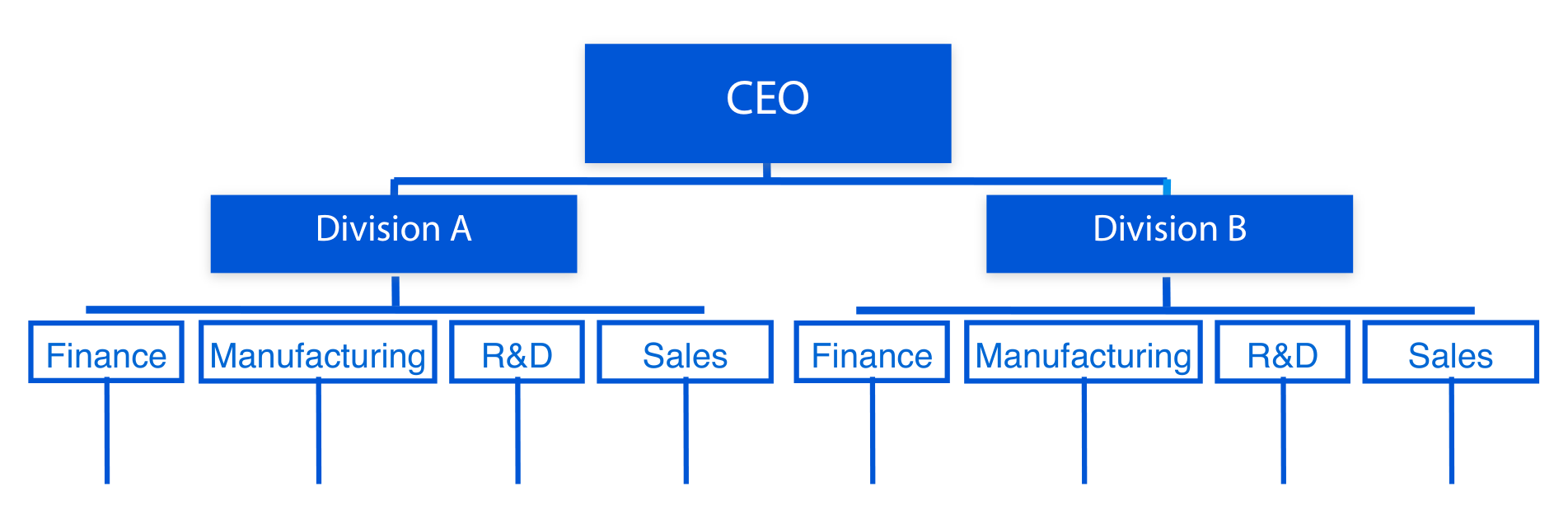
For example, a very large chemical manufacturer could typically be manufacturing paints and agriculture chemicals. There is very little in common between these two activities: the suppliers of raw material will be different as will be the competition, customers and the manufacturing processes. It makes little sense to try and jam these together in one structure, and almost certainly it’s going to be better to have a divisional structure based on products where there are separate departments for finance, manufacturing, sales, research and developments, and so on. This allows a degree of specialisation so that each division concentrates very specifically on what it does best.
2.1 The normal bases for splitting up an organisation into divisions are:
Product, as explained above.
Geography, for example, the North American division and the European division
Customer, for example some very large organisations have one division which deals with government contracts and another one which deals with private business contracts.
3 Matrix structure
Classical management theory puts great importance on what was called ‘unity of command’. That is, any person should only be reporting to one boss. To have to report more than one boss was regarded as unfair: one person shouting at you is quite enough, but to have two people shouting at you is more than mortal flesh should have to bear. The matrix structure abandons that principle and recognises that a person can have two bosses.
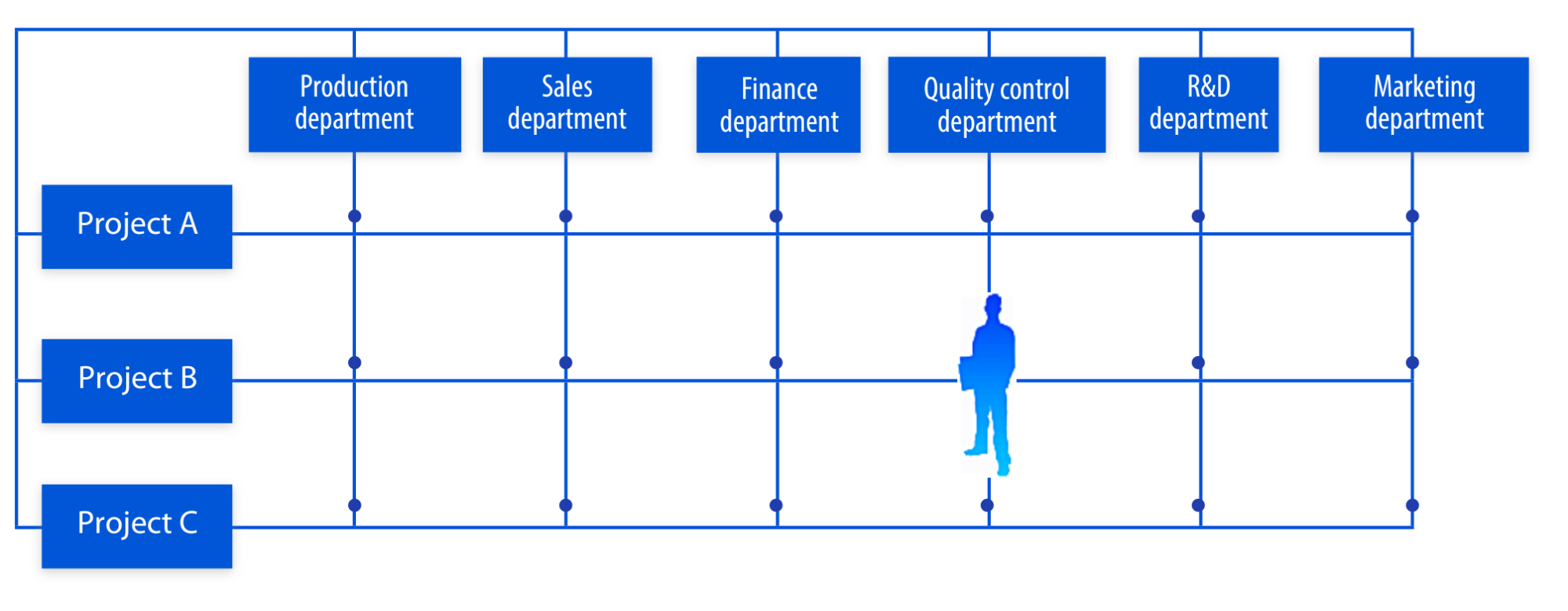
This diagram shows someone who is part of the quality control department and who will report to a quality control manager, but who is also been assigned to project “B” and will have to report to the manager of project “B”. One can easily envisage a situation where there are conflicts. If project “B” were running behind time, the project “B” manager could ask the quality control person to skip some of the tests, but that person, who is technically a quality control person, will be reluctant to do that because they have responsibilities to carry out all the tests demanded by the quality control department. So, there is one boss, the project “B” manager, who says ‘Cut tests, go faster’, and another one, the quality control manager, who says ‘Don’t cut tests, do everything as it should be done’. So what is this person to do?
Many people say that the matrix structure does not cause this problem and that even if we were to try to show this in a conventional functional format, there would still be two people bringing pressure to bear on the quality control person. It can therefore be argued that the matrix structure is a more honest representation of what happens in practice. No doubt we have all had situations where we have had a kind of dual responsibility and have had to try to make compromises.
What the matrix structure allows the quality control person to do is to say, “Look, both of my managers are responsible here. It’s not fair that you, who are managers, should pressurise me, who is relatively low down in the organisation, to make choices. It’s for you, the managers, the project “B” manager, and the quality control manager to get together and to come to some solution for the benefit of the organisation as a whole.”
Advocates of the matrix structure say, the matrix structure therefore encourages communication between various departments and projects, and that it encourages people to see that is important is that project “B” gets completed on time with the proper quality. There may well be compromises available that allow that end to be achieved, but it is for the managers of the department to reach those compromises rather than the junior member of the team who might make a decision based on which boss shouts loudest.
4 Wide flat/tall narrow
Organisations have to decide on their overall shape: whether they will be tall/narrow or wide/flat.
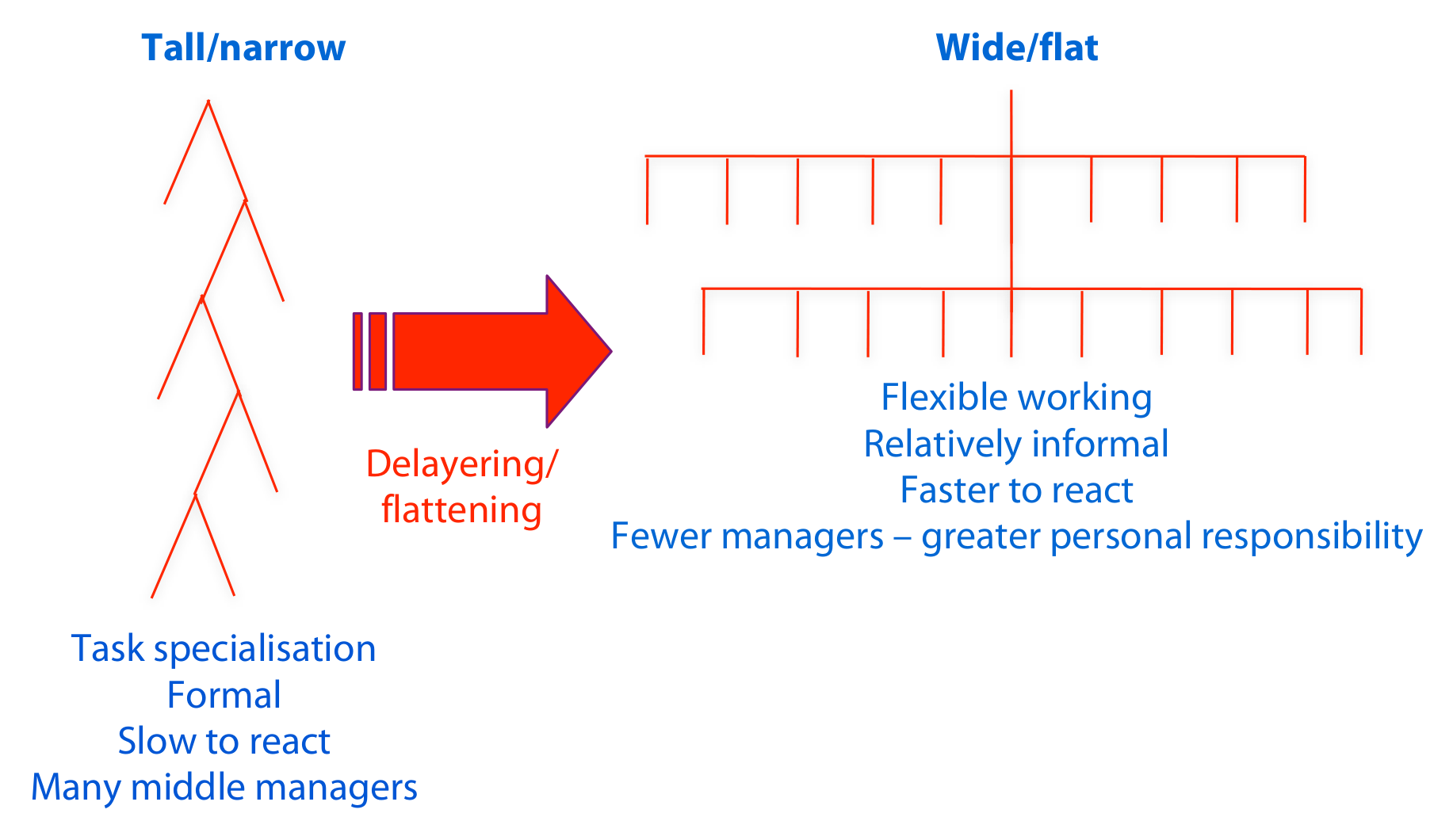
Over the last 10 – 20 years most have moved from tall/narrow to wide/flat. This was because tall/narrow structures were found to be:
Inflexible and slow to adapt within fast-changing environments
Expensive – lots of middle managers not adding much value
Poor vertical communication. With fast changing technologies and markets it is important that new, probably younger employees have ready access to decision-makers at the top of the organisation.
5 Centralisation/decentralisation
In addition to, and independent from, the shape of the organisation, is the question of how power should be distributed within it. What should the balance be between centralisation and decentralisation?
Some decentralisation is good because:
Top managers have more time for strategic decisions.
Better decisions: fast, made by functional experts and by geographical experts.
Motivation of staff. Good people like to be able to make decisions and to run a department, for example.
Training and assessment of staff. How can people gain experience if they are never allowed to make decisions?
But
There is a risk of poor coordination – dysfunctional decision making. One manager might make a decision (proper for that department) which does damage elsewhere in the organisation
Some duplication of effort/services
6 Mintzberg
Mintzberg’s organisational form diagrams show organisations consisting of five major parts:
The strategic apex, for example, the board of directors.
The middle line; the middle managers.
The operating core, the people who actually does the work
Support staff, like the accounts department
The techno-structure. The techno-structure is the part of the organisation which tries to standardise procedures. The techno-structure, for example, would be responsible for writing procedures manuals, quality control manuals, accounting manuals, personnel manuals.
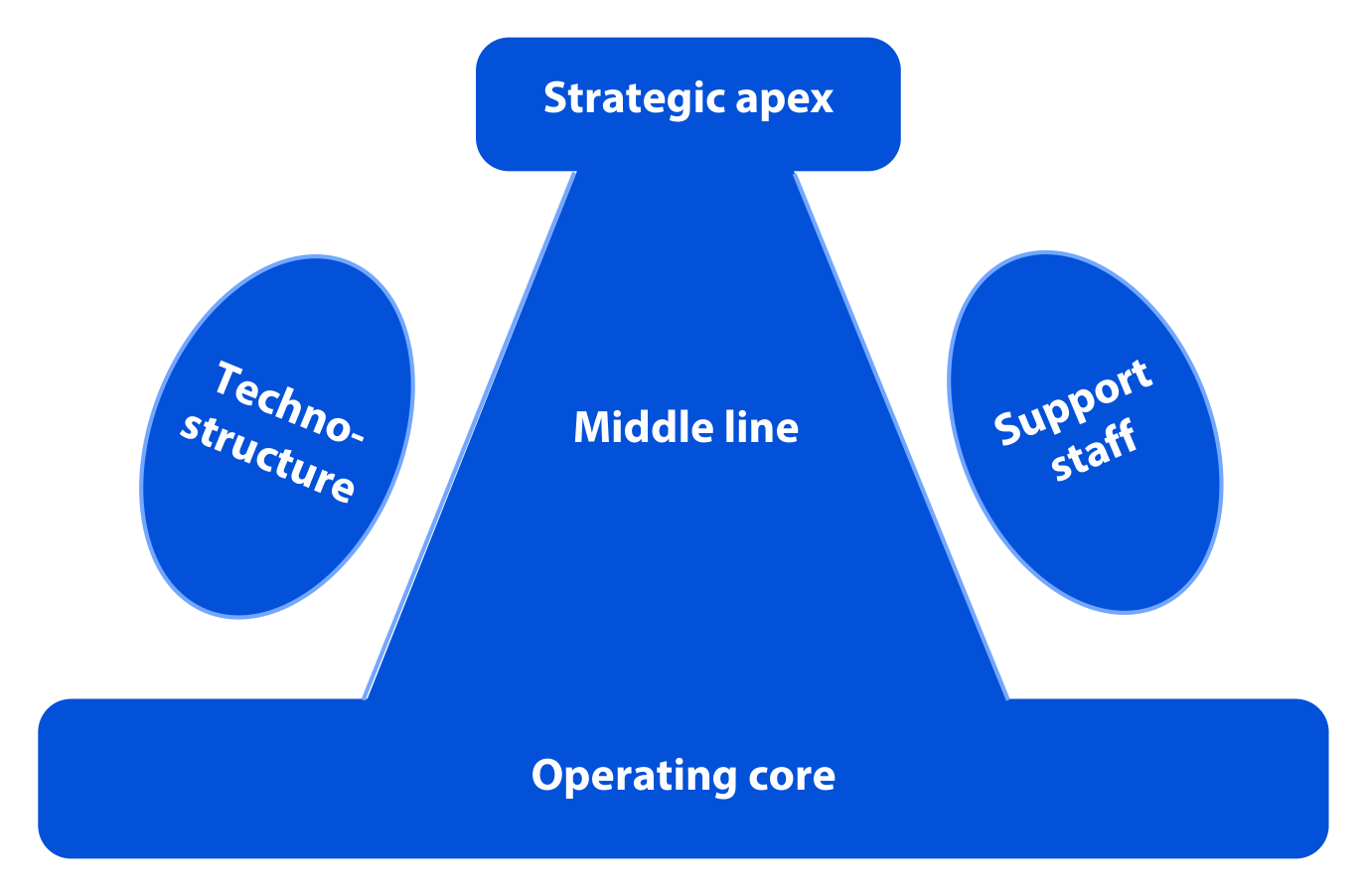
Mintzberg’s point was that the size and importance of these five different parts of a company change depending what the company is doing. For example, a very small company, that is an entrepreneurial company, would really only have the strategic apex and the operating core. It will be too small to have much of a middle line, support staff and techno-structure wouldn’t have developed yet. It’s basically the boss and his workers.
The diagram as shown probably represents what is called the machine bureaucracy that’s really an organisation dealing in mass produced products. In these organisations, the technostructure is large: quality control manuals, good financial internal control systems, health and safety rules, employee handbooks. All of these are necessary to ensure consistency in mass produced goods and the proper management of employees. The central middle line is also fairly long.
Another structure is the professional bureaucracy such as found in a firm of accountants or a firm of lawyers. In such a structure, the middle line is very short and the techno-structure is very small. The middle line is short because in firms of accountants or lawyers there has to be a very close relationship between the people who do the work and the partners of the organisation. Very good communication between the top and the bottom is essential because every audit or every legal case is unique.
Because every client is unique there can’t be a lot of standardisation. Some documents will be standard, but each job is unique. Although there might be standard documentation, the use of that documentation cannot be standardised if you are going to give unique service to each client.
Mintzberg’s structures don’t really tell you how an organisation ought to be structured. It’s more of a retrospective description of how an organisation might be structured.
7 Boundaryless organisations
A boundary-less organisation can be virtual, hollow or modular:
Virtual: create a company outside the organisation to respond to exceptional, often temporary market opportunities.
Hollow: all non-core operations are outsourced eg accounting, human resources, legal services and manufacturing could be outsourced, leaving the company to concentrate on its core competence eg design of new products.
Modular: order parts from different internal and external providers and assemble into a product.
Because market and technical conditions are changing rapidly and unpredictably, there has been growth in the boundaryless organisation as they tend to allow flexibility and fast reaction to changes.
Hollow organisations have become particularly common and there is a current trend to outsource as much as possible. A small core company of management and key employees is kept and company buys in specialist services (outsources) as and when needed from suppliers who are experts in what they do.
By keeping the permanent organisation relatively small, fixed costs are minimised and the organisation is supposed to be faster at changing and adapting to match its environment.