
Corporate culture


1 Why culture is important
Charles Handy defined the corporate culture as “the way we do things around here”, and culture is something to which we are all very sensitive. For example, whenever we change job, we go carefully for a little while to see how people do things: the level of formality, dress codes, how they address each other, length of the working day.
It is important for organisations to get their corporate culture right as this will affect how the organisation performs. For example, a cost leadership strategy will require close control of expenditure and might be expected to have strict manager-subordinate relationships. A differentiation strategy would require less cost control and different routines (such as ensuring very high customer satisfaction). The organisational assumptions in those types of business would also be different.
2 The cultural web
The cultural web describes the various influences that determine corporate culture:
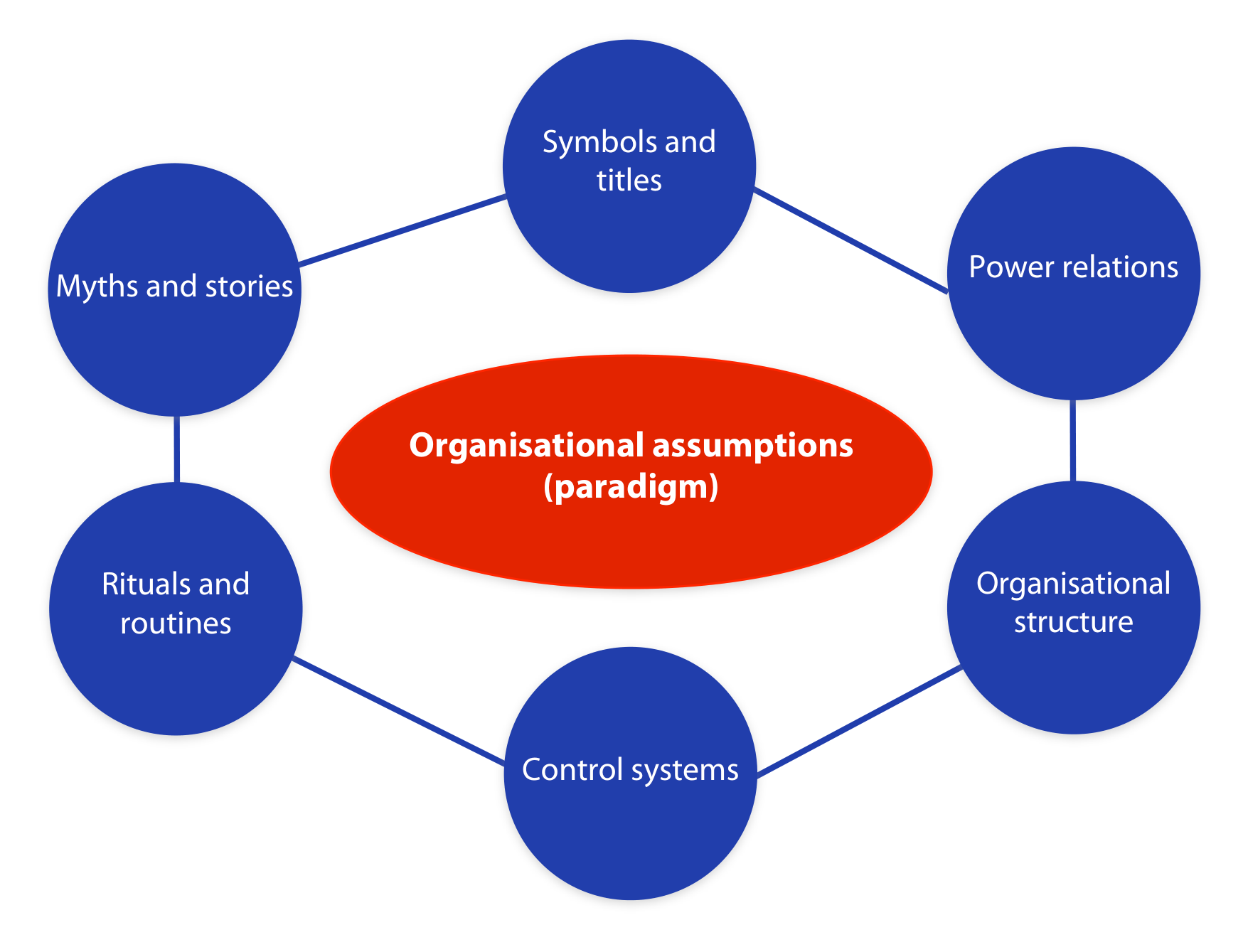
Symbols and titles. Do the members of the board have reserved parking places? Do they have very large offices or do they tend to share an open plan office with other employees?
Power relations. Does your boss always tell you what to do or do you usually discuss what should be done and come to a consensus?
Organisational structure. We will see later that organisations can have what is called a tall narrow shape or a wide flat shape. The tall narrow shape tends to result in organisations which are rather bureaucratic and formal; wide flat tends to produce less formal cultures.
Control systems. How carefully are you controlled? How much are you allowed to use your own initiative? What reporting mechanisms are there?
Rituals and routines. Some telephone-sales orientated organisations have a ritual that people, for example, ring a bell whenever a sale is made.
Myths and stories. For example, how in the past the company beat a powerful competitor.
Organisational assumptions. These can often be difficult to pin down, but a typical assumption is that we are the best, or we never fail or we never miss a deadline. A hospital might have the assumption that its purpose is to provide healthcare irrespective of cost.
The outer elements of the cultural web are usually the easiest to identify. You very quickly begin to appreciate the power relations, control systems, symbols and titles. However, many of these elements of culture will be relatively superficial. Usually the most important element of a culture will be the organisational assumption which is often the most difficult to identify. Therefore organisations often work hard to try to instil these assumptions in their employees.
3 Culture classification
Organisational cultures can be classified in many ways. One of the easiest is this one by Charles Handy. He describes four types of culture: power, role, task, and person.
Power culture. In the power culture, all or nearly all power is concentrated in the hands of one person. Organisations with this culture often are small, perhaps family, organisations and the person who has the power is probably the founder. As organisations grow, it becomes increasingly difficult for this person to successfully wield power as there is simply too much to do and too much to know. However, even in some large organisations there can be a very charismatic Chief Executive Officer who with force of personality manages to wield great power. This can result in successful organisations, but auditors and investors should worry that perhaps one person wields too much power. Current corporate governance rules suggest that the Chief Executive Officer and the Chairman should be different people so the power at the top is spread.
Role culture. As organisations grow, role cultures become more common. Role cultures are essentially bureaucracies. There tends to be great task specialization, many layers and titles, great formality. In stable environments, this can be an inefficient organisational culture, but it tends to be rather slow to adapt to change. Furthermore, employees think that their role and job title is more important than the work they actually do.
Task culture. This is a more modern type of culture. Here employees do not concentrate so much on their role or title. Instead they concentrate on getting the task done and achieving organisational success. They will tend to be highly motivated, flexible, adaptable, and eager to learn.
Person culture. This isn’t of great importance in most organisations. It refers to an organisation where the people are really pursuing their own particular ambitions. They may have to be in an organisation to fulfil that, but they are not really interested in the organisation so much as doing what they want. Perhaps a talented surgeon in a hospital might fall into this category. They have to be in a hospital to make use of the infrastructure, but what they really like doing is operating and curing people. Their interaction with the organisation is kept at a minimum.