
The purpose and process of management and leadership


1 Definitions
There are many possible definitions of management. Here is one:
“Getting things done through other people”. Management implies that you are in some way organising what other people are doing, and indeed the idea of organising should make us consider what’s meant by an organisation.
An organisation is:
“A social arrangement with a controlled performance of collective goals”. The important words here are “social,” “controlled,” and “collective.”
The word “social” recognises that we are not machines, that we are people, that we have an important social or human aspect to our characters. We will see that in the early theories of management, the social dimension was often rather understated.
The idea of “controlled” is important. Basically one of the roles of management will be to set some sort of goals or targets and then to try to ensure that people achieve that.
Finally, “collective”; the idea that in an organisation we should all be working together.
So, what then is leadership?
Bennis makes a distinction between the term “manager” and the term “leader.”
A manager is primarily concerned with administering the status quo. In other words, primarily looking after the existing business somewhat in the short term, and keeping an eye on the profit for the coming year. That’s not to say management is not an important activity. But best to think of a manager as having a time horizon of about a year.
A leader is more concerned with innovation, will be looking at the long-term future of the organisation, will not be so concerned with matters of detailed control, but will be focusing on people, inspiring trust, asking “How can we improve, where should the business go, what should the business do?”.
The leader can therefore be regarded as transformational - in other words, concerned with doing the right thing; whereas the manger is more concerned with transactional leadership - in other words, doing things right, but not necessarily questioning whether what we are doing and controlling is useful.
Kotter said that leadership and management are two distinct and complementary systems and both are necessary.
Transformational Leadership – change (Leadership) | Transactional Leadership (Management) | |
Creating agenda | Establishing direction | Planning and budgeting |
Developing HR | Aligning people | Organising and staffing |
Execution | Motivating and inspiring | Controlling and problem solving |
Outcomes | Produces changes – often dramatic | Produces predictability and order |
Management is about coping with complexity. Without good management complex companies and organisations tend to become chaotic. Good management brings order and consistency.
Leadership by contrast is about coping with change. All change always demands more leadership.
Companies manage complexity by planning and budgeting, by organising their staff, by controlling performance, and problem-solving.
Leading an organisation, however, involves setting a direction, developing a vision of the future, developing strategies to achieve that vision, motivating and enthusing people to keep them moving in the right direction.
2 What makes a leader?
Bennis suggested that great leaders have certain qualities. You might like to compare this list with the qualities of good managers you have known or good world leaders and politicians you know about.
Integrity – that really means honesty.
Dedication.
Magnanimity - magnanimity is like generosity, particularly when you have won a battle; humility.
Openness, so that people can trust you.
Creativity, so that you can think of novel solutions to difficult problems.
However, this list, sensible though it seems, does not really tell someone how to become a good leader nor will it help in the recruitment of potential leaders. Several theories emerged attempting to predict leadership or to help people achieve good leadership abilities.
2.1 Trait theory
One of the earliest theories is known as “trait theory.” Here the hope was that we could perhaps spot who will be a good manager through certain other traits that they might possess such as intelligence, initiative, self-assurance, even how tall the person was. This never really got very far; it was too subjective. For example, how would you balance intelligence versus charisma? Many good leaders are tall but then leaders such as Napoleon and many others were rather small and were perhaps overcompensating.
Trait theory was really a dead end: it proved to be no good whatsoever by predicting who the good managers might be.
2.2 Human relations approach
Around 1935, Elton Mayo carried out a very important series of experiments at the Hawthorne plant of the Western Electric company.
In one of these experiments he divided a department into two. Half of the workers were the control group, but for the other half he varied the lighting, sometimes making it better, sometimes worse. He then asked those workers what lighting they preferred and what suggestions they might have for improving it. Much to his surprise he discovered that whether or not the lighting was increased or decreased, the productivity of the people in the experimental group went up.
The conclusion from this experiment was that by making these people feel special, by asking their opinions, by asking for suggestions, they were motivated i.e. the manager led people to be enthusiastic about their work. Employees enjoyed being treated as individuals, as people, rather than simply being told what to do. This led to what was called a “human relations school” in recognition that there is more to good management than simply planning, organising, controlling, coordinating, and communicating.
2.3 Style theory and contingency theories
Style theory says that a manager’s or leader’s style determines leadership success. In particular, styles might have to change depending on who you are dealing with. In other words, good leadership is not a set way of behaving but is contingent on the circumstances.
2.4 McGregor - theory X and Theory Y
McGregor’s name is associated with Theory X and Theory Y. This can be regarded as a contingent theory of management.
The Theory X manager assumes that people really don’t want to work, that they have to be watched very carefully, that they are lazy, that they only go to work with some reluctance because they have to earn money to live.
The Theory Y manager believes that the workforce thinks that work is as natural as play, that they get enormous social rewards from going to work, that they get enormous interest from going to work, that they like being given problems to solve, and they like recognition.
So how should we lead these people?
McGregor recognised that there may be at the extremes these two sorts of people. It was called Theory X and Theory Y to be entirely neutral, not Theory Wrong and Theory Right. Basically he was saying that if you are put in charge of people who don’t like to work and who go there reluctantly, then perhaps the way you have to get the best work out of these people is to be very strict with them, to watch them carefully, to control them closely.
If however you are a manager of people who have good qualifications, who are used to being asked their opinion, who have high technical skills, then by far the best way to motivate them is a much more participative approach.
So motivation is effectively a matter of contingency. It depends whom you are trying to motivate. Different people are motivated by different managerial approaches.
2.5 The Ashridge Management College model.
This identified four types of leadership style, but remember these are only points in the continuum of management styles.
Where a requirement asks you to assess leadership styles for a particular change or decision, this continuum is one suitable way to organise the answer; another classification of styles, such as tells / sells / consults, does the same work. The marks are for taking the styles and the range the question puts in play, saying how each would work in that situation and how appropriate it would be, and then recommending one with a reason. Defining the styles is not assessing them, and a discussion of the change itself — rather than of the styles that could be used to lead it — answers a different question.

First and the most autocratic or dictatorial is “tells.” The manager simply tells the staff what to do. The manager does not even feel a need to have to explain why that’s what has to be done.
A slightly more liberal approach is “sells.” Here the manager tells people what to do but then sells that idea to them, convinces or persuades them, or explains why it has to be done that way.
Next, there is the “consults” style. Here the manager will ask staff what they think ought to be done, but then the manager will make the final decision. However, this is quite a participative style.
Finally there is “joins” or joins with. This can be entirely democratic where the manager actually abandons management and asks people to vote on what should be done. This might be the sort of style adopted for deciding things like where should the summer outing be. However, many people regard this extremely democratic style of leadership as abandoning one of the important functions of management which is to direct and control.
2.6 Handy’s best-fit theory identified four variables:
Leader
Subordinates
Task
Environment.
Handy said that each of these variables could be what he described as ‘loose’ or ‘tight’.
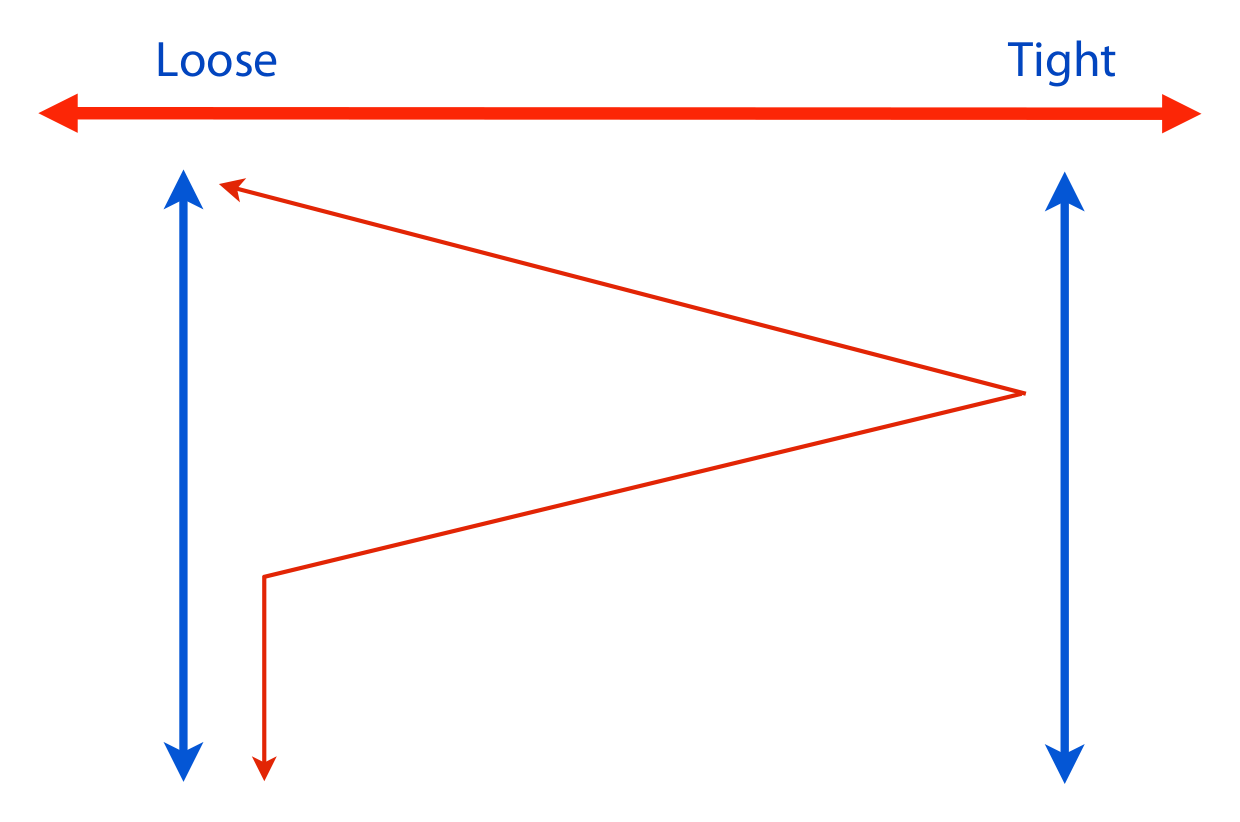
A tight leader is very autocratic. Tight subordinates like being told what to do and want to avoid risk. They want repetitive tasks; tighter tasks are routine and well understood, relatively simple. And a tight environment would be one where, perhaps, time is short or there isn’t much resource to go around.
‘Loose’ would mean that the leader is very participative or democratic; subordinates want to participate and contribute to solutions. The tasks are novel, complex, high risk; the environment is one which is more generous in time and resources to allow complex tasks to be dealt with.
Handy said that provided all four variables line up, either all loose or all tight, things will work fairly well. So an autocratic manager in charge of staff who want to be told what to do, doing routine, repetitive tasks in an environment which is rather constrained will tend to work. However, he said that once you get a crossover you are in trouble. If you put an autocratic leader in charge of highly trained subordinates who are used to contributing towards solutions or problems, and who are used to participation, and these people are given routine tasks with not much time to do them in, then it’s not going to work very well. The subordinates will not get on with their leader; the subordinates will not enjoy the task.
So when it comes to “How shall we manage?”, Handy is saying it depends on the situation and the variables. The best way of managing is to make sure the leader, subordinates, task, and environments all match. Note that this is quite different from saying that tight is better than loose or loose is better than tight. What we are saying is that either will work provided the four variables match.
2.7 Adair – action-centred leadership
Adair is associated with action-centred leadership.
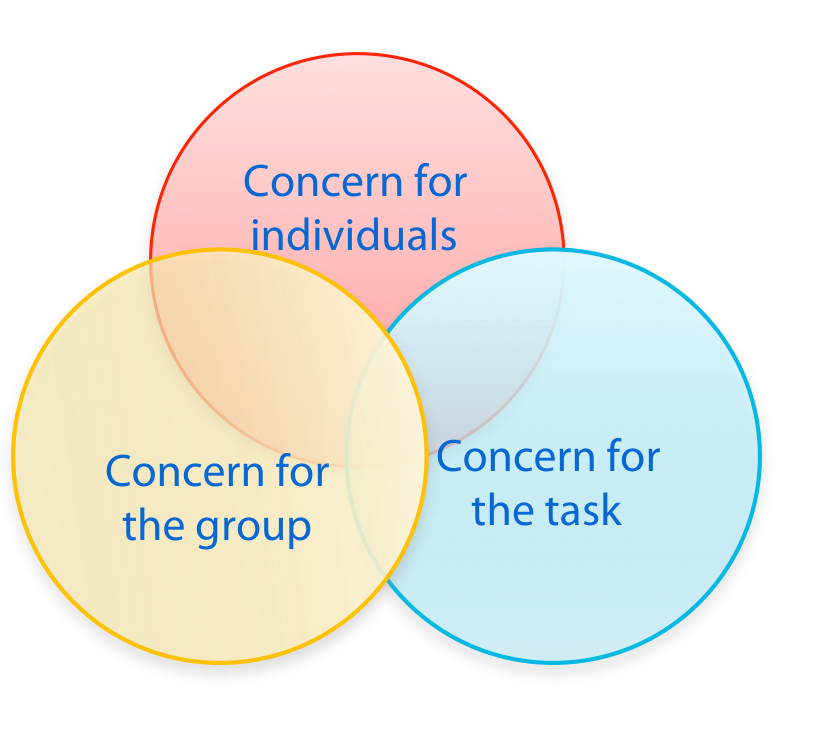
How shall we manage? Well, according to Adair, it depends. On some occasions there may be a very urgent task and we have to reduce our concern for individuals and the group and concentrate on the task. Sometimes there may be crisis within a group; perhaps their leader has left, perhaps there is disagreement within it, and then the manager or leader should pay more attention to making sure that the group operates properly. Of course, sometimes the proper approach to leadership will mean concentrating on an individual and seeing to their needs, perhaps like giving advice or training.
2.8 Entrepreneurship and intrapreneurship
An entrepreneur is someone who is willing to make the effort and to take the risks to set up a new business. Generally these people have strong wills, determination and a belief that they are right and that the business opportunity they have spotted and are working on will be a success. They are not always easy to get along with and often have an abrasive management style. Also, although they are inspired by the excitement and challenge of starting a new venture they often become bored with day-to-day management and administrative tasks. Professional managers, not entrepreneurs, are often better a running a business once it is established.
An intrapreneur is an employee who promotes innovation and new business ideas within an existing organisation. Intrapreneurs bear much less risk than entrepreneurs and investment capital is supplied by the company that employs them. However, intrapreneurs are different from traditional managers. For example:
Traditional managers | Intrapreneur | |
Primary motivation | Promotion, salary and traditional employee rewards | Freedom to pursue own ideas; self-motivated |
Action | Tends to delegate to subordinates | Action-orientated |
Attitude to risk | Risk avoiding | Moderate risk sought |
Skills | Professional management and administration skills | Greater business acumen; good at innovation |
Market research | Has market research carried out by others | Intuitive market assessment; carries out own research |
There is a growing trend for companies to encourage employee entrepreneurship to discover and exploit new goods and services. Particularly when a business is dealing with rapidly changing products and services (such as in IT, pharmaceuticals, entertainment) new employees might have better and more up-to-date ideas than established managers - who might be somewhat staid.
The following can encourage intrapreneurship:
Let it be known that spending time on new ideas is welcomed.
Remove administrative and cultural barriers. For example, make it easy for employees to meet up with others to discuss and develop ideas.
Give ownership. If employees have promising ideas let them present them to management and fully involve the employee in developing that idea.
Embrace failure. Nothing ventured - nothing gained. Many employee ideas will lead to nowhere, but better floating ideas in the first place than having none.
Examples of innovation that arose from intrapreneurship:
DreamWorks (a film production company) provides staff with scripting courses then encourages them to present their ideas for new films to senior management.
Google started as a search engine, but an employee had the idea to create Gmail.
3M - allowed employees to spend time on their own ideas. One discovered the technology that led to Post-It notes.