
The Internet, E-Business, Big Data, Robotics and artificial intelligence


1 The internet
The internet will be familiar to most of you. The very fact that you are using the OpenTuition site proves that. The internet is basically a network of networks, connecting many millions of computers. Those computers host websites and each website has unique address known as a uniform resource locator (URL). Typically, these begin with www, so that www.bbc.co.uk will access the BBC website held on a computer in the UK. To relate the URL to the physical location of a website, that is the precise computer which is holding the web pages, an index is accessed.
Almost certainly you will be familiar with most of the functions of a website:
Marketing. For example, when you ‘Google’ something and you put in for example, “ACCA tuition” you will get lists of companies who provide ACCA tuition and that’s marketing. The great thing about it is it tends to be very specific. You have taken the initiative of entering in “ACCA tuition” and it hands you a lists of relevant sites.
FAQ pages. Many companies put up frequently asked question pages as a form of service.
Selling. Some companies like Amazon will sell over the web.
Information provision. Web sites can provide information about companies, for example many large companies make their annual reports available online.
Feedback. Sites can also be used to receive feedback and queries from clients and most sites have some sort of e-mail facility built into them, perhaps to reach a general enquiry destination or a particular person in the organisation.
External links. Many sites have links to other sites. These allow you to travel through the internet from one site to another, gradually building up information.
Advertising. Many web pages host adverts for other companies. For example, if you go to an airline website, the chances are you will see adverts for hotels and car hire firms there as well.
Many internet sites use cookies. These are small bits of code which are downloaded to your computer. They keep a track of the pages on the website you have visited. When you go back to that web page at some later date, the cookie is used to direct you towards page you might be particularly interested in based on your previous visits.
Remember if your computer is connected to the internet, the internet is connected to your computer. If you can access other sites, there is a chance that other sites can access you. To prevent this, you should use a firewall. This prevents unauthorised access to your computer which could, for example, allow others to download confidential information from your files or even to alter some of the information which you have recorded.
2 The 6Is of e-business
When a question asks how e-marketing could attract and keep customers or supporters, these six headings are a way of generating ideas, not the answer in themselves. A list of the six with a sentence of definition against each scores very little; each method has to be tied to what it would actually do for the organisation in the question. Two boundaries are worth keeping in mind as well: methods that are not electronic are outside such a requirement, and so are benefits of e-marketing other than the relationship with customers, such as lower marketing cost.
E-business, particularly internet sites, can provide the following:
Intelligence. Companies routinely track every click made by a visitor to their internet site. If someone has logged in, information becomes even more useful as you know exactly what that person was interested in, they know what they may have bought in the past, and they can direct new marketing campaigns on a very individual basis.
Individualisation. Everyone’s experience on a website can be made different either by choosing to visit different pages or by the website suggesting that you visit different pages.
Interactivity. You go back and forward through a website putting items into your shopping cart, removing them from the shopping cart until you are happy with the results. You can write reviews, you can read recommendations
Integration. When you place an order it can be integrated into the manufacturing process so that immediately production is started on the items you have ordered. Or, if you were booking hotel room or an airline seat, immediately you press the purchase button, the seat or the room is reserved for you.
Independence. This means that businesses are largely independent of geography. When you visit a website you don’t necessarily know where the company is located. To all intents and purposes, the Internet gives the company a world wide presence.
Industry. E-business can restructure the industry. For example, in the travel industry there has been a huge restructuring because there is much less need for travel agents and you can go directly to airline or hotel sites. Similarly, the book industry has been transformed by e-readers.
3 E-business patterns
The following e-business patterns have been observed:
E-shopping, for example a site like Amazon which sells books, CDs, and increasingly hardware of various sorts.
E-auctions. The best known one is the site eBay where members of the public or trading organisations can put up goods for sale and other members of the public bid against for another.
Reintermediation and disintermediation. Disintermediation means getting rid of a middleman. So instead of going to a travel agent you could go directly to an airline site to book a flight. Reintermediation means putting back a middleman so that, for example the site Expedia allows you to compare different flights from different airlines. It’s a new form of intermediary.
Countermediation is where the providers themselves set up an intermediary. An example is Opodo which is run by several of the large airlines. When you go to that site, the site shows only flights provided by the owners of the site.
You can advertise other people’s goods and services, usually earning an advertising fee when someone clicks on the advert, clicking through as it is known. This is very popular with advertisers as it means only when somebody goes and visits a site do they have to pay for the advert. And indeed the internet is taking a lot of advertising revenue from commercial television which inevitably has a much broader brush approach.
You can advertise your own goods and services - electronic catalogues. You can give someone access to inventory records so that they know whether or not something is in stock and whether it’s worth ordering it. The Amazon site displays some very clever advertising. When you buy a book it will suggest other titles you might like based on what other people have bought. It also lets you submit reviews about books and hearing from other readers is a very powerful form of advertising.
E-procurement; this is very popular in businesses such as supermarkets where when the amount of stock on the shelves falls below reorder level immediately an order is placed with the supplier.
Customer relationship management. This means building up an ongoing relationship with a customer, making the customer feel welcome, valued and recognised.
4 Customer relationship management software
Firstly, what’s mean by relationship management and marketing? A useful distinction can be drawn between:
Transaction marketing, and
Relationship marketing.
Transaction marketing focuses on the product, and develops the marketing mix (product, price, position, and place) according to the needs customers satisfy when they buy the product. However, this approach looks at one transaction at a time. You may well have developed a product which suits a particular segment of the market, but that doesn’t mean that you build that segment of the market into a loyal following.
Relationship marketing goes further. It seeks to attract, maintain, and enhance customer relationships by focusing on the whole satisfaction experienced by the customer when dealing with the firm. It’s not satisfied simply with one-off transactions, one-off sales. It wants ongoing close relationship with the customer.
It is aimed at:
Acquiring customers
Retaining customers
Extending customers i.e. sell more, sell related products or sell more expensive products (up-selling).
What customer relationship management software does can best be illustrated by an example.
A client rings up and the incoming caller number is recognised and it brings up to customer’s details on the screen. Those details show the name, address, telephone number of the customer and also the main personnel with whom we deal. It will give the job title of these people and may give their spending authorities. It may also contain information about their likes, dislikes and interests so it is possible to make relatively easy conversation with them. It will show a history of the products bought: the name of the product, the date of the purchase, the amount paid. This would be extremely useful, let’s say, in a software company allowing it to suggest an upgrade which is now available for some products that the client had.
It will also contain a diary where a summary of previous conversations can be noted. It gives the client the impression that the company they are dealing with is well-organised. If you can look at the diary and know that the client phoned up last week with this query, then that’s definitely impressive. It’s not at all impressive if the client has to explain yet again why they are phoning. You can also set alerts if you promised to ring the client back next week. How else are you going to remember it?
The emphasis here is on building a relationship, making the client believe that you know them, that you know the products they have, and the problems they have. It can be used for e-marketing and e-commerce. It can allow sales to be automated and certainly gathers very valuable information about the client. It’s very effective communication within the company. It doesn’t matter who answers the phone, if relevant information about the client is brought up, it gives the client the impression that they are dealing with a joined-up company. Finally, it’s a very important mechanism for knowledge management. At a very simple level, we are simply noting down conversations with the client and this is available to everybody in the organisation.
5 Barriers to e-business
Although there are many advantages to e-business, whether setting up a website, permitting e-procurement and e-marketing or customer relationship management, there are also certain barriers to e-business so that not every organisation embraces it with the same enthusiasm.
Typical barriers are as follows:
Set up costs. To set-up a website, particularly one which will permit e-commerce, could be rather expensive. Like all investment decisions, one has to be convinced that the cost is outweighed by the benefits and not everyone might be convinced that this will be the case, or at least certainly not for a sophisticated system. It is of course very easy and cheap to set up a very simple website, but you perhaps have to be a little bit careful that a very simple website may actually do your organisation some harm. It may give the impression that your organisation is not sophisticated and not capable of more complex transactions.
Type of business. Some businesses which rely very much on personal relationships and on supplying services more than supplying products, may find that the use of e-business is rather restricted.
Running costs. These might be perceived as being too high. Hardware is required to host the website and you might have to employ experts to update the website consistently and in a timely manner. The website is a continuous window for the public to peer through, and if it’s not up-to-date then it begins to look very shoddy.
Time. The time to plan and to set up the system may be an impediment. And additionally, if there are no in-house skills, the time to communicate what is required and to pay consultants may be regarded as being too high.
Suppliers and customers may simply not be interested. One could perhaps argue that if you are dealing with the customer base which is predominantly older people who are less comfortable with e-business and web browsers then the return you get from setting up a sophisticated web page could be very little.
Security worries. Some people have security worries. This could be customers who are frightened to put in their credit card numbers or it could be the company itself which is frightened of its systems being accessed illegally and damage being caused. Proper firewalls, passwords, and encryption should cut this risk down very substantially.
6 Brands

A brand is a unique design, sign, logo, symbol (or combination of these) used to create an image that identifies a product and differentiates it from competitors.
Over time, successful brands become associated with desirable attributes of the product such as quality, reliability, price, taste. This enables consumers to quickly identify and buy products that they like and trust.
For example, supermarket shelves are crowded with competing products, but when shopping we often simply grab the familiar (for example a packet of toothpaste like ‘Colgate’). The packaging, colours and graphical devices allow us to quickly find and buy the product without much thought – except we know that the brand has pleased us previously.
Brands owners often work hard to associate a particular image with their brands (for example, up-market or down-market) and defend the image strongly. For example, some manufacturers will allow their luxury brands to be stocked by only exclusive outlets.
Brands are powerful means of differentiation.
Brand value (or brand equity) considers the additional income a company can make from a product with a recognisable name as compared to its generic equivalent. If consumers are willing to pay more for a generic product than for a branded one, however, the brand is said to have negative brand equity. This might happen if a company had a major problem or scandal associated with a brand (think of Volkswagen in 2015 with the diesel emission scandal).
E-branding
E-branding becomes more important as companies offer their services and products online. Website design, corporate branding, e-commerce and search engine optimisation are critical components in building a company’s e-branding.
Choices about how to handle e-branding:
Exactly the same branding on the website as in other places. Website style, quality and commercial offers are consistent with the existing brand.
Offer slightly amended product or service - still connected to the original brand. Often signalled by putting the word ‘On-line’ after the original brand name; e.g. ‘Timesonline.co.uk’ - the products are slightly different from the paper-based products, so are differentiated but still strongly linked. The ‘on-line’ description also promises interactivity.
Form a partnership with an existing brand.
Create an entirely new brand - perhaps to emphasise a more modern, flexible approach. Common with financial institutions (eg HSBC and First Direct where there is a conventional banking operation and an on-line operation that makes high use of the internet).
7 Social media
Social media such as Facebook and Twitter have become very important promotional tools. Be-friending a supermarket allows you to receive up-to-date offers, recipes and news. Similar effects are obtained through Twitter accounts where consumers can follow brands and suppliers.
Note that some Twitter campaigns have backfired on companies where consumers have been disappointed or feel that the organisation is being unfair. Angry ‘tweets’ can be ‘retweeted’ and soon multiply, potentially damaging a brand.
8 Big Data
There are many definition the term ‘big data’ but most suggest something like the following:
“Extremely large collections of data (data sets) that may be analysed to reveal patterns, trends, and associations, especially relating to human behaviour and interactions.”
In addition, many definitions also state that the data sets are so large that conventional methods of storing and processing the data will not work.
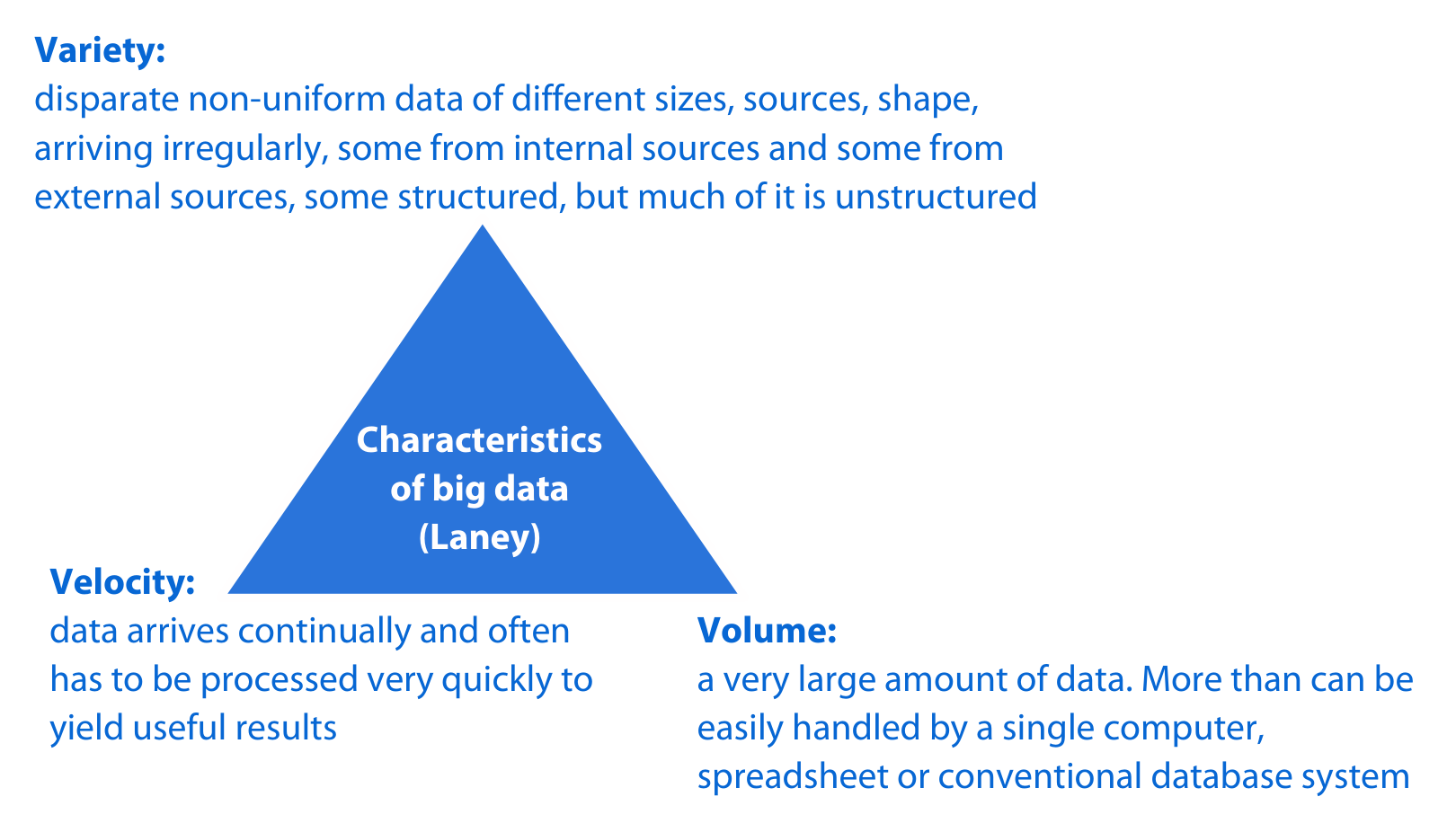
In 2001 Doug Laney, an analyst with Gartner (a large US IT consultancy company) stated that big data has the following characteristics, known as the 3Vs:
Volume
Variety
Velocity
These characteristics, and sometimes additional ones, have been generally adopted as essential qualities of big data.
The commonest fourth ‘V’ that is sometimes added is veracity: Is the data true? Can its accuracy be relied upon?
8.1 Volume
The volume of big data held by large companies such as Walmart (supermarkets), Apple and eBay is measured in multiple petabytes. What’s a petabyte? It’s 1015 bytes (characters) of information. A typical disc on a personal computer (PC) holds 109 bytes (a gigabyte), so the big data depositories of these companies hold at least the data that could typically be held on 1 million PCs, perhaps even 10 to 20 million PCs.
These numbers probably mean little even when converted into equivalent PCs. It is more instructive to list some of the types of data that large companies will typically store.
Retailers
Via loyalty cards being swiped at checkouts: details of all purchases you make, when, where, how you pay, use of coupons.
Via websites: every product you have every looked at, every page you have visited, every product you have ever bought. (To paraphrase a Sting song “Every click you make I’ll be watching you”.)
Social media (such as Facebook and Twitter)
Friends and contacts, postings made, your location when postings are made, photographs (that can be scanned for identification), any other data you might choose to reveal to the universe.
Mobile phone companies
Numbers you ring, texts you send (which can be automatically scanned for key words), every location your phone has ever been whilst switched on (to an accuracy of a few metres), your browsing habits. Voice mails.
Internet providers and browser providers
Every site and every page you visit. Information about all downloads and all emails (again these are routinely scanned to provide insights into your interests). Search terms you enter.
Banking systems
Every receipt, payment, credit card payment information (amount, date, retailer, location), location of ATM machines used.
8.2 Variety
Some of the variety of information can be seen from the examples listed above. In particular, the following types of information are held:
Browsing activities: sites, pages visited, membership of sites, downloads, searches
Financial transactions
Interests
Buying habits
Reaction to ads on the internet or to advertising emails
Geographical information
Information about social and business contacts
Text
Numerical information
Graphical information (such as photographs)
Oral information (such as voice mails)
Technical information, such as jet engine vibration and temperature analysis
This data can be both structured and unstructured:
Structured data: this data is stored within defined fields (numerical, text, date etc) often with defined lengths, within a defined record, in a file of similar records. Structured data requires a model of the types and format of business data that will be recorded and how the data will be stored, processed and accessed. This is called a data model. Designing the model defines and limits the data that can be collected and stored, and the processing that can be performed on it.
An example of structured data is found in banking systems, which record the receipts and payments from your current account: date, amount, receipt/payment, short explanations such as payee or source of the money.
Structured data is easily accessible by well-established database structured query languages.
Unstructured data: refers to information that does not have a pre-defined data-model. It comes in all shapes and sizes and this variety and irregularities make it difficult to store it in a way that will allow it to be analysed, searched or otherwise used. An often-quoted statistic is that 80% of business data is unstructured, residing in word processor documents, spreadsheets, PowerPoint files, audio, video, social media interactions and map data. Velocity
Information must be provided quickly enough to be of use in decision making. For example, in the above store scenario, there would be little use in obtaining the price-comparison information and texting customers once they had left the store. If facial recognition is going to be used by shops and hotels, it has to be more-or less instant so that guests can be welcomed by name.
You will understand that the volume and variety conspire against the third, velocity. Methods have to be found to process huge quantities of non-uniform, awkward data in real-time.
8.3 Software for big data
Without getting too technical on this issue, a library of software known as Apache Hadoop is specifically designed to allow for the distributed processing of large data sets (ie big data) across clusters of computers using simple programming models. (Clusters of computers are needed to hold the vast volume of information.) Hadoop is designed to scale up from single servers to thousands of machines, each offering local computation and storage.
The processing of big data is generally known as big data analytics and includes:
Data mining: analysing data to identify patterns and establish relationships such as associations (where several events are connected), sequences (where one event leads to another) and correlations.
Predictive analytics: a type of data mining which aims to predict future events. For example, the chance of someone being persuaded to upgrade a flight.
Text analytics: scanning text such as emails and word processing documents to extract useful information. It could simply be looking for key-words that indicate an interest in a product or place.
Voice analytics: as above with audio.
Statistical analytics: used to identify trends, correlations and changes in behaviour.
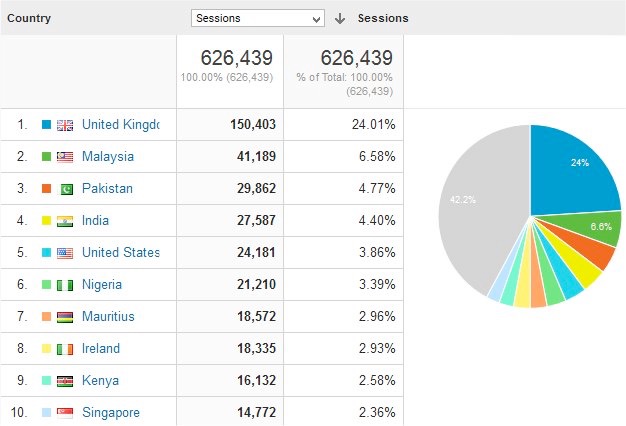
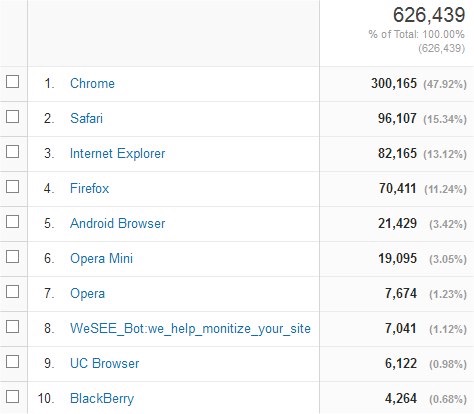
Google provides web-site owners with Google Analytics that will track many features of web-site traffic. For example, Google analytics on the OpenTuition.com reports statistics such as the following:
Geographical distribution of users:
Type of browser used
Age of user
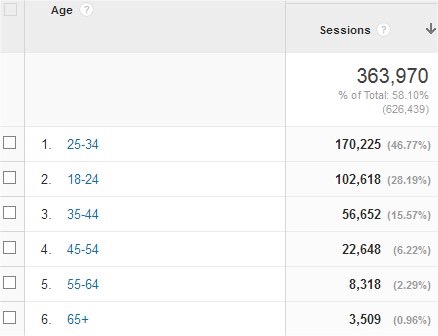
The final table is instructive. OpenTuition.com does not ask for users’ ages, so this data has been pieced together from other information available to Google; it has been able to do this for only about 58% of users.
The analytical findings can lead to:
Better marketing
Better customer service and relationship management
Increased customer loyalty
Increased competitive strength
Increased operational efficiency
The discovery of new sources of revenue.
8.4 Dangers of big data
Despite the examples of the use of big data in commerce, particularly for marketing and customer relationship management, there are some potential dangers and drawbacks.
Cost: It is expensive to establish the hardware and analytical software needed, though these costs are continually falling.
Regulation: Some countries and cultures worry about the amount of information that is being collected and have passed laws governing its collection, storage and use. Breaking a law can have serious reputational and punitive consequences.
Loss and theft of data: Apart from the consequences arising from regulatory breaches as mentioned above, companies might find themselves open to civil legal action if data were stolen and individuals suffered as a consequence.
Incorrect data (veracity): If the data held is incorrect or out of date, incorrect conclusions are likely. Even if the data is correct, some correlations might be spurious leading to false positive results.
Employee monitoring: data collection methods allow employees to be monitored in detail every second of the day. Some companies place sensors in name badges so that employee movements and interactions at work can be monitored. The badged monitor to whom each employee talks and in what tone of voice. Stress levels can be measured from voice analysis also. Obviously, this information could be used to reduce stress levels and to facilitate better interactions but you will easily see how it could easily be used to put employees under severe pressure.
9 Robotics and artificial intelligence
9.1 Robots and robotic process automation (RPA)
Robotics is the branch of technology that deals with the design, construction, operation, and application of robots. A robot is a machine - especially one programmable by a computer - capable of carrying out a complex series of actions automatically. Robots are now extensively used for process automation in both manufacturing and service industries.
In process automation a whole process is automated, not just individual steps. For example, when you order goods on Amazon, once you click on ‘Buy’ the goods are automatically picked by machinery in the warehouse, brought together, packed and then despatched with very little human intervention. Similarly, car manufacturing allows different components to be automatically delivered to the production line so that the precise vehicles specified by customers can be made: engine size, trim, upholstery style, manual/automatic transmission, wheel style, clear or tinted windows and so on.
Process automation should allow:
Greater flexibility to respond to customers’ orders
Cheaper production or service delivery
Greater reliability as there is less opportunity for human error
Faster production because of the meticulous co-ordination needed.
Custom manufacturing and 3D printing (additive manufacturing) is also used in process automation. Instead of drilling holes in a piece of metal or cutting it to shape, in 3D printing material (plastic or metal powder) is gradually built up. The process is automated allowing the quick production of prototypes or one-off components. This can be important in making strategic decisions as to which products might be popular with consumers
Processes automation is not confined to physical operations. For example, banks nearly all use process automation when you ring them, often involving voice recognition. So, you can ask about your balance, report a lost or stolen card, query a payment, order documentation. You might have discovered that with some process automation banks have some way to go in making this automation wholly successful and satisfying for customers.
9.2 Artificial intelligence
Artificial intelligence (AI) Artificial intelligence allows machines to learn and to make deductions based on data supplied. For example, playing games such as Go, facial recognition, predicting customer purchasing requirements and tastes, recommending music (like Pandora) that each consumer should like. Note that in AI people are not programming machines’ responses: the machines are learning, uncovering patterns, trying out strategies and making decisions based on their learning. Examples from business include:
Engineering: Rolls-Royce uses AI when designing new engines and also to monitor engines in flight so as to learn how to predict when maintenance or part replacement is needed.
Warehousing and distribution: AI improves demand prediction, picking, packing and working out efficient distribution routes.
Marketing: AI builds up patterns of consumers’ behaviour and can suggest items that are likely to be attractive to each customer.
Voice and face recognition: AI has allowed these technologies to become very reliable.
Law and accountancy: Lawyers perform due diligence to uncover background information, contract review, legal research and electronic discovery (eg searching through vast numbers of emails). Forecasting the likely outcome of litigation. Auditors use AI to examine transactions to identify those which appear to be incorrect or which might imply fraud.
AI might create increased opportunities for automated strategic decision-making. For example, sophisticated analysis of populations and their associated buying habits might provide useful insight about which markets to enter, which products to sell, which product features to incorporate and what prices to charge.
9.3 Risk, control and ethical implications of artificial intelligence
The World Economic Forum published an article (Bossmann, 2016) which listed the top nine ethical issues relating to artificial intelligence. Inevitably, these touch on issues of control and risk also. The issues are:
Unemployment: what happens employees as AI and robots take over more tasks? For example, autonomous vehicles will mean that many fewer truckers need to be employed.
Inequality and wealth distribution: By using artificial intelligence, a company can drastically reduce reliance on the human employees and this means that revenues will go to fewer people. Consequently, individuals who have ownership in AI-driven companies will make all the money.
Behaviour and interaction: machines will become increasingly good at interacting with us in a natural way. For example, by using speech recognition and voice generation. However, this will be combined with greater analysis of tone of voice, hesitation etc and will allow more accurate manipulation of humans.
Errors: If a machine makes an error who is responsible? The business using the machine? The machine manufacturer? The programmer? How can catastrophic errors be prevented? (Think about the Boeing 737 Max.)
Racist robots (or other biases in robotic decision-making): AI systems are created by humans, who can be biased and judgemental and these biases can be subconsciously reflected in AI algorithms.
Security: how can robots and AI be kept safe from interference (hacking)? Robust cybersecurity is becoming increasingly vital.
Evil genies: this is where the AI system inadvertently causes us harm. For example, AI were used to design a new pharmaceutical but there are serious side-effects that were not anticipated by the system.
Control: will we be able to stay in control of a comprehensive AI system which starts to make decisions we don’t like? Can the system be safely turned off or reprogrammed or could we become so dependent on it that we fear any interference?
Robot rights: probably a long way off yet, but as AI develops we might need to consider whether their intelligence begins to encompass an appreciation of risk and reward, an appreciation of success and failure. In essence we are talking about robots having feelings.