
Marketing

1 What is marketing?
To understand the marketing concept or the marketing approach it’s useful to contrast this with certain other approaches that might be available.
The product-led approach. For this, imagine a company which was started by a couple of engineers, clever and successful people, who are very interested in the technical qualities and the cleverness of the products they produce. They get enormous satisfaction in well-engineered, clever innovative products. Unfortunately, just because the product is well-engineered, innovative and clever doesn’t mean that product will sell. No matter how much those engineers appreciate the fine details of that product it may be a product that no one wants, or a product which is too expensive.
The production-led approach puts great emphasis on high efficiencies and low down-time. That approach concentrates in making sure inventory is produced very efficiently, but unfortunately doesn’t make sure that the inventory is being sold. The inventory may simply be accumulating in the warehouse.
The sales-led approach may sound okay, but what it means is great emphasis on selling what you have, even if customers don’t really want it. The sales-led company will have a very high-powered sales team, skilled in the arts of persuasion and getting people to sign contracts which they may later regret.
The marketing-led concept is quite different. What’s important about that is that it is very outward looking. It looks to see:
What will potential customers want?
What do they appreciate?
What amount of money do they think it’s worth paying for the product or service we are providing?
Through market research the needs of potential customers are established, and then an appropriate product is developed to match those needs. It will stress to those customers the ability of the product or service to satisfy their needs and it will profit through customer satisfaction because it fulfils the needs of the customers.
In many ways it’s a very humble approach. It’s saying that the customer knows best. There is no point in making a product which we think is good if customers think it’s not very satisfactory. It doesn’t mean, of course, that it’s an entirely passive process, just taking input from customers. You can’t always expect customers to be innovative and it will certainly be part of the market research process to develop prototype products, to show those to customers and to see whether the customers will be interested, or to find out how those products could be changed in some way to better match the requirements of the customers. But at the end of the day, the marketing concept means finding out what customers want and developing products or services to fulfil customers’ needs.
2 Market segmentation
The first stage is to find out whether all potential customers want the same thing or can the market be broken into different sections or segments. Market segmentation looks how a market can be split up.
Commonly it can be split up according to age, sex, lifestyle, wealth, and geography. For example in the fashion market, there are quite different fashions which are bought by younger and older people. Obviously, there are different fashions depending whether you are selling to male or female. Lifestyle is important, are we addressing the leisure market or are we addressing a more formal market? Wealth and disposable income are important, and it’s normal for most ranges of fashions to have cheaper ‘value goods’ and also the more expensive luxury goods. Geography, for example simply whether people live in the north of the country or the south of the country, can make a difference in the type of clothing they want to buy.
The idea of segmentation is that if you break the market up into smaller sections and you design products or services which specifically address the needs of each segment of the market, you will do better than simply adopting an approach of one product suits all.
3 Market targeting
After investigating market segmentation, the next stage is market targeting, that is deciding which segments of the market to attack.
3.1 Undifferentiated market targeting
The first type of market targeting is known as undifferentiated market targeting. This means that your research has shown that the market is effectively not segmented and that one product will suit all potential buyers.
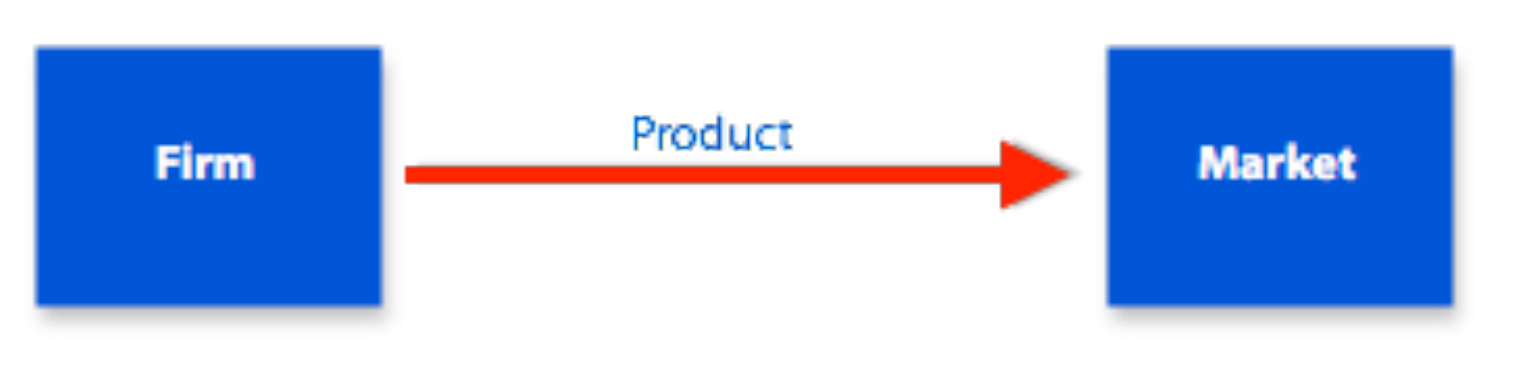
This is extremely rare; in fact it is very difficult to think of an example. Even the sale of basic products like water is to a segmented market. Some people are perfectly happy with tap water, others want mineral water, but some want still, some want sparkling. It is sold in different quantities of small bottles, large bottles, and there is whole range of flavours. Similarly with something like bread, there is white bread, brown bread, slice bread, non-slice bread, whole grain, and so on. Nearly all markets turn out to be segmented and undifferentiated market targeting is very unusual.
3.2 Differentiated market targeting
By far the most common type of market targeting is known as differentiated market targeting. Here the firm perceives that the market is segmented and designs a different product or service to suit each segment of that market.
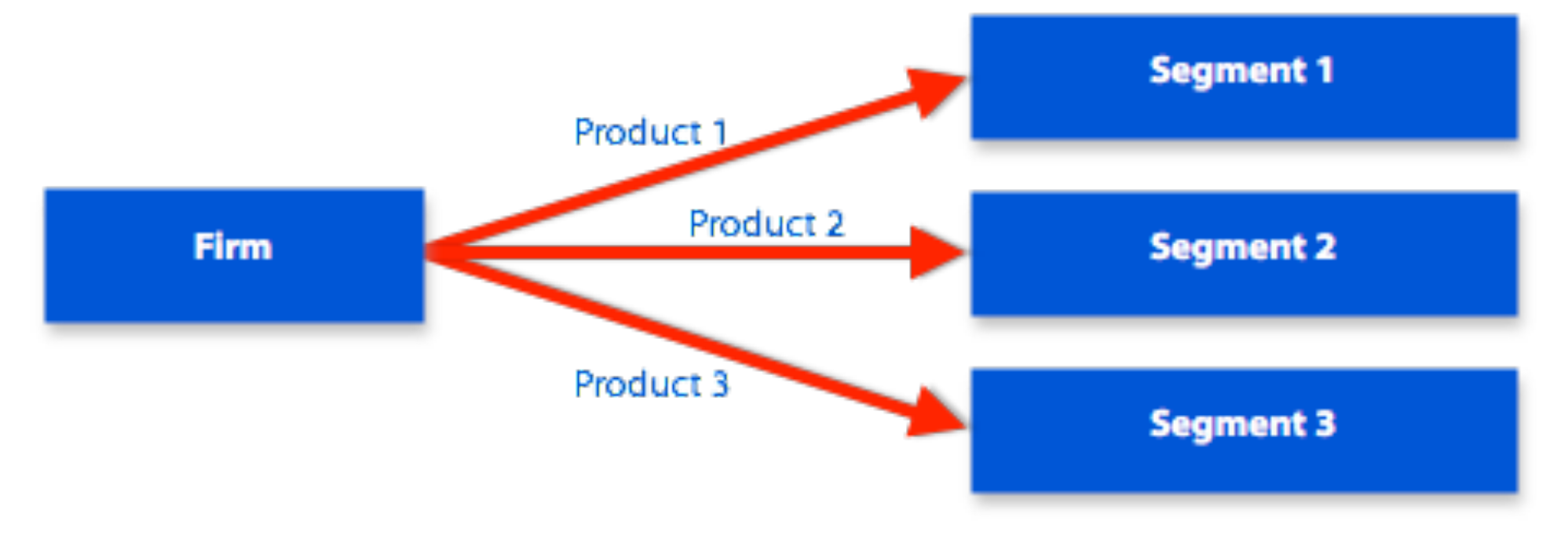
You only have to try to buy a common consumable such as shampoo or toothpaste to see how the manufacturers have differentiated their products. There are probably dozens of products to choose from, and the manufacturers hope that by changing the product and a number of other variables that they make their product particularly suitable and attractive to one segment of the market.
3.3 Concentrated market targeting
Finally, there is concentrated market targeting. This is equivalent to the strategic focus strategy and may be known as niche marketing.
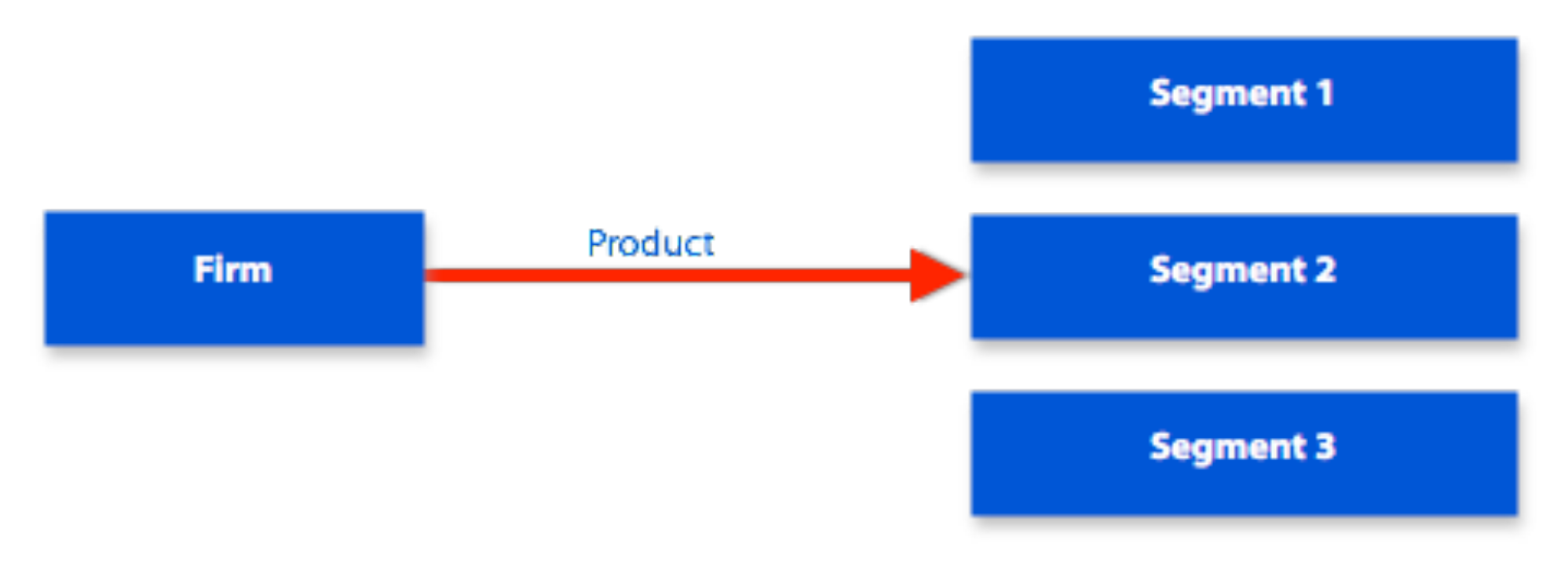
The company perceives the market as being segmented, but for some reason decides to target only one, or a limited number of segments of that market. It could be that the company is too small to have a wide range of products, so concentrates on one segment. Or, the company may believe that it has particular expertise to fulfil the needs of one segment or that the company perceives that segment as being the only one that is profitable. But for whatever reason, the firm concentrates its resources in addressing the very specific needs of one or a very limited number of segments.
4 Product positioning
‘Positioning’ means making a product or service address specific segments of the market.
Originally there were four variables or levers that could be used. These were known as McCarthy’s marketing mix, or the Four Ps. Now seven Ps are often shown:
Product
Price
Promotion
Place
People
Process
Physical evidence
The first four (product, price, promotion, and place) were the original components of the marketing mix and apply to the marketing of physical products.
The three last ones (people, process, and physical evidence) are additional variables specifically to do with positioning services. When services are provided it is important to have the right people with the right attitude, whereas in manufacturing, customers might never meet employee. The process by which it is provided, and the physical evidence that something has actually happened are also important. For example, if you are booking an airline flight, you may ring up the airline and you expect to be dealt with in a helpful and friendly way by the representative. The process has to be convenient to you, you don’t want to be waiting too long before your phone call is answered. Finally you expect some sort of physical evidence, such as an e-mail, to show you that the service is actually going to be provided.
4.1 Product
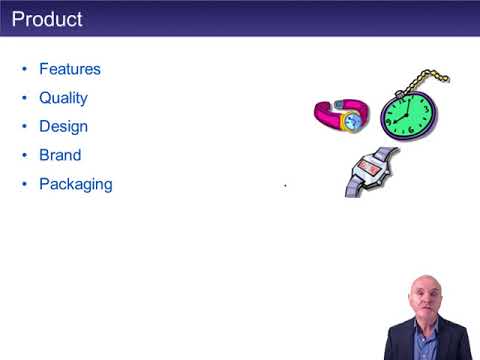
The first of the Four Ps is product, and this includes:
The features of the product (what it does)
Quality,
Design,
Brand,
Packaging.
For example, take calculators. Some have got simple arithmetic functions whereas others have trigonometric, scientific or statistical functions; some have rolls of paper on which calculations can be displayed. These are all different features of the product. Some calculators will be relatively cheap and perhaps very durable whereas others will be of high quality for everyday office use. Design might not be very important in calculators, but some are marketed on the basis of having a sleek futuristic looking design whereas others are more commonplace. Brand and packaging are probably not particularly important for calculators, but are very important when considering something like cosmetics or perfume where the packaging might possibly be more expensive than the contents.
4.2 Pricing
The second of the Four Ps is price. This includes not only the price itself (the price level or price point), but also discounts for bulk buying which are particularly important in business-to-business sales. Price also includes the terms, that is how long a customer has to pay. There are also various types of strategic pricing, described below.
Pricing can be more sophisticated than it first looks. For example if your customer had a very seasonal business, perhaps in agriculture, you might be able to make your product attractive to that customer if your terms of sale were arranged to match that customer’s cash flow. Perhaps the customer could buy in the spring and not have to pay until the autumn when crops are harvested.
We look at pricing in more detail later
4.3 Promotion
There are four main types of promotion:
Advertising
Sales promotion
Personal selling
Public relations.
We are all familiar with advertising and we know that it can take place on a number of different media. For example, television, magazines, newspapers, billboards by the side of roads. Television addresses a mass audience and it wouldn’t be particularly sensible to advertise a specialist product there. Those types of products would be better advertised in specialist magazine.
The internet has become a very important advertising medium. Advertisers love it because potential customers usually volunteer interest by access a particular web-site or entering a search term. The behaviour of the customer can be monitored and the advertiser usually does not have to pay until the customer clicks through on the advert.
Sales promotion is something which happens very close to the point-of-sale. You may have been in supermarkets where staff offer small portions of cheese or small glasses of wine for you to try in a hope that you will then go and purchase. Buy-one-get-one-free offers and coupons which give you money off the next purchase are also forms of sales promotion.
Personal selling is when a salesman or saleswomen, a sales representative in other words, goes around spending time with customers or potential customers trying to persuade them to buy. This is very important in business-to-business sales and, of course, it is economically justified there because often the orders placed in business-to-business sales are quite large and valuable.
Public relations usually means good mentions in the press. Sometimes there are charitable endeavours (perhaps under the heading of corporate social responsibility) where a local firm has made some sort of donation or lent some sort of equipment.
4.4 Promotion can be divided into two categories:
Push promotion
Pull promotion
Imagine a new product is about to be launched. Push promotion is concerned with getting the product into the shops and would use, for example, personal selling. Pull promotion is getting the public to demand that product, to go into shops and ask to buy it. That promotion could be done by advertising. For the whole promotional campaign to be successful, you need both push promotion and pull promotion to match up. There is no point in people knowing about a product if it is not available; there is no point in the product being available if nobody wants to buy it.
4.5 Place
The last of the four Ps is ‘Place’, meaning the place you go to buy or acquire the product. It really means distribution. Considerations to bear in mind there are:
The length of the distribution chain.
The shortest distribution chain is going directly from manufacturer to consumer and this is sometimes seen in mail order businesses. Some computer manufacturers such as Dell operated in this way for many years. It doesn’t work quite so well when you come to distributing something like clothing. Even though you can have catalogues which have pictures of the garments, you really want to try them on, to see the colour, to feel the material. Direct selling works particularly well with computers because they can be perfectly described by their technical specifications. By contrast, may consumer goods have a very long distribution chain, going from manufacturer to wholesaler to retailer and ultimately to the consumer. Everyone in the distribution chain needs profit so this pattern results in goods that are usually more expensive than through direct marketing
Suitability of the outlet.
For example, if you are selling very, very high-quality audio equipment, you would expect the people in the shop to be able to explain the pros and cons of different systems. Perhaps the shop should be equipped with soundproof rooms where could try different speakers out in. You wouldn’t expect to buy very high-quality audio equipment in your local supermarket. The outlet is part of the value network.
5 Pricing
5.1 Introduction
You can now be required to describe a process for establishing a pricing strategy that recognises both economic and non-economic factors.
The influences on prices are:
Mission and marketing objectives
Pricing objectives
Costs
Competition
Customers
Controls
5.2 Mission and marketing objectives
A mission sets out the organisation’s purpose and its feeling about its position in the market. Pricing cannot be separated from mission. An organisation might have a charitable or not-for-profit purpose, in which case prices for its products and services might be zero or heavily subsidised. An organisation might perceive itself to be ‘up-market’, in which case it might have to charge high prices to project quality and exclusivity.
5.3 Pricing objectives
In the shorter term there can be a variety of pricing objectives, such as generating as much cash as possible. Sometimes an organisation might reduce its prices, sustaining losses for a while, in the hope of forcing competitors to withdraw from the market.
5.4 Costs
Any positive contribution (that is when marginal revenues exceed marginal costs) helps to cover fixed costs. To make a profit, revenue has to exceed all costs. You should always consider opportunity costs and exit costs.
An opportunity cost is the revenue foregone as a result of a decision.
Exit costs can arise when trying to abandon a strategy. For example, redundancy costs.
5.5 Competition
There are four main types of market, each giving rise to a particular type of competition:
Perfect competition. Here, suppliers must charge the market price. It is worth noting that the Internet has tended to make price and competition much more transparent and that there are sites which specialise in comparing suppliers’ prices.
Oligopoly. A small number of suppliers supplying identical product, such as petrol companies. There is little incentive to reduce prices as competitors will follow to maintain their market share.
Monopoly. The supplier can charge whatever is wished. This is the great freedom a monopolist has: choose the price to charge so that profits can be maximised. Note that being a monopolist does not guarantee that a profit is made. You might be the sole suppliers of something no one wants.
Monopolistic competition. This means that there are a number of suppliers of similar but not identical goods. Essentially, products are being differentiated and therefore can command different prices. Suppliers are competing, but with different offerings.
Price competition means that consumers are motivated primarily by price and usually suppliers will have to offer low prices to succeed. Very often organisations which use a cost leadership strategy adopt price competition. Their products are ordinary, but because their costs are very low (if not actually the lowest) prices can also be kept down.
Non-price competition means that consumers pay attention not only to the price of the goods but are also influenced by other marketing mix variables such as the:
Quality, brand and features of the goods
Promotional activities
Place (where the goods or services are obtained).
Essentially, organisations which follow a differentiation or focus strategy will be making use of non-price competition.
5.6 Consumers
Suppliers have to keep in mind what the end consumers are willing to pay. It is common to segment markets according to wealth so that a company will have a ‘value’ range of goods for less wealthy customers and a more expensive range for better-off customers, who might respond to non-price competition.
The perceived value of goods is a concept which is also related to non-price competition. For example, when buying a T shirt there is a very wide range of prices for garments which are very similar looking. We assume that the expensive T shirt with the fashionable label is ‘better’ than the cheaper, more basic lines. However, often we really don’t know, and might even be paying for the kudos we feel an exclusive label gives us.
Whether goods are necessities or luxuries also influences consumers’ reactions to prices and price changes. The elasticity of demand of the product is a measure of how a change in sales volume is caused by a change in price. Goods that have a high elasticity of demand are very price sensitive and are likely to be luxury products that consumers are prepared to do without if the price rises too much. Goods with a low elasticity of demand are relatively unaffected by price changes and are likely to be necessities.
5.7 Controls
Some industries are closely regulated by statute and regulation, and they have little power to choose their own prices.
6 Strategic pricing
Now we will look at strategic pricing.
6.1 Price skimming
This is when a very high initial price is set for a product, for example a new electronic product. You might know that there will be a certain number of people who will be prepared to pay, let’s say $1000. After they have all bought the product you can then lower the price, say to $900, and there will another layer of people who will be willing to pay that, and so gradually you work your way down. Price skimming is always a temporary phenomenon. Prices always fall, if for no other reason because other manufacturers will join in and bigger volumes that have to be sold.
6.2 Penetration pricing
Penetration pricing means going in with a very low initial price in a hope of getting a very high market share. With luck, the high market share will give you very high volume and consequently a low cost per unit for production, and you may be able to sustain a very low market price indefinitely. Indeed, this can be a strategy to protect yourself against new entrants to the market. If you are going with a low price and win, let’s say a 70% market share, it will be quite expensive for anyone else to come into the market and make as good profits as you are.
6.3 Related product pricing
This aims to get someone ‘hooked’ by a low initial price, then follow up prices are high. A good example of related product pricing can be seen with inkjet printers. Typically a new inkjet printer might cost around $100, but then to renew the ink cartridges might be costing about $70. The initial printer is almost a lost leader, the rationale being that once you have bought that, the follow-on cost of maintaining and replenishing the supplies is where the profit is going to be made.
7 Setting prices
7.1 Introduction
In an ideal world, organisations would have full information about:
Customers – what would they pay and what is the likely demand?
Competitors – what are their products, what are their prices and how do they compete?
The resultant costs, revenues and profits arising from a specific price.
In practice, determining much of this information can be difficult, and again it is worth emphasising that markets are often very volatile and prices might need to be reviewed and changed frequently.
The methods of setting prices include the following:
7.2 Setting prices to maximise profits
In theory, profits are maximised when:
Marginal cost = Marginal revenue
In practice, this is almost useless advice as very few organisations will have sufficiently detailed or stable information about how revenues move, as they are affected by fickle consumers, competitor action, and economic confidence.
7.3 Setting prices to break-even
The break-even volume is given by:
Fixed costs/(Selling price per unit – Variable cost per unit)
or
Fixed costs/Contribution per unit
Setting a high selling price per unit will generate a high contribution per unit and this would require a smaller volume to be sold before breakeven point is reached. The company could therefore evaluate various options of prices and volume.
7.4 Cost based pricing
Here the cost per unit is determined and a set amount, or a set percentage, is added to that to give the selling price. Although useful as a guideline, the method is not sufficient because it is entirely inward looking and pays no heed to competitors or customers. The resulting prices must always be looked at with some scepticism, and the organisation must assess how those fit in with the market.
7.5 Competition-based pricing
By contrast, this approach is entirely outward-looking. It strives to match what competitors are charging and is the only option when in perfect competition.
7.6 Market-orientated pricing
In this approach, the organisation attempts to escape from the constraints of perfect competition and sells a product differentiated by features, quality, design, promotion, place and so on. Generally, higher prices are sought and are justified by products better matching a market segment’s needs.