
Determining strategy


1 An overview
There are three stages in determining strategy:
1.1 Choose generic strategy.
This is like a fundamental strategy and there are three:
cost leadership
differentiation, and
focus.
1.2 Choose strategic direction.
Having decided the fundamental way in which the organisation is going to compete it then must turn to more detailed matters. The organisation can expand by:
market penetration, efficiency gains, consolidation and withdrawal
market development
product development, and
diversification.
1.3 Choose how to grow.
Two main approaches:
Organic. The organisation can grow organically, essentially internally; or
Merger/acquisition. Acquire or merge with an already existing organisation.
2 Porter’s generic strategies
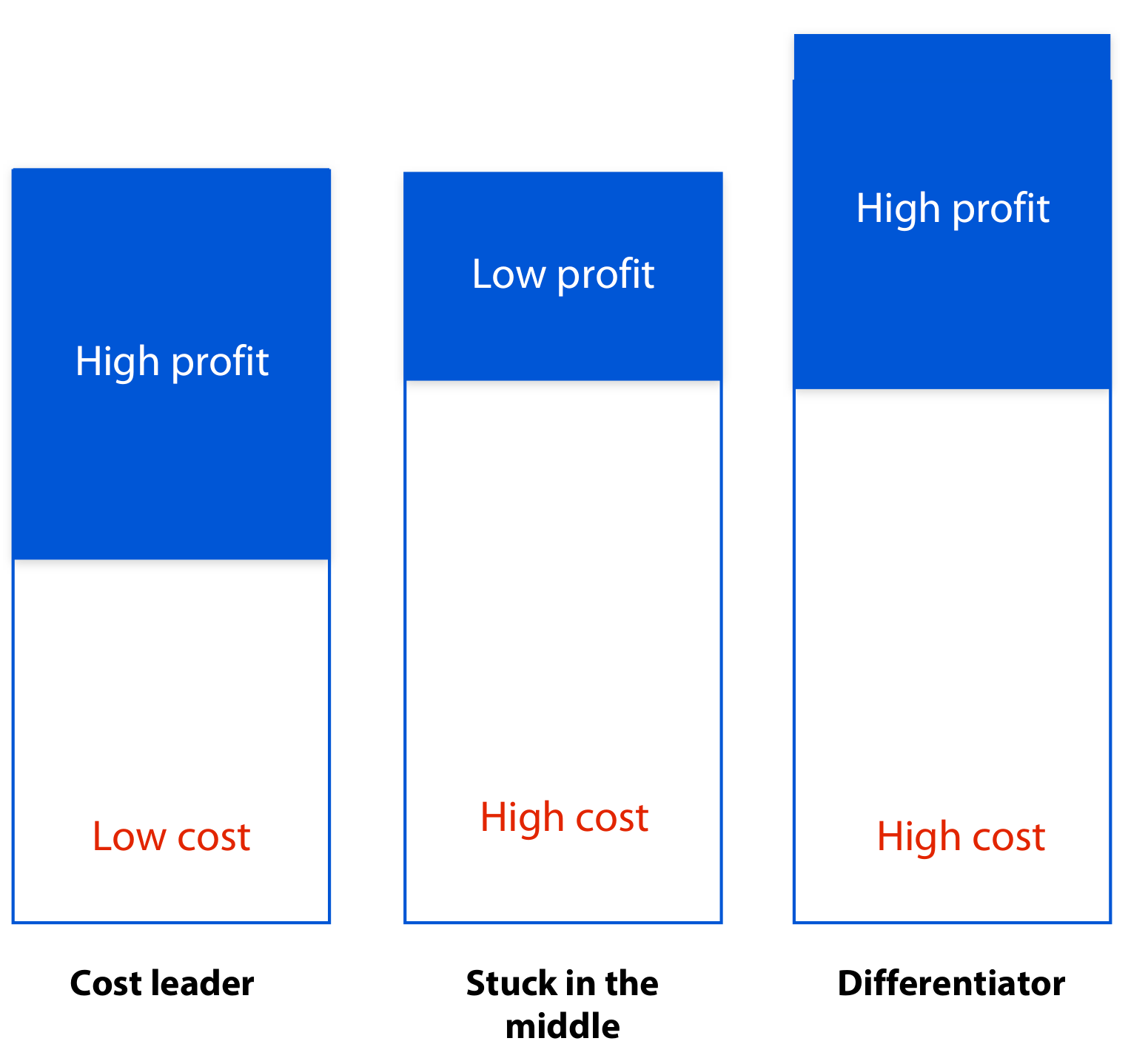
Porter sets out three generic strategies:
Cost leadership
Differentiation
Focus
The first two are set out above and are usually mutually exclusive. Focus is discussed later and can be applied on top of either differentiation or cost leadership.
A generic strategy is required if a company is to gain competitive advantage, meaning that it is capable of earning good profits in the long term. ‘Good profits’ are profits which recompense investors adequately for risk whilst allowing the company to invest in research and development, training and new machinery to stay ahead of competitors.
2.2 Cost leadership
Here a company is supplying a basic product or service into a competitive market. It can’t put its prices up because the product is ordinary and there are competitors supplying equivalent products. If the selling price can’t be raised, the only way the company can improve its margins is to lower its costs.
A cost leader aims to have the lowest costs of all its competitors and its competitors are liable to be ‘stuck in the middle’, squeezed between low prices and high costs, so making miserable profits. The cost leader will be much stronger financially and will have spare cash to spend on marketing, development of new products and the purchase of new machinery. It could even drop its selling prices temporarily to put extra pressure on competitors. Weaker competitors could be forced out of the market, reducing competitor pressure and making the cost leader even stronger.
Cost leaders need to have ferocious cost controls: their only trick is keeping costs low and that is therefore where they must pay great attention. The whole culture of the organisation will be focused on cost control.
An excellent example of a very successful cost leader is the Irish airline company, Ryanair. This company is enormously profitable. The ways it uses to keep costs down include: non-reclining seats (cheaper, lighter, nothing to break down), no seat pockets (nothing to clean out after each flight), use of cheap airports, modern efficient aircraft, web-based communications with customers.
Cost leaders are not guaranteed a secure future. They are, for example, vulnerable to technological breakthrough which might allow a competitor to become even cheaper.
2.3 Differentiation
Differentiators do not aim to compete by supplying ordinary products or services. They compete by supplying better products and services for which they can charge more. Here ‘better’ means something which better suits a customer so that the customer doesn’t mind paying more. The product could be differentiated by quality, design, features, size, reliability, brand etc.
So, the differentiator company increases its margin by raising its prices. It is not so concerned with lowering its costs – in fact its costs might be higher because of better quality products with more features.
Here, the company is much more interested in innovation and higher customer service than saving costs. Costs, of course, are important but the differentiators’ trick is the ability to raise selling prices.
An excellent example of a differentiator company is Apple. This company is an excellent innovator and its products always have very high design values. Customers are willing to pay more for an Apple computer than they would for a Windows-based PCs of similar performance because of the qualities that Apple machines have.
2.4 Focus
The focus company has decided to concentrate on a small sector of the market rather than trying to address the whole market. The company might have decided to do this because it is relatively small and doesn’t have the resources to target the whole market, or it might have decided to target particularly profitable segments or segments where it feels it has particular expertise.
Once a company has decided to focus it still has to decide whether to be a cost leader or a differentiator. It must be said, however, that a natural combination of generic strategies is to become a focus-differentiator because if you are concentrating one or two market segments which you have got to know very well, it is probably natural that you develop products and services which are particularly attractive to those segments and for which more can be charged.
Porter’s generic strategies is a model which is very useful because, if a business is successful, it will be following one of these strategies. If it is not successful, then it should be advised to follow one of these strategies!
If the case study presents a small company which despite a profitable history is now facing problems, perhaps from a large multinational company. Note that it is usually easier for very large companies to become cost leaders than for small companies to do so. This is because large companies can enjoy greater economies of scale and if they are international they can make goods in countries with cheaper labour. It is very difficult for a small company to drive down its costs as much and it would usually be bad advice to tell a small company to compete on cost/price. Small companies can find a niche which might allow them to survive. If they focus on a small segment of the market and differentiate their products to appeal to consumers in that market, they can make good profits even with higher costs. Also, the segment they are specializing in might be too small to interest larger players, who are usually after large mass markets and large-scale production.
3 Ansoff’s matrix
After the generic or fundamental strategies have been decided on, we can turn to more detailed strategies. Ansoff’s matrix is an immensely useful way of presenting the options that companies have. It can be helpful if you think that most companies wanted to increase profits and Ansoff’s matrix sets out all the ways in which this could be done.
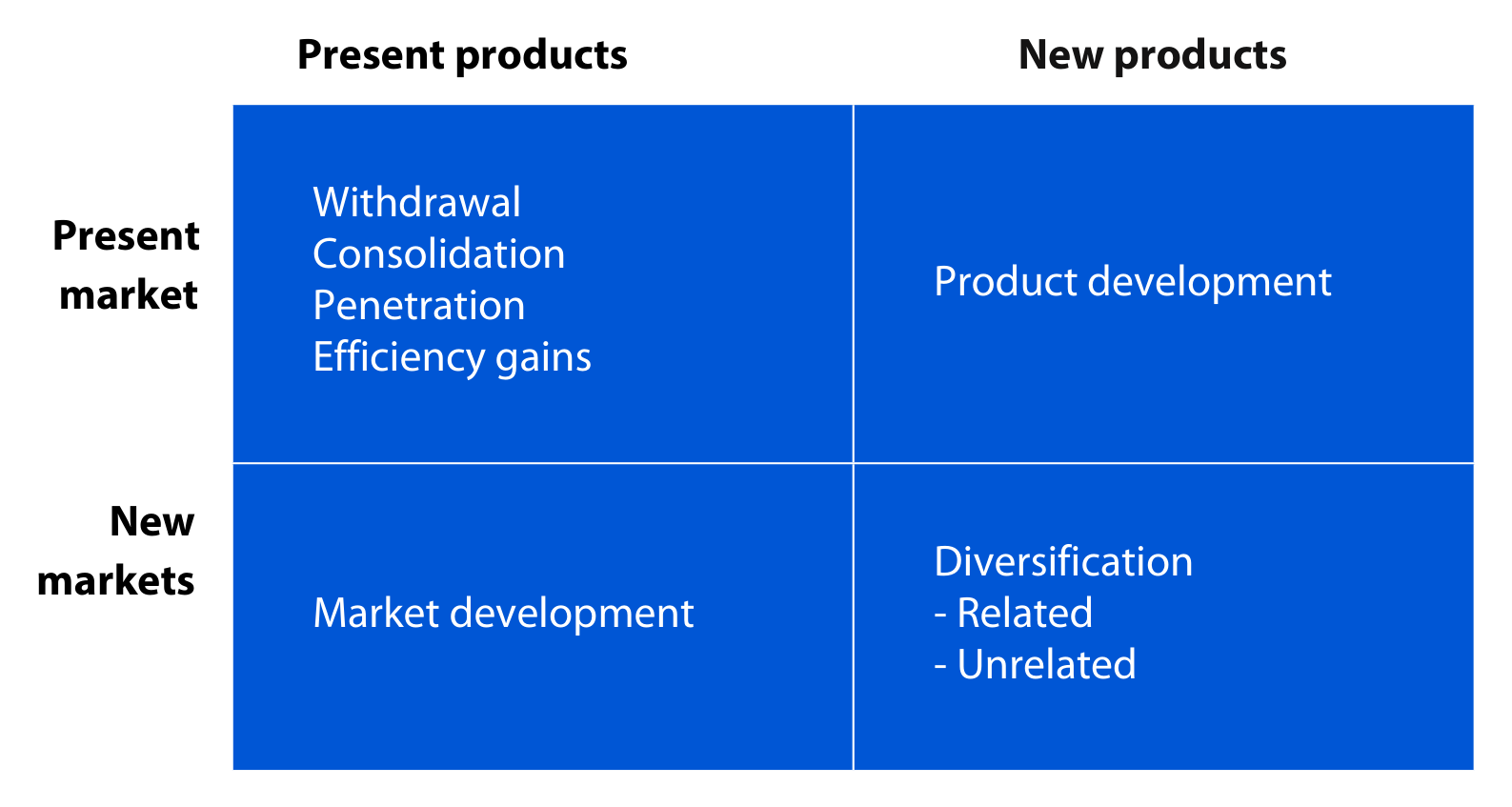
In the top left quadrant the company will stay with present products and present markets. If it does that it can increase profits by first of all efficiency gains (which is a euphemistic way of talking about cost savings). It could withdraw from some markets allowing it to concentrate on other markets or just allowing it to save money. It can consolidate its existing markets. For example, make its back-office operations more efficient. Or it can try to gain the market share, (increase market penetration). So the company might try to raise its market share from, say, 20% to 22%. All of these options are regarded as relatively low risk and low return. The company is in its home territory both for products and markets.
Next, the company can turn either to product development or market development. An example of market development will be trying to export. An example of product development might be a washing machine manufacturer now trying to make vacuum cleaners. Both of these options are somewhat higher risks. They tend to require an amount of upfront investment, and there is no guarantee that that investment will be successful. The company is venturing into unknown territories either geographically or in terms of its product mix.
The final option, and by far the riskiest, is diversification.
Diversification can be:
related, For example, a sister industry, or
unrelated, sometimes known as conglomerate diversification.
We will see that, by and large, there is very little justification for unrelated diversification, but related diversification may be create some benefits, for example, by integrating supply and purchase operations and in cross marketing to each other’s customers.
Remember this diagram summarizes everything a company can do to try to increase its profits. It therefore has very wide application in scenario questions. Most of what the company featured in the scenario may wish to do can be described in terms of one of the quadrants of Ansoff matrix.