
SWOT Analysis


1 SWOT analysis: position analysis
A SWOT analysis can either be used in its own right or it can be used as a summary sheet on which other findings are placed.
SWOT stands for:
Strengths
Weaknesses
Opportunities
Threats
Strengths and weakness are internal to the organisation;
Opportunities and threats are external.
For example, an organisation might have strong resources in finance and weak resources in marketing. Opportunities and threats are external. For example, there may be political threats, but the economy might be looking up and might provide opportunities. Those political and economic factors could have arisen from a PESTEL analysis.
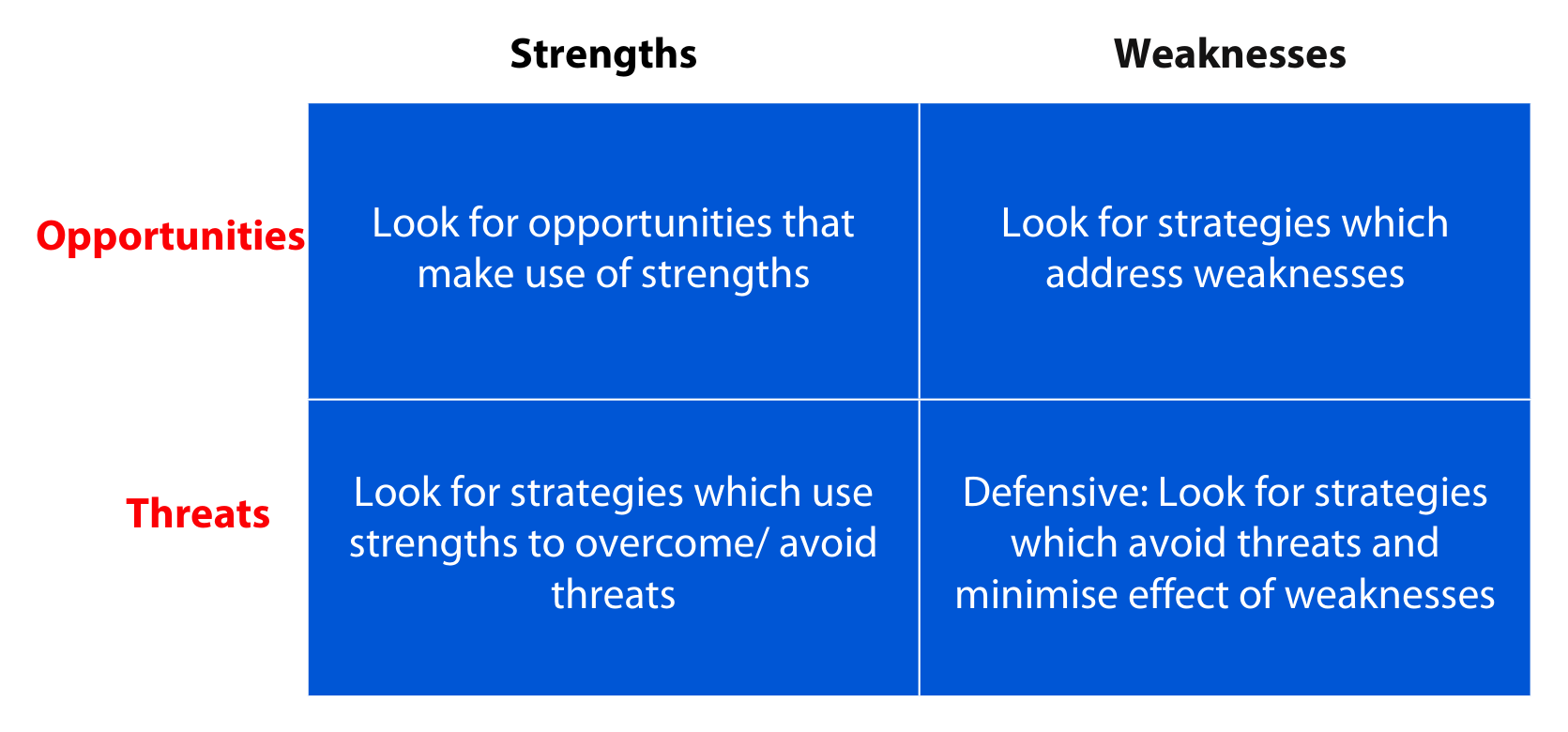
Once the strength, weaknesses, opportunities and threats have been summarized, an organisation then has to decide what to do with them. The point of any analysis is to stimulate action.
Certain things match well. For example, if there is an opportunity which is matched by a strength then the organisation should try to make use of that strength. However if the opportunity depended on using an area in which the company was weak, then the chances of success there are relatively low. Either avoid that opportunity or look for strategies which address the weakness. Similarly, if there is a particular threat which is matched by a strength then it should be relatively easy for the company to overcome that threat. But if there is a threat in an area where the company is particularly weak, then the company could be in some difficulty. For example, the threat might be coming from overseas imports which are particularly low cost. If our organisation is weak in manufacturing so that its costs are relatively high because of inefficient machinery it’s not easy to see what the company can do to fight that threat and it will be particularly vulnerable in that area. Perhaps what it should do instead of fighting the imports face on is to try to avoid the whole conflict by, for example, moving up market. Note, however, that if it is going to move up market it must be strong in the areas of research, development, quality, and innovation.
SWOT analysis can also be called ‘position analysis’. It sets out the important internal and external factors (good, bad, favourable and unfavourable) which will allow the company to determine its trading and marketing position: healthy, struggling, dangers and opportunities. From this analysis the organisation can set realistic objectives and then the strategies that might allow those objectives to be reached.
It must be said that for many exam questions dealing with strategy, when asked to assess a company’s strategic position, a SWOT analysis will always work insofar as it gives you some structure in which to arrange the factors which have been described in the scenario. Note, however, that the examiner does get a little tired of SWOT analysis not supported by more detailed analysis such as five forces, BCG, product lifecycle, and PESTEL.
2 Objectives
‘Good’ objectives should be SMART:
Specific: sales, rejects, cost per unit are all specific. Better and improve are not.
Measurable: usually that the specific aspects of performance have to be quantified
Agreed/accepted/achievable: imposing an unrealistic or impossible target will be ineffective
Relevant: relevant to the person responsible (ie they can affect it); relevant to the organisation’s mission. If objectives are seen as irrelevant, arbitrary and merely an exercise in management power they will fall into disrepute.
Time-bound: objectives should be attained within a specified time frame.
Examples of ‘real-life’ financial objectives over the next 3 years could be:
To increase the operating profit before taxes by 15%
Return on equity of at least 20%
Cost-income ratio below 45%
Net credit losses below 0.5%.
Objectives need to be:
Consistent throughout the organisation. For example, if you have two divisions one has an objective of earning 3 million and other has an objective of earning 6 million, you are not going to get a corporate profit out of that of 10 million: it simply doesn’t add up. Similarly, there is no point in having an objective which says that sales should be 10,000 units, if manufacturing can only cope with 8,000 units.
Consistent through time. For example, It doesn’t make sense to have a gross profit percentage in 2023 of 20%, then 50 % in the next year, and then 35% in the following year.
Comprehensive. All desirable aspects of performance should have objectives. Once objectives are set then employees and departments know they are going to be judged on whether or not they meet those objectives. Other desirable elements of behaviour are often then ignored. So, setting an objective for production volume might adversely affect quality if there were not also quality targets. Some important categories of performance will be difficult to measure. For example, staff morale is important in all businesses but particularly for customer-facing staff. Measuring morale will be difficult but if it is important for the business to have high staff morale an effort must be made.
Deal with short-term/long-term conflicts. Accounting isn’t really very good at displaying the long-term success of a company as most accounts are simply made up for 12 months. There can be a great temptation therefore, to make short term savings like cutting expenditure on research and development, training and maintenance. These measures will boost current profits but this will certainly cause difficulties in a few years’ time.