
Diversification


1 Types of diversification
This diagram shows four types of diversification.
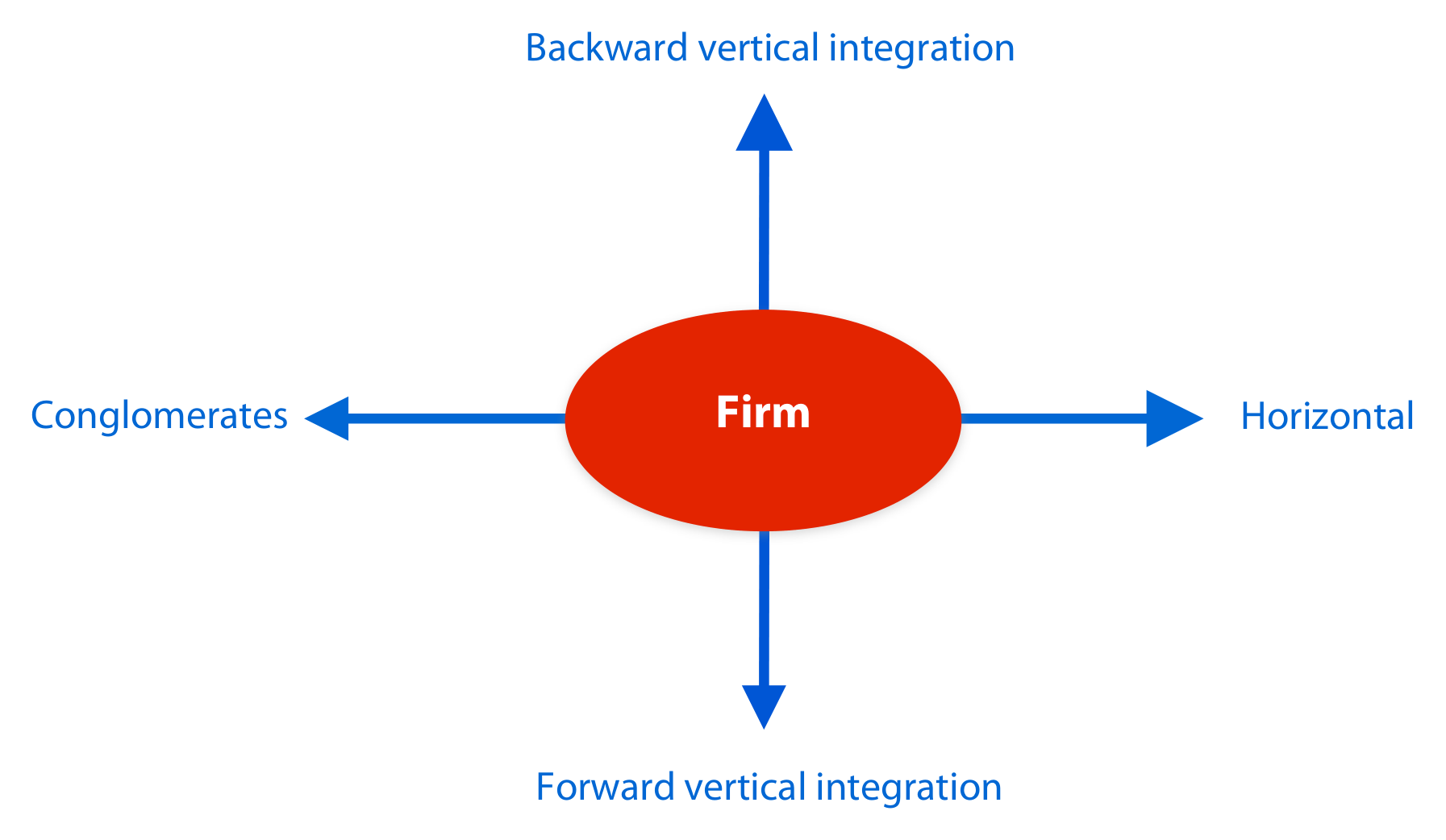
We will deal with them in two sections, starting with conglomerate diversification.
2 Conglomerate diversification
Conglomerate diversification is unrelated diversification: the businesses which are joined together have no connection whatsoever. An example would be a supermarket joining with a car manufacturing company. What advantages might arise from this? Well, the directors of the operations are likely to say that the combined companies will probably give the shareholders a most stable pattern of returns. Diversification often smooths the pattern of returns and profits. However, this overlooks the fact that if the shareholders had wanted a stake in both the supermarket and the car manufacturer they could buy shares in those separate companies themselves. They don’t need the companies to combine for the investors to enjoy a portfolio effect.
The directors might then claim that there will be cost savings or synergy. Synergy is defined by Goold and Campbell as “links between business units that result in additional value creation”. However, if the businesses are truly different it’s difficult to see how the cost savings or other forms of synergy could arise. Suppliers, processes, and customers will be entirely different. It will be difficult to achieve economies of scale in manufacturing or processing. There will be few opportunities, if any, for cross-marketing. It’s unlikely that even the head offices can be combined. If a business which is already well-run is taken over by another one, the only way in which the value of the business can increase is if more profits are squeezed out of it. With conglomerate diversification, it is difficult or impossible to achieve this. The only situation in which conglomerate diversification might add value is if the company taken over is badly run and its new owners can put in better management, turn the company around, and probably sell it on for an increased price, yielding the shareholders a capital gain. However, taking over an already well-run unrelated company cannot yield gains.
More often than not what happens with conglomerated diversification is that a well-run business is taken over, and as the new owners begin to meddle in things they know little about, value is therefore destroyed. There have been many occasions where a business has been bought, for example for ten million, and a few years later sold back to its original owners for perhaps only five million.
3 Horizontal diversification; backward and forward vertical integration
Horizontal diversification means expanding into a related business. For example, an airline taking over a chain of hotels. Because the businesses are related there is a real chance that the combined business will achieve efficiencies, for example, through cost savings or better marketing. You can see how the airline and the hotels could cooperate by offering accommodation when people go to the airline booking system.
Backward and forward of vertical integration are forms of related diversification. Backward vertical integration means taking over or setting up with a supplier. Forward vertical integration means taking over or setting up a distributor or customer. Obviously, the operations are related and there appear to be great attractions in vertical integration. It’s very easy for a firm to say it itself, I make a profit, my suppliers also make a profit and I want their profit and therefore we will take them over. However, like many elements of strategy the real situation can be more complicated.
3.1 Let’s look at some of the potential disadvantages of vertical integration.
Avoiding the discipline of the market. If you take over a supplier the chances are that that supplier becomes sloppy. Why should they become efficient, keep costs down, improve quality, when they are almost guaranteed that anything they produce is going to be bought by the next company in the group? Compare that to where a supplier has to compete to win each order with the best in the world: that really keeps them on their toes.
Secondly, you could take over a perfectly good supplier and just by bad luck another supplier happens to have a technical innovation. You are left with your in-house supplier who, really by luck, hasn’t done quite so well. The company would rather switch and purchase from the more technically advanced supplier, but feel inhibited in doing that.
The third potential disadvantage is that taking over or setting up either a supply chain or a distribution chain takes capital, and any capital spent there cannot be spent in the core business.
Operating gearing is increased. When a supplier is taken over costs which had previously been all variable are now partially fixed. Takeovers mean that you acquire another set of fixed costs.
And finally, although there is a relationship between the various companies in an integrated group, there is nevertheless a degree of diversification. The central firm could be a manufacturer, but managing the people there, getting used to that company’s market, understanding the priorities of a manufacturing firm is quite different from understanding and making a retailing firm work well. It’s quite different skill set and there is still a risk of the dominant company messes it up.
3.2 Having said that, there can be certain advantages in vertical integration:
Assurance of supply or assurance of distribution. You may remember back to the five forces analysis that two of the forces were pressure from suppliers and pressure from buyers. If you own a supplier you can’t be cut out. In fact, by owning a supplier that is a monopoly supplier, you could cut suppliers to your competitors.
There can be efficiencies. You can better integrate the supply and use of components in the supply and sale of finished products. However, many companies which have stayed separate manage to integrate their operations to a very high degree by sharing data with third party suppliers and third-party customers and it’s not clear there is any guaranteed advantage in integration.
Secrecy. If you own the supplier, only you know what components are being used and you don’t have to place outside orders which give clues to other people.
Differentiation. By owning a customer you might be able to differentiate your product better. You determine precisely the components that are made and you determine precisely the way in which the product can sold and this can help you to differentiate your products and services from others. However, there is probably nothing available in integration that isn’t available by close contracts. You can stipulate in your contract for purchase or supply exactly what is needed.