
Capabilities

1 Resources and competences
When analysing an organisation’s position we have to analyse its strategic capability. This is an internal quality of the organisation, and capability depends on:
Resources (things you have like manufacturing resources, patents, people), and
Competences (how you use the things you have).
Strategic capability (that is capability which gives sustained competitive advantage so that you do better than others in the long-term) depends on:
Threshold capabilities, which are the minimum capabilities needed for the organisation to exist at all so that the company just survives; and then on
Additional capabilities, which give the organisation competitive advantage.
The additional capabilities can arise from:
Unique resources, or
Core competences.
Unique resources are resources which one organisation has but which others don’t. It could, for example, be the right to use a particular technique or patent. However, by and large, unique resources are hard to find. Many resources, such as production equipment, can be bought easily and this allows rivals to copy what is being achieved.
Core competences are ways in which an organisation uses its resources better than its competitors do and in ways that other organisations cannot easily imitate or obtain. Core competences are generally harder to identify and define, and they are therefore more difficult for other organisations to copy. Core competences will therefore usually provide a more permanent way in which an organisation can achieve and retain competitive advantage. For example, Apple has core competences in designing and developing new hardware and services such as iTunes. Other companies find Apple’s competences difficult to replicate.
2 Position-based or resource-based strategies
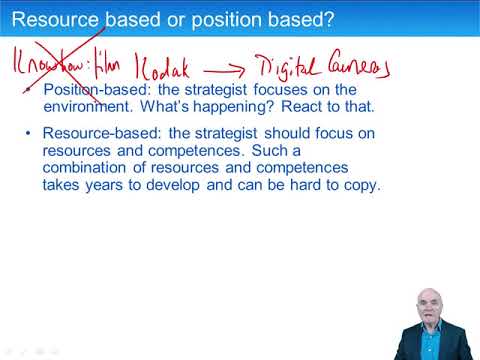
To a large extent, traditional strategic planning has been position-based. In this approach a strategist focuses on the environment (for example using PESTEL analysis or Porter’s five forces), discovers and analyses what’s happening in the environment, and then reacts to that, often changing what the organisation is doing.
A more recent approach is resource-based strategy. This maintains that a strategist should focus on resources and competences. Successful combinations of resources and competences, particularly unique resources and core competences, take years to develop and can be hard for others to copy. These resources and competences are the secret of the organisation’s success: they are likely to be the organisation’s ‘crown jewels’.
A position-based strategic planning approach can lure organisations into areas where they haven’t got the appropriate resources and competences, and it makes them abandon the resources and competence which hitherto have made them successful. Why should they throw away the resources and competences in the hope of discovering others? There is no reason to think that an organisation which has been successful in one area of business through employing specific resources and competences should automatically expect to be successful in another area where entirely different resources and competences are required.
Organisations, therefore, should perhaps not abandon their resources and competences too easily. The organisation should view the future as not just something it happens to them and which renders its resources and competences irrelevant. Perhaps they can create and mould the future to make use of their resources and competences. Of course as in so many matters dealing with strategic planning, a balance is needed. There is no point in an organisation clinging to existing resources and competences when technology or public taste has advanced, and their older products and services have become unpopular. However, it is very salutary for organisations to remind themselves where their strengths lie, and not to give those up without a reasonable struggle.
3 Resources
Many resources can be remembered by lists of words all starting with ‘M’.
Businesses need the following:
Money (financial resources).
Manpower (more properly called human resources).
Management. The need for good management should not be underestimated and it is the lack of management which often restricts small businesses, particularly family businesses, from growing.
Manufacturing or machinery needs to be adequate,
Markets (customers who will buy the goods)
Marketing skills have to be adequate.
Material, so that the goods can be made.
Make (brand)
Methods (knowhow)
MIS (information technology)
When a business is planning its strategy either it must have:
The resources in place to carry out that strategy, or
It must be able to acquire the resources.
It certainly cannot pursue its strategy if adequate resources are not in place how can it be put in place.