
Budgeting

1 Introduction
Budgeting is an essential tool for the management accounting in both planning and controlling future activity. In this chapter we will discuss the benefits of budgeting, the types of budget, and the preparation of budgets.
2 Benefits of budgeting
Planning
Co-ordination
Control
Authorising and delegating
Evaluation of performance
Communicating and motivating
3 Principal budget factor
The principal budget factor is the factor that limits the activity for the budget period. Normally this is the level of sales and therefore the sales budget is usually the first budget to be prepared and this leads to the others.
However, it could be (for example) a limit on the availability of raw materials that limits activity. In this case Raw Materials would be the principal budget factor, and this would the first budget to be prepared.
4 The preparation of budgets
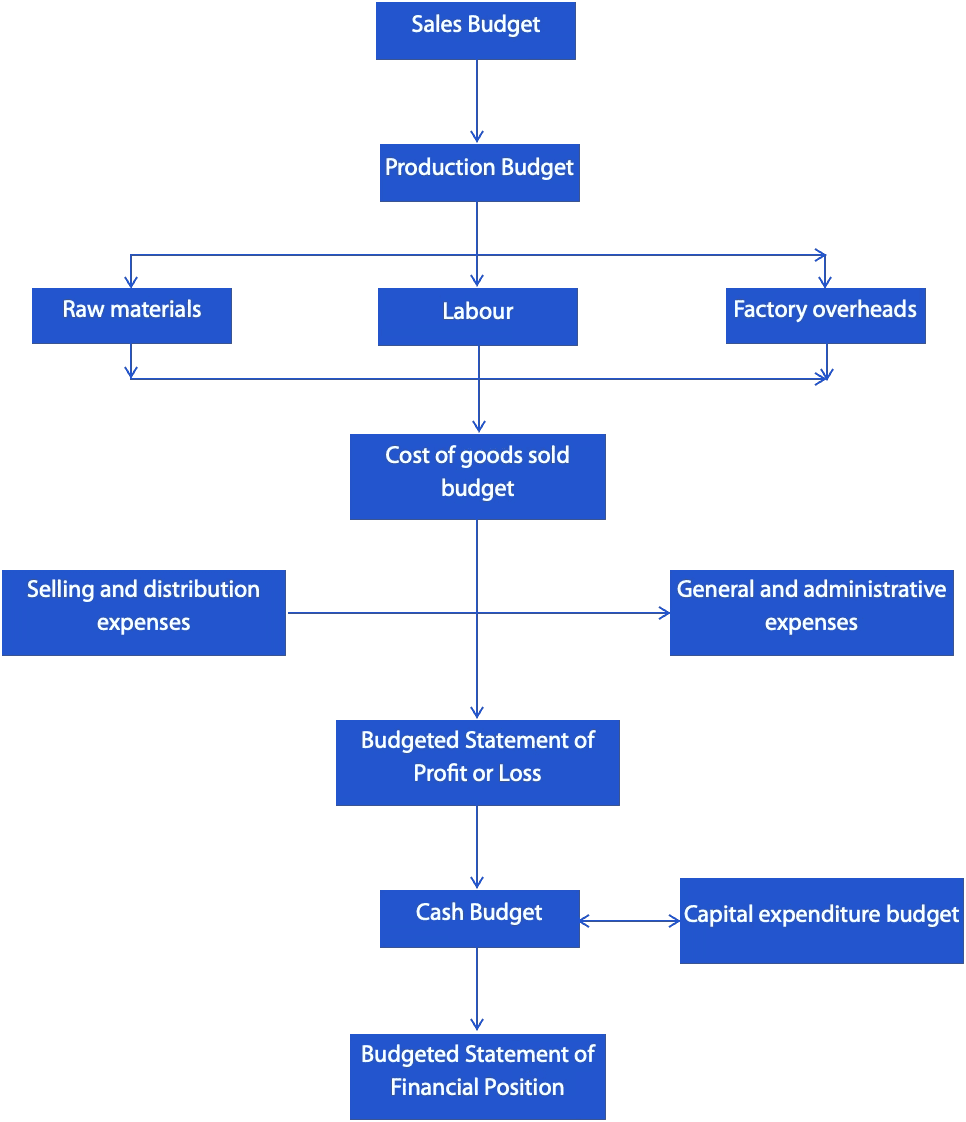

The XYZ company produces three products, X, Y, and Z. For the coming accounting period budgets are to be prepared using the following information:
Budgeted sales
Product X 2000 units at $100 each
Product Y 4000 units at $130 each
Product Z 3000 units at $150 each
Standard usage of raw material
Wood | Varnish | |
Product X | 5 | 2 |
Product Y | 3 | 2 |
Product Z | 2 | 1 |
Standard cost of raw material | $8 | $4 |
Inventories of finished goods
X | Y | Z | |
Opening | 500u | 800u | 700u |
Closing | 600u | 1000u | 800u |
Inventories of raw materials
Wood | Varnish | |
Opening | 21,000 | 10,000 |
Closing | 18,000 | 9,000 |
Labour
X | Y | Z | |
Standard hours per unit | 4 | 6 | 8 |
Labour is paid at the rate of $3 per hour | |||
Prepare the following budgets:
(a) Sales budget (quantity and value)
(b) Production budget (units)
(c) Material usage budget (quantities)
(d) Material purchases budget (quantities and value)
(e) Labour budget (hours and value)
Everything downstream depends on the production budget, so settle it first and show it: production = sales volume + closing inventory − opening inventory. Put the working in the spreadsheet rather than only the answer — an error in the quantity still earns the follow-on marks on the budgets built from it.
5 Types of budget

Fixed budget
Flexed budget
Rolling budget
A company has prepared the following fixed budget for the coming year.
Sales | 10,000 units |
Production | 10,000 units |
$ | |
Direct materials | 50,000 |
Direct labour | 25,000 |
Variable overheads | 12,500 |
Fixed overheads | 10,000 |
$97,500 |
Budgeted selling price $10 per unit.
At the end of the year, the following costs had been incurred for the actual production of 12,000 units.
$ | |
Direct materials | 60,000 |
Direct labour | 28,500 |
Variable overheads | 15,000 |
Fixed overheads | 11,000 |
$114,500 |
The actual sales were 12,000 units for $122,000
(a) Prepare a flexed budget for the actual activity for the year
(b) Calculate the variances between actual and flexed budget, and summarise in a form suitable for management. (Use a marginal costing approach)
6 Methods of budgeting

6.1 Incremental budgeting
This approach is to take the previous years results and then to adjust them by an amount to cover inflation and any other known changes.
It is the most common approach, is a reasonably quick approach, and for stable companies it tends to be fairly accurate.
However, one large potential problem is that it can encourage the continuation of previous problems and inefficiencies.
The reason for this is that the budget is a plan for the coming year – not simply a financial forecast.
If we require a wages budget, we will probably ask the wages department to produce it and they (using an incremental approach) will assume that our workers will continue to operate as before. They will therefore simply adjust by any expected wage increases.
As a result, the ‘plan’ for our workers stays the same as before. Nobody has been encouraged to consider different ways of operating that may be more efficient. It is at budget time that we perhaps should be considering different ways of operating.
6.2 Zero-based budgeting
With zero-based budgeting we do not consider the previous period. Instead, we consider each activity on its own merits and draw up the costs and benefits of the different ways of performing it (and indeed whether or not the activity should continue).
We then decide on the most effective way of performing each activity.
Clearly any changes to the way an activity is performed may require funding, and there may not be sufficient funding available for all changes proposed, and therefore they are ranked to decide which changes are made.
Although this approach is in principle a much better approach to budgeting, it is time-consuming and also requires much more expertise than incremental budgeting. For this reason, it is often restricted just to a few activities each year in order that training and help may be given to the people involved. Other activities are budgeted using the incremental approach.
7 Behavioural aspects

7.1 Participation
If the budget process is not handled properly, it can easily cause dysfunctional activity. It is therefore necessary to give thought to the behavioural aspects.
Top-down budgeting
This is where budgets are imposed by top management without the participation of the people who will actually be involved for implementing it.
Bottom-up budgeting
Here the budget-holders do participate in the setting of their own budgets.
Advantages and disadvantages
7.2 Target setting and motivation
Targets can assist motivation and appraisal if they are set at the right level.
if they are too difficult then they will demotivate
if they are too easy then managers are less likely to strive for optimal performance
ideally they should be slightly above the anticipated performance level
Good targets should be:
agreed in advance
dependant on factors controllable by the individual
measurable
linked to appropriate rewards and penalties
chosen carefully to ensure goal congruence
7.3 Responsibility accounting
A system of accounting that separates revenues and costs into areas of separate responsibility, which can then be assigned to specific managers
7.4 Management by objectives
A system of management incorporating clearly established objectives at every level of the organisation.
Here there is less emphasis on monetary budgets and more emphasis on taking action which helps the business to achieve its objectives.
8 Beyond budgeting
There has been much recent criticism of the annual budgeting process for many reasons, including the following:
Time consuming and costly to put together
Restricts responsiveness and flexibility and is a barrier to change
Rarely strategically focused (most budgets are for one year only)
Adds little value
Concentrates on cost reduction, not on creating value
Encourages ‘gaming’ and perverse behaviour just to meet the budget.
Not updated often enough
Based on assumptions, estimates and guesses
Reinforces departmental barriers rather than sharing and cooperation
Makes people feel undervalued: the budget is seen as a strict control mechanism and employees have to stick to the budget no matter what.
Several companies are adopting a ‘beyond budgeting’ approach whereby instead of preparing budgets and measuring the performance of managers by reference to the budget, managers are measured by comparison with other similar companies or by comparison with other similar divisions of the same company.
“The annual budgeting process is a trap. Pressured by fixed targets and performance incentives, managers focus on making the numbers instead of making a difference, meeting set goals instead of maximizing potential. With their compensation at stake, managers often resort to deceitful - even unethical-behaviour. In the end, everybody loses - the employee, the company, and ultimately the customer. The Beyond Budgeting model argues that companies should abandon traditional budgeting in favour of a new model that links performance measurement to evolving competitive benchmarks-and shifts the firm’s focus from controlling employee behaviour to delivering customer value.”
8.1 Principles of beyond budgeting
The creation of a performance management climate that measures success against the competition and not against an internally focused budget. The motivation and reward process is based on the success of the team compared to the competition.
The target setting process is based on the agreement of external benchmarks.
Motivation through challenges and delegating responsibility to operational managers who can make decisions themselves.
The empowerment of operational managers by giving them the means to act independently (access to resources). The resource utilisation process is based on direct local access to resources (within agreed parameters). The coordination process coordinates the use of resources on the basis of internal markets
The two fundamental elements of the Beyond Budgeting model are:
New leadership principles based on the principle of the empowerment of managers and employees, and
New more adaptive management processes.
The new leadership principles (devolution) should unlock the full potential of managers and employees in order to enable the organization to react in an appropriate way and as quickly as possible to new chances and risks in the market environment.
Adaptive management processes are not based on fixed targets and resource plans like under the budgeting model. Instead, they enable an organization for a high degree of flexibility.
Budgeting
7 questionsAnswer the questions one at a time. Your progress is saved so you can leave and come back.
Open chapter practice