
Risk and Uncertainty

1 Introduction
Decision making involves making decisions now which will affect future outcomes which are unlikely to be known with certainty.
Risk exists where a decision maker has knowledge that several possible outcomes are possible – usually due to past experience. This past experience enables the decision maker to estimate the probability or the likely occurrence of each potential future outcome.
Uncertainty exists when the future is unknown and the decision maker has no past experience on which to base predictions.
Whatever the reasons for the uncertainty, the fact that it exists means that there is no ‘rule’ as to how to make decisions. For the examination you are expected to be aware of, and to apply, several different approaches that might be useful.
2 Risk preference
As will be illustrated by an example, the approach taken to make the decision will depend on the decision-makers attitude to risk.
A risk seeker will be interested in the best possible outcome, no matter how small the change that they may occur.
Someone who is risk neutral will be concerned with the most likely or ‘average’ outcome.
A risk avoider makes decisions on the basis of the worst possible outcomes that may occur.
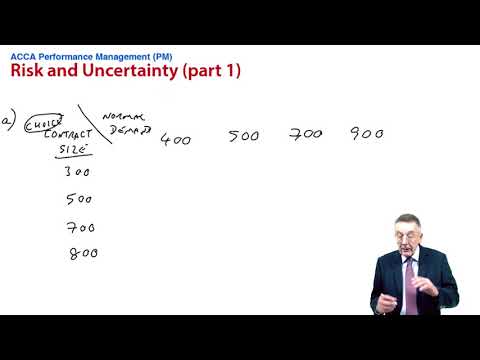


John has a factory capacity of 1,200 units per month.
Units cost him $6 each to make and his normal selling price is $11 each. However, the demand per month is uncertain and is as follows:
Demand | Probability |
400 | 0.2 |
500 | 0.3 |
700 | 0.4 |
900 | 0.1 |
He has been approached by a customer who is prepared to contract to a fixed quantity per month at a price of $9 per unit. The customer is prepared to sign a contract to purchase 300, 500, 700 or 800 units per month.
The company can vary production levels during the month up to the maximum capacity, but cannot carry forward any unsold units in inventory.
(a) Calculate all possible profits that could result
(b) Determine for what quantity John should sign the contract, under each of the following criteria:
i) expected value
ii) maximin
iii) maximax
iv) minimax regret
(c) What is the most that John would be prepared to pay in order to obtain perfect knowledge as to the level of demand?
3 The limitations of expected values.
Although we say that someone who is risk neutral would take an expected value approach to decision making, there are two serious limitations of this approach:
4 Decision Trees


A decision tree is a diagrammatical representation of the various alternatives and outcomes. It is relevant when using an expected value approach and where there are several decisions to be made – it makes the approach more understandable.
Combi plc are having problems with one of their offices and have decided that there are three courses of action available to them:
(a) shut down the office, raising proceeds of $5 million
(b) have an expensive refurbishment of the office costing $4,000,000
(c) have a cheaper refurbishment of the office at a cost of $2,000,000
If they do the expensive refurbishment, then a good result will yield a return of $13,500,000 whereas a poor result will yield a present value of only $6,500,000.
If they alternatively decide to do the cheaper refurbishment, then a good result will yield a return of $8,500,000 whereas a poor result will yield $4,000,000.
In either case, the probability of the refurbishment achieving a good result has been estimated to be 2/3.
An independent company has offered to undertake market research for them in order to identify in advance whether the result of refurbishment is likely to be good or poor. The research will cost $200,000 and there is a 68% probability that it will indicate a good result.
Unfortunately, the research cannot be guaranteed to be accurate. However, if the research indicates a good result, then the probability of the actual result being good is 91%.
If the survey indicates a poor result, then the probability of the actual result being good is 13%.
Combi have already decided that if they do have market research, and if the research indicates a poor result, then they will only be prepared to consider the cheaper refurbishment.
Use a decision tree to recommend what actions should be taken.
Note: In this example, the market research is not guaranteed to be accurate. This is likely to be the case in real life and is an example of imperfect knowledge
Risk and uncertainty
10 questionsAnswer the questions one at a time. Your progress is saved so you can leave and come back.
Open chapter practice