
Short-term decision making

1 Introduction
This chapter looks at various techniques for the making of decision in the short-term. You should be already familiar with them from your previous studies. First we will revise the terminology and then revise the techniques by way of examples.
2 Terminology
2.1 Variable costs
These are costs where the total will vary with the volume. In the case of production costs, the total will vary with the level of production, whereas in the case of selling costs the total will vary with the level of sales.
Normally, the variable cost per unit will be constant, although this is not always the case. In the case of materials cost, it may be that the cost per unit falls with higher quantities due to discounts being received. In the case of labour, again the cost per unit may fall with higher production due to the learning effect (covered in a later chapter).
The total of the variable production costs is also called the marginal cost of production.
2.2 Fixed costs
These are costs where the total will not vary with volume. An example perhaps is factory rent, where the same total rent is payable whether we produce 1 unit or 1,000 units.
2.3 Contribution
The contribution per unit is the difference between the selling price and all variable costs per unit. (Or, alternatively, the profit before charging any fixed costs).
The contribution is of fundamental importance in decision making, because it is this element of profit that will vary with volume – the fixed costs, by definition, staying fixed.
2.4 Avoidable (or discretionary) fixed costs
These are the specific fixed costs of an activity or sector of a business which would be avoided if that activity or sector did not exist. These costs are usually associated with decisions as to whether or not to shut down a sector. If we were to shut down a sector, then any contribution from that area would be lost, but any avoidable fixed costs of that area would be saved.
Note that not all fixed costs are avoidable by shutting down an area. For example, there may be head office fixed costs that remain payable in full even if one sector of the business were to be closed.
A branch or clinic that reports a loss after a share of head office cost has been charged to it is not automatically one to close. That apportionment carries on after closure, so run the chapter’s test: compare the contribution that would be lost with the direct costs that would actually be saved and any other relevant effects, and close only if the saving is greater.
2.5 Sunk costs
These are costs that have already been incurred. They are irrelevant for decision making. The reason for this is that in any decision we will be concerned with whether or not the future benefits from the decision will outweigh the future costs. Any costs already incurred will remain payable whatever decision we make.
2.6 Relevant costs
A relevant cost is simply a cost that is relevant to the decision being made. A sunk cost is not a relevant cost for the reasons stated above.
2.7 Opportunity cost
This is the value of a benefit sacrificed when one course of action is taken in preference to an alternative.
For instance, one factor that might be involved in deciding whether or not to launch a new product could be that sales of another existing product may fall. If, as a result we would lose (say) $20,000 of existing contribution, then for the purpose of making the decision about the new product we would consider the $20,000 as being a cost of the new product. (The new product will only be worthwhile if the revenue from it covers not only any direct costs of production but also the $20,000 that we would be losing.)
2.8 Incremental costs
Incremental means extra, or additional. These are any extra costs which would be incurred as a result of the decision and will therefore be relevant to the decision.
3 Shutdown problems
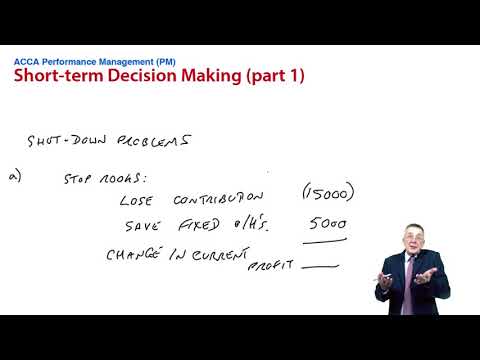
This sort of question is asking for a decision as to whether or not to close part of the business.
(a) A company manufactures three products, Pawns, Rooks and Bishops. The present net annual income from these is as follows:
Pawns | Rooks | Bishops | Total | |
$ | $ | $ | $ | |
Sales | 50,000 | 40,000 | 60,000 | 150,000 |
Less variable costs | 30,000 | 25,000 | 35,000 | 90,000 |
Contribution | 20,000 | 15,000 | 25,000 | 60,000 |
Less fixed costs | 17,000 | 18,000 | 20,000 | 55,000 |
Profit/loss | 3,000 | (3,000) | 5,000 | 5,000 |
The company is considering whether or not to cease selling Rooks. It is felt that selling prices cannot be raised or lowered without adversely affecting net income. $5,000 of the fixed costs of Rooks are direct fixed costs which would be saved if production ceased. All other fixed costs would remain the same.
(b) Suppose, however, that it were possible to use the resources released by stopping production of Rooks to produce a new item, Crowners, which would sell for $50,000 and incur variable costs of $30,000 and extra direct fixed costs of $6,000.
Consider whether the company should cease production and sale of Rooks under each of the scenarios in (a) and (b) above.
4 Relevant costing

This sort of question is really testing that you can determine what information in the question is relevant to the decision, and what information (for example, sunk costs) is irrelevant.
This is not a topic for which you can really learn rules. The main thing is to understand the thought process involved and then to read questions very carefully and to state the assumptions you have made where relevant.
The managing director of Parser Ltd, a small business, is considering undertaking a one-off contract and has asked her inexperienced accountant to advise on what costs are likely to be incurred so that she can price at a profit. The following schedule has been prepared:
Costs for special order:
Notes | $ | |
Direct wages | 1 | 28,500 |
Supervisor costs | 2 | 11,500 |
General overheads | 3 | 4,000 |
Machine depreciation | 4 | 2,300 |
Machine overheads | 5 | 18,000 |
Materials | 6 | 34,000 |
98,300 |
Notes:
Direct wages comprise the wages of two employees, particularly skilled in the labour process for this job, who could be transferred from another department to undertake work on the special order. They are fully occupied in their usual department and sub-contracting staff would have to be bought-in to undertake the work left behind. Subcontracting costs would be $32,000 for the period of the work. Different subcontractors who are skilled in the special order techniques are available to work on the special order and their costs would amount to $31,300.
A supervisor would have to work on the special order. The cost of $11,500 is comprised of $8,000 normal payments plus $3,500 additional bonus for working on the special order. Normal payments refer to the fixed salary of the supervisor. In addition, the supervisor would lose incentive payments in his normal work amounting to $2,500. It is not anticipated that any replacement costs relating to the supervisor’s work on other jobs would arise.
General overheads comprise an apportionment of $3,000 plus an estimate of $1,000 incremental overheads.
Machine depreciation represents the normal period cost based on the duration of the contract. It is anticipated that $500 will be incurred in additional machine maintenance costs.
Machine overheads (for running costs such as electricity) are charged at $3 per hour. It is estimated that 6000 hours will be needed for the special order. The machine has 4000 hours available capacity. The further 2000 hours required will mean an existing job is taken off the machine resulting in a lost contribution of $2 per hour.
Materials represent the purchase costs of 7,500 kg bought some time ago. The materials are no longer used and are unlikely to be wanted in the future except on the special order. The complete inventory of materials (amounting to 10,000 kg), or part thereof, could be sold for $4.20 per kg. The replacement cost of material used would be $33,375.
Because the business does not have adequate funds to finance the special order, a bank overdraft amounting to $20,000 would be required for the project duration of three months. The overdraft would be repaid at the end of the period. The bank’s overdraft rate is 18%.
The managing director has heard that, for special orders such as this, relevant costing should be used that also incorporates opportunity costs. She has approached you to create a revised costing schedule based on relevant costing principles.
Adjust the schedule prepared by the accountant to a relevant cost basis, incorporating appropriate opportunity costs.
5 Make or Buy decisions

In order to overcome problems of limited resources, a firm may buy in a product instead of making it itself.
Where incremental costs of manufacture are less than those of buying in, the firm should make – assuming that there are not limited resources.
Where resources are limited, the firm should concentrate on making those products which give the greatest saving (over buying in) per unit of the scarce resource.
To decide which products should be made and which should be bought, we calculate the saving per unit of scarce resource from making the product rather than buying it in.
Short-term decision-making
10 questionsAnswer the questions one at a time. Your progress is saved so you can leave and come back.
Open chapter practice