
Accounting policies, changes in accounting estimate and errors (IAS 8)



1 Accounting policies

Error
Adomas Co Statement of Profit or Loss and Other Comprehensive Income extract and summarised Statement of Financial Position for the year ended 31 December, 2008
$’000 | |
|---|---|
Revenue | 2,500 |
Cost of sales and expenses | (1,200) |
Profit for the year | 1,300 |
Statement of Financial Position at 31 December, 2008 | |
Non-current assets | 2,000 |
Current assets | 800 |
2,800 | |
Share capital | 600 |
Reserves | 2,000 |
2,600 | |
Current liabilities | 200 |
2,800 |
During 2009 it was discovered that certain non-current assets had been included in the records at 31 December 2008 at $500,000 in excess of their recoverable amount and that this situation was unlikely to change.
Prior to making any adjustment for the above the results and summarised Statement of Financial Position of Adomas Co for 2009 was as follows:
Statement of Profit or Loss (extract) for the year ended 31 December 2009
$’000 | |
|---|---|
Revenue | 2,600 |
Costs and expenses | (1,400) |
Profit for the year | 1,200 |
Statement of Financial Position at 31 December 2009
$’000 | |
Non-current assets | 2,800 |
Current assets | 1,700 |
4,500 | |
Share capital | 600 |
Retained earnings | 3,500 |
4,100 | |
Current liabilities | 400 |
4,500 |
During 2009 some other items of property had been revalued by $300,000 (included in the above retained earnings figure).
Prepare extracts from Adomas Co’s financial statements for the year ended 31 December, 2009.
Show answerHide answer
2 Accounting estimates
Changes in accounting estimate are recognised prospectively:
Period of change
Period of change and future periods
Accounting Estimates
Would the following be a change in accounting policy or revision of an estimate?
If a company decides to change its method of depreciation from straight line method to reducing balance method.
If a company decides to change from capitalising finance costs to immediate write off.
Show answerHide answer
3 Prior period error
Accounting errors (omissions and misstatements) include:
Errors in applying accounting policies
Oversights
Fraud and the effects of fraud
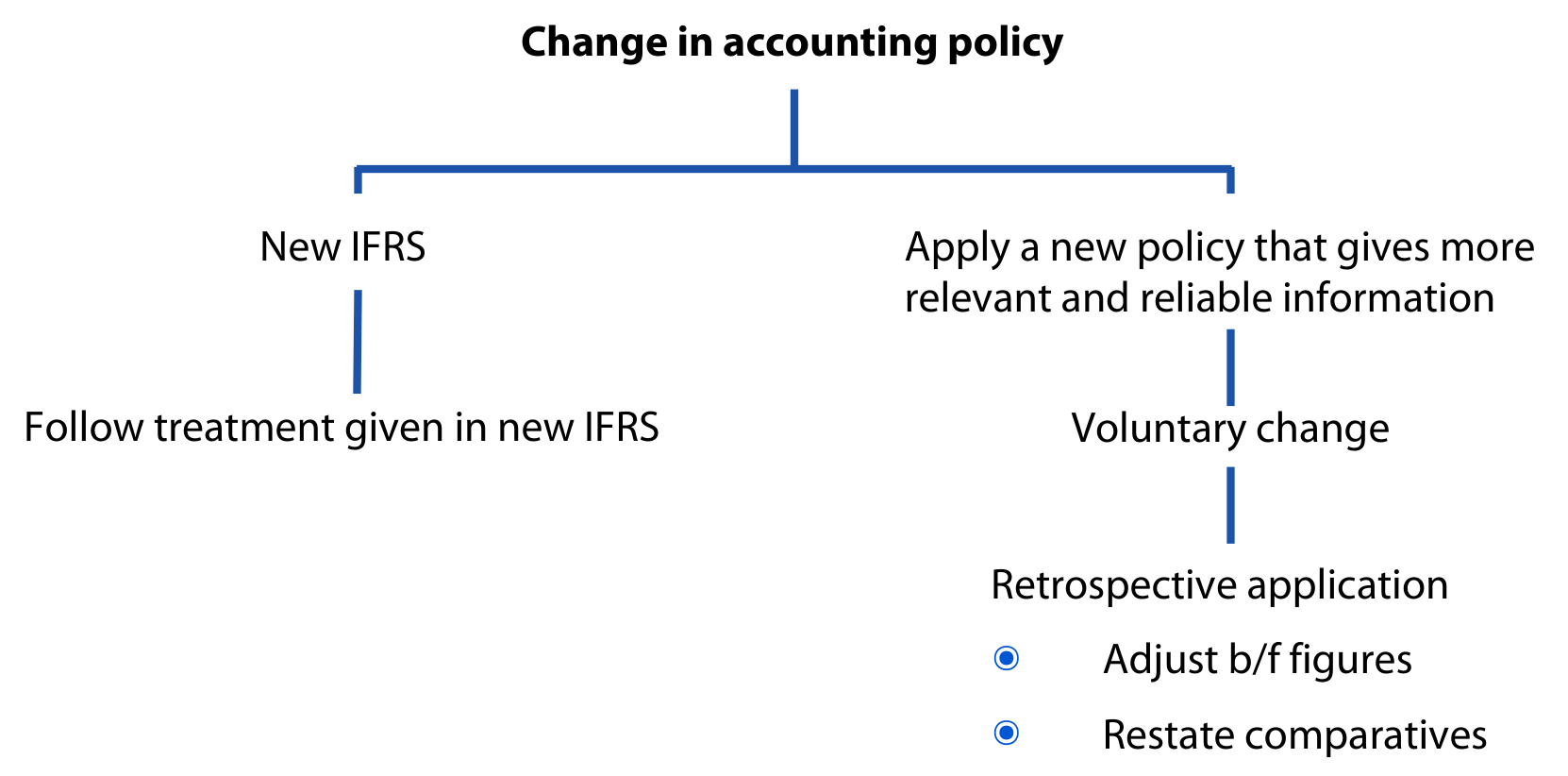
Material errors are corrected retrospectively, the same as for a change in accounting policy.
Retrospectively means adjusting the brought-forward figures and restating the comparatives, so that the prior year is shown as though the new policy had always applied, or as though the error had never been made. The part that belongs to earlier years goes to opening retained earnings in the statement of changes in equity, and only the part that belongs to the current year goes through this year's profit — in the Dodgy Co example below, $1.0m is an expense this year and $2.4m adjusts opening retained earnings.

Prior year error
Fraudulent financial reporting has been found within the accounts of Dodgy Co, which amounts to $3.4m of trade receivables that need to be written off. Of the total $3.4m, $1.0m relates to the current reporting period, and the remaining $2.4m relates to pervious period.
Explain the accounting treatment of the fraudulent financial reporting in the financial statements of Dodgy Co.
Show answerHide answer
Accounting policies, estimates and errors (IAS 8)
10 questionsAnswer the questions one at a time. Your progress is saved so you can leave and come back.
Open chapter practice