
Non-current assets


1 Property, plant and equipment (IAS 16)

1.1 Measurement at recognition
At cost
Purchase price
Directly attributable costs in bringing asset to its location and condition
Costs to dismantle/restore (@ present value)
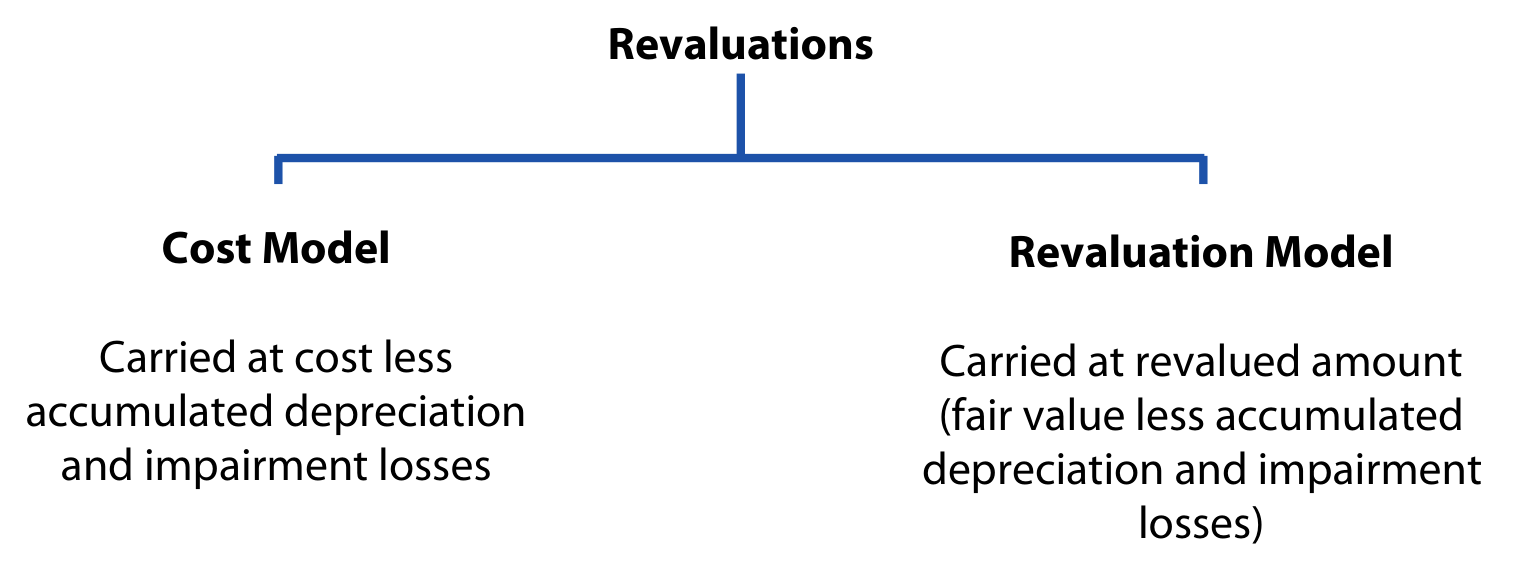
If the asset is carried under the revaluation model, the following must be applied:
Review periodically and keep revaluations up to date
Consistent policy for each class of asset (avoids cherry-picking of assets)
Depreciate the revalued asset less residual value over its remaining useful life
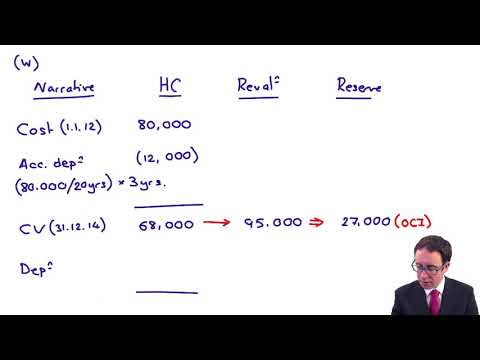
Revaluation increase
Panama bought an item of property, plant and equipment for $80 million on 1 January 2012. The asset had zero residual value and was to be depreciated over its estimated useful life of 20 years.
On 1 January 2015 the asset was revalued to its fair value of $95 million.
Calculate the amounts to shown in the financial statements of Panama for the year-ended 31 December 2015.
Show answerHide answer
The revaluation decrease will go to the revaluation reserve first, so that the value of the asset is no greater than its depreciated historical cost as if there was no initial revaluation upwards, and any excess will go through profit or loss.

Revaluation decrease
On 1 January 2013, Panama purchased an item of property, plant and equipment for $12 million. Panama uses the revaluation model to value its non-current assets. The asset has zero residual value and is being depreciated over its estimated useful life of 10 years. At 31 December 2014, the asset was revalued to $14 million but at 31 December 2015, the value of the asset had fallen to $8 million. Panama has not taken the effect of the revaluation at 31 December 2015 in its financial statements.
Calculate the amounts to shown in the financial statements of Panama for the year-ended 31 December 2015.
Show answerHide answer
1.2 Depreciation
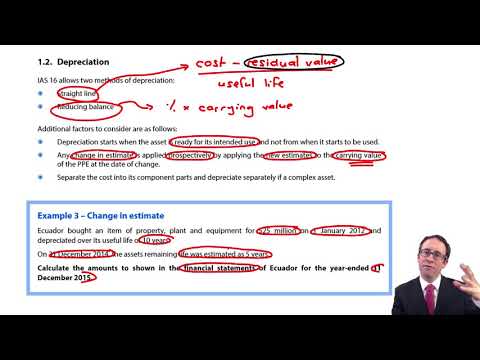
IAS 16 allows two methods of depreciation:
Straight line
Reducing balance
Additional factors to consider are as follows:
Depreciation starts when the asset is ready for its intended use and not from when it starts to be used.
Any change in estimate is applied prospectively by applying the new estimates to the carrying value of the PPE at the date of change.
Separate the cost into its component parts and depreciate separately.
Change in estimate
Ecuador bought an item of property, plant and equipment for $25 million on 1 January 2012 and depreciated over its useful life of 10 years.
On 31 December 2014, the assets remaining life was estimated as 5 years.
Calculate the amounts to shown in the financial statements of Ecuador for the year-ended 31 December 2015.
Show answerHide answer

PPE and financial statements
The extracts from the trial balance of Kandy as at 30 September 2014 are:
$’000 | $’000 | ||
Land ($5 million) and buildings – at cost | 55,000 | ||
Plant and equipment – at cost | 58,500 | ||
Accumulated depreciation at 1 October 2013 | |||
: buildings | 20,000 | ||
: plant and equipment | 34,500 |
The following notes are relevant:
Non-current assets:
The price of property has increased significantly in recent years and on 1 October 2013, the directors decided to revalue the land and buildings. The directors accepted the report of an independent surveyor who valued the land at $8 million and the buildings at $39 million on that date. The remaining life of the buildings at 1 October 2013 was 15 years. Kandy does not make an annual transfer to retained profits to reflect the realisation of the revaluation gain.
Plant and equipment is depreciated at 12½% per annum using the reducing balance method.
No depreciation has yet been charged on any non-current asset for the year ended 30 September 2014. Depreciation is charged to cost of sales.
Prepare extracts from the statement of profit or loss and other comprehensive income for Kandy for the year ended 30 September 2014 and from the statement of financial position as at the same date with regards property, plant and equipment.
Show answerHide answer
On revaluation to fair value the depreciation charged on the revalued asset is likely to be higher than what was charged prior to the revaluation taking place. IAS 16 allows an entity to transfer the excess depreciation between the new deprecation charge on the revalued asset and the previous depreciation charged prior to the revaluation from the revaluation surplus to retained earnings. This adjustment is done as a reserve transfer in the statement of changes in equity.
DR Revaluation surplus ↓ (SOCIE) | X |
CR Retained earnings ↑ (SOCIE) | X |
Complex assets and depreciation
Paraguay bought an aircraft for a total cost of $200 million at the start of the financial year that consists of different component parts, each one with a separate useful life. The cost and useful life of each component is as follows:
Component | Cost ($m) | Useful life |
Fuselage (airframe) | £100m | 20 years |
Engines | $75m | 10 years |
Cabin interior | $25m | 5 years |
The annual depreciation charge on each component is calculated as follows:
Component | Calculation | Depreciation charge |
Fuselage (airframe) | £100m/20 years | $5m per annum |
Engines | $75m/10 years | $7.5m per annum |
Cabin interior | $25m/5 years | $5m per annum |
Paraguay would charge a total of $17.5m during the first year of operation of the aircraft ($5m + $7.5m + $5m) and the carrying value of each component would be as follows at the end of the first year.
Component | Calculation | Carrying value |
Fuselage (airframe) | £100m - $5m | $95m |
Engines | $75m - $7.5m | $67.5m |
Cabin interior | $25m - $5m | $20m |
The total carrying value at the end of the first year to appear in PPE under non-current assets would be $182.5m ($95m + $67.5m + $20m).
2 Borrowing costs (IAS 23)
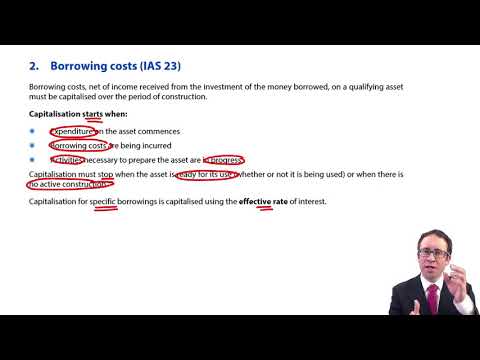
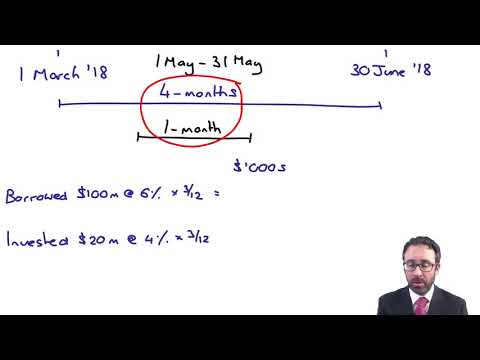
Borrowing costs, net of income received from the investment of the money borrowed, on a qualifying asset must be capitalised over the period of construction.
Capitalisation starts when:
Expenditure on the asset commences
Borrowing costs are being incurred
Activities necessary to prepare the asset are in progress
Capitalisation must stop when the asset is ready for its use (whether or not it is being used) or when there is no active construction.
Capitalisation for specific borrowings is capitalised using the effective rate of interest.
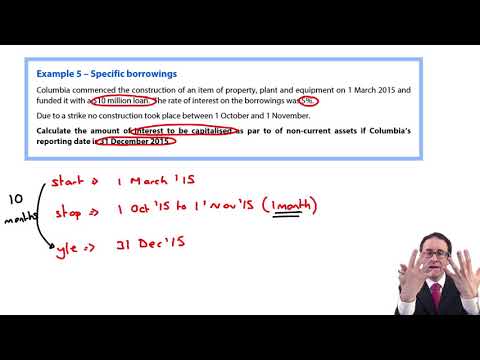
Specific borrowings
Columbia commenced the construction of an item of property, plant and equipment on 1 March 2015 and funded it with a $10 million loan. The rate of interest on the borrowings was 5%.
Due to a strike no construction took place between 1 October and 1 November.
Calculate the amount of interest to be capitalised as par to of non-current assets if Columbia’s reporting date is 31 December 2015.
Show answerHide answer
General borrowings
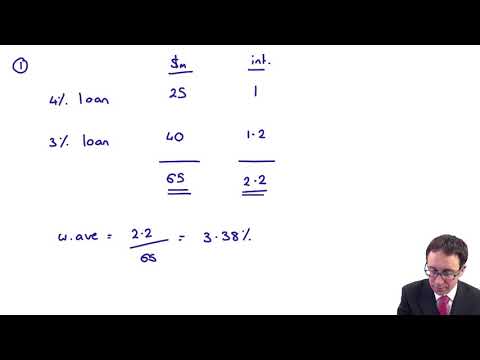
Venezuela had the following bank loans in issue during 2015.
$m | |
4% bank loan | 25 |
3% bank loan | 40 |
Venezuela commenced the construction of an item of property, plant and equipment on 1 January 2015 for which it used its existing borrowings. $10 million of expenditure was used on 1 January and $15 million was used on 1 July.
Calculate the amount of interest to be capitalised as part of the non-current assets during 2015.
Show answerHide answer
3 Government grants (IAS 20)

Recognise the grant when the:
Entity will comply with the conditions attached to the grant
Entity will actually receive the grant
Grants should be recognised according to the deferred income approach, using a systematic basis. This spreads the income over the period in which the related expenditure is recognised.
If the grant is used to buy depreciating assets, the grant must be spread over the same life and using the same method.
Under the deferred income method the grant does not simply sit as a liability. Each year a slice of it is released to profit or loss on the same basis as the depreciation, so the net charge is the depreciation less that release, and it is the release that is missed. On the statement of financial position the deferred income is then split, with the amount due to be released in the next twelve months shown as a current liability and the rest as non-current.
Grants and depreciable assets
Tweddle bought an item of property, plant and equipment for $10 million and received a government grant of $2 million. The PPE has a useful life of 10 years and has no residual value.
Explain how the purchase of the property, plant and equipment and government grant would be dealt with in the financial statements of Tweddle.
Show answerHide answer
Note: If a government grant becomes repayable, it is treated as a change in accounting estimate.
The payment is first shown against any remaining deferred income balance.
If the payment exceeds the deferred income balance then the excess payment is treated as an expense.
Government Grants
XRT acquired plant costing $3m on 1 January 20X3, funded in part by a government grant of $1m. The plant has a useful life of 10 years.
Calculate the non-current liability shown in the statement of financial position as at 31 December 20X3 if the deferred income method is applied.
Calculate the value of the PPE as at 31 December 20X3 under the deferred income method and the netting-off method.
Show answerHide answer
4 Investment properties (IAS 40)

Investment property is property (land or a building – or part of a building – or both) held to earn rentals or for capital appreciation or both, rather than for:
Use in the production or supply of goods and services or for administrative purposes (IAS 16); or
Sale in the ordinary course of business (IAS 2); or
4.1 Initial measurement
Investment properties should initially be measured at cost plus directly attributable costs.
4.2 Subsequent measurement
Fair value model | Cost model |
The investment properties are revalued to fair value at each reporting date | The investment properties are held using the benchmark method in IAS 16 (cost) |
Gains or losses on revaluation are recognised directly through profit or loss | The properties are depreciated like any other asset |
The properties are not depreciated |
Transfers into and out of investment property should only be made when supported by a change of use of the property.
IP to owner occupied (IAS 16) – Fair value at date of change
IP to inventory (IAS 2) – Fair value at date of transfer
Owner occupied (IAS 16) to IP – Revalue under IAS 16 and then treat as IP
Inventory (IAS 2) to IP – Fair value on change and gain/loss to profit or loss
Investment property and change of use
Addlington owns a property that it is using as its head office. At 1 January 2015, its carrying value was $20 million and its remaining useful life was 20 years. On 1 July 2015 the business was reorganised cheaper premises were found for use as a head office. It was therefore decided to lease the property under an operating lease.
The property was valued by a qualified professional, who assessed the property’s value as $21 million on 1 July and $21.6 million on 31 December 2015.
Explain the accounting treatment of the property in the financial statements for the year-ended 31 December 2015.
Show answerHide answer
Investment property
Deller owns a property which it does not occupy and is rented to third parties under an operating lease. The property was acquired on 30 June 20X3 for $5m and had an estimated useful life of 40 years. Deller uses the fair value model to measure investment property and the fair value of the property was estimated at $5.4m at 31 December 20X3. If the property was sold then expected selling costs would be $0.1m.
Calculate the gain on the investment property and highlight where the gain should be recorded.
Show answerHide answer
Note: The gain or losses on the revaluation of investment property can be shown in either the operating or investing section of the statement of profit or loss.
The gain will be recognised in the investing section if the main business activity is not the holding of investment property. This will be the case if the business is a manufacturing company and it holds an investment property for investment purposes.
The gain will be recognised in the operating section if the main business activity is the holding of investment property.

Property, plant and equipment (IAS 16)
10 questionsAnswer the questions one at a time. Your progress is saved so you can leave and come back.
Open chapter practice