
Group statement of profit and loss

1 Basic consolidation

Basic consolidation (revision)
Keswick Co acquired 80% of the share capital of Derwent Co on 1 June 20X5.
The summarised draft statements of profit or loss for Keswick Co and Derwent Co for the year ended 31 May 20X6 are shown below:
Keswick | Derwent | ||
Revenue | 8,400 | 3,200 | |
Cost of sales | (4,600) | (1,700) | |
Gross profit | 3,800 | 1,500 | |
Operating expenses | (2,200) | (960) | |
Profit before income taxes | 1,600 | 540 | |
Income tax expense | (600) | (140) | |
Profit | 1,000 | 400 |
Prepare the Keswick group consolidated statement of profit or loss for the year ended 31 May 20X6.
Show answerHide answer

Consolidated statement of profit and loss and other comprehensive income
2 Basic consolidation (mid-year acquisition)

Basic consolidation (mid-year acquisition)
Statements of profit or loss for the year-ended 31 December 20X5
Vader | Maul | ||
Revenue | 1,645 | 1,280 | |
Cost of sales | (1,205) | (990) | |
Gross profit | 440 | 290 | |
Operating expenses | (190) | (120) | |
Operating profit | 250 | 170 | |
Dividend income | 10 | ||
Profit before financing and income taxes | 260 | 170 | |
Interest expense on borrowings and lease liabilities | (55) | (30) | |
Profit before income taxes | 205 | 140 | |
Income tax expense | (35) | (28) | |
Profit | 170 | 112 |
Additional information:
On 1 July 20X5, Vader acquired 80% of the equity shares of Maul. It is the group policy to measure the non-controlling interest at acquisition at fair value.
Maul declared a dividend during the year of $10,000.
An impairment review at the reporting date revealed the goodwill in Maul to be impaired by $20,000
Assume that the profits accrue evenly.
Prepare a consolidated statement of profit or loss for the Vader group for the year-ended 31 December 20X5
Show answerHide answer
3 Adjustments

Intra-group trading transactions
E.g. sales, loans/debenture interest and management charges
Remove the expense – adjustment column
Remove the income – adjustment column
Unrealised profits
PUP adjustment on goods unsold at year-end (cost structures) by increasing C’o’S in seller’s column.
Fair value adjustment
Any additional, annual deprecation on the fair value increase of S’s net assets is adjusted through C’o’S in S’s column.
Two errors in this statement are treated as fundamental. The first is not time-apportioning a subsidiary acquired during the year: the statement of profit or loss covers a period, so only the months since acquisition are consolidated. The second is multiplying the subsidiary's income and expenses by the ownership percentage — every line goes in at one hundred per cent whatever the holding, and the ownership share is dealt with only at the bottom, in the split between the parent's shareholders and the non-controlling interest.

Unrealised profits
Statement of profit or loss for the year ended 31 December 20X5
Gary | Nick | ||
$000 | $000 | ||
Revenue | 120,000 | 90,000 | |
Cost of sales | (70,000) | (40,000) | |
Gross profit | 50,000 | 50,000 | |
Operating expenses | (20,000) | (35,000) | |
Operating profit | 30,000 | 15,000 | |
Interest expense on borrowings and lease liabilities | (2,000) | (500) | |
Profit before income taxes | 28,000 | 14,500 | |
Income tax expense | (6,000) | (3,000) | |
Profit | 22,000 | 11,500 |
Additional information:
Gary acquired 80% of Nick on 1 January 20X5. Goodwill on acquisition has been impaired by $1m during the year and should be charged to operating expenses. Full goodwill method
During the year Nick sold $10m goods to Gary at a mark-up of 25% on cost. One quarter of those goods are in inventory at the year end.
Prepare the Gary Group consolidated statement of profit or loss for the year to 31 December 20X5.
Show answerHide answer
4 Group disposals
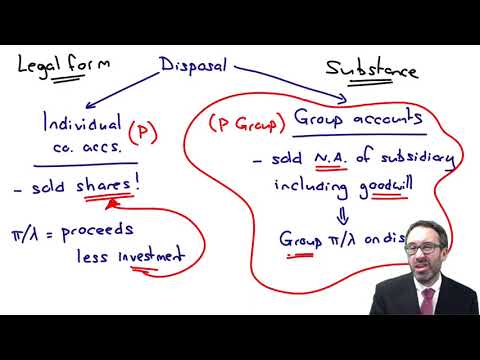
A group structure can change if the parent company sells the shares in an entity (subsidiary). At this level only the full disposal of a subsidiary is examinable, whereby the parent has control and then following the disposal of shares no longer owns any further shares.
Control -> no control
Calculate a group profit or loss on disposal of the subsidiary.
The revenues and costs of the subsidiary must be consolidated up to the date of the disposal
(W) Group profit/loss on disposal
$m | |
Proceeds | X |
Add: non-controlling interest | X |
Less: net assets at disposal | (X) |
Less: goodwill | (X) |
Group profit or loss on disposal | X |
Socks owned 90% of Mogs before it decided to sell all of its investment on 31 December 2017 for $200 million. The non-controlling interest at that date was $15 million.
The goodwill on acquisition was $38 million and the net assets at the date of disposal were $150 million.
Calculate the group profit on disposal that will appear in the group financial statements of Socks group for the year-ended 31 December 2017.
Show answerHide answer
Exam standard question – Profit attributable to the equity holders of the parent
Romeo acquired 90% of the equity share capital of Juliet on 1 July 2020. Juliet sold $5m of goods on 31 October 2020 making a profit of $2m. One quarter of these goods remain in inventory at the reporting date.
For the year-ended 31 December 2020, Romeo made profits of $85,600,000 and Juliet made profits of $25,400,000.
Calculate the profit attributable to the equity shareholders of Romeo to appear in the consolidated statement of profit or loss for the year ended 31 December 2020.
Consolidated statement of profit or loss
10 questionsAnswer the questions one at a time. Your progress is saved so you can leave and come back.
Open chapter practice