Skip to contentSkip to search

Associates (IAS 28)

VIVA Subject Guide
YouTube video

An associate is where an entity has significant influence over the associated company.

Significant influence is the power to participate in the financial and operating policy decisions. It is presumed that an investment of between 20% and 50% indicates the ability to significantly influence the investee.

Where an entity has significant influence, the investment is accounted for using equity method of accounting in the financial statements.

1 Group Statement of financial position – ‘Investment in associate’

The investment in associate is calculated as follows:

$

Cost of investment in A

X

Add: % of A’s post acquisition reserves

X

Less: impairment of goodwill

(X)

Investment in associate (NCA)

X

When an associate pays a dividend, the share of dividend paid is deducted from the investment in associate figure. This is done because the dividend payment is a reduction in the amount the parent has invested within the associate as the associate’s earnings have been redistributed in the form of the dividend payment.

Both adjustments in this working are the group's share only, but they are worked differently. If the shares were bought part way through the year, the share of profit is the group's percentage of the profit for the months since acquisition, not of the whole year's profit. The dividend is the group's share of the dividend the associate actually paid, and it is deducted — not added, and not ignored. The exam preparation question below shows both: 25% × 235,000 × 6/12 added, 25% × 40,000 deducted. A question can leave the carrying amount short or over by either of those two steps alone.

Example 1 – Associate (SFP)

Penny bought 30% of the equity share capital of Alex on 1 January 20X5 for $250,000. Alex’s profits for the year were $170,000.

An impairment review was carried out at the end of the year and the investment in Alex was found to be impaired by $20,000.

Calculate the investment in associate to appear in Penny’s financial statements at 31 December 20X5.

Show answerHide answer

$

Cost of investment in A

250,000

Add: 30% x 170,000

51,000

Less: impairment of goodwill

(20,000)

281,000

Exam preparation question – Investment in associate

On 1 June 20X3, S acquired 25,000 equity shares in A for $300,000. At the date of acquisition, A had in issue 100,000 $1 equity shares. A generated profits for the year of $235,000 and paid a dividend of $40,000.

Calculate the carrying amount of the investment in associate to appear in the group statement of financial position as at 31 December 20X3, assuming the profits accrue evenly during the year.

Show answerHide answer

Exam preparation solution – Investment in associate

$300,000 + (25% x 235,000 x 6/12) – (25% x $40,000) = $319,375

Example 2 – Group SFP incl. associate

Hartsop, a public limited company, operates in the retail sector. The draft statements of financial position at 31 December 2020 are as follows:

Hartsop
$m

Skiddaw
$m

Assets:

Non-current assets

Property, plant and equipment

1,560

1,250

Investments

1,540

3,100

1,250

Current assets

1,020

1,200

Total assets

4,120

2,450

Equity and liabilities:

Share capital

1,700

1,000

Retained earning

1,450

800

Total equity

3,150

1,800

Non-current liabilities

520

350

Current liabilities

450

300

Total liabilities

970

650

Total equity and liabilities

4,120

2,450

The following information is relevant to the preparation of the group financial statements:

On 1 January 2019, Hartsop acquired 70% of the equity interest of Skiddaw for a cash consideration of $1,340 million. At 1 January 2019, the identifiable net assets of Skiddaw had a fair value of $1,850 million, and retained earnings were $450 million. The excess in fair value is due to an item of property, plant and equipment that has a remaining useful life of 10 years.

It is the group policy to measure the non-controlling interest at acquisition at is proportionate share of the fair value of the subsidiary’s net assets.

On 1 July 2020, Hartsop acquired 25% of the equity interest of Angletarn for a cash consideration of $200 million. Angletarn’s profits for the year were $80 million, out of which a dividend of $20 million was declared on 31 December 2020. The 25% holding gives Hartsop the power to participate in the operating and financing decisions of Angletarn.

Prepare the group consolidated statement of financial position of Hartsop as at 31 December 2020.

Show answerHide answer

Hartsop

$m

Assets:

Non-current assets

Property, plant and equipment

(1,560 + 1,250 + (400 – 80) (W2))

3,130

Goodwill (W3)

45

Investment in associate (W6)

205

3,380

Current assets

(1,020 + 1,200)

2,220

Total assets

5,600

Equity and liabilities:

Share capital

1,700

Retained earnings (W5)

1,644

3,344

Non-controlling interest (W4)

636

Total equity

3,980

Non-current liabilities

(520 + 350)

870

Current liabilities

(450 + 300)

750

Total liabilities

1,620

Total equity and liabilities

5,600

Workings

W1)   Group Structure

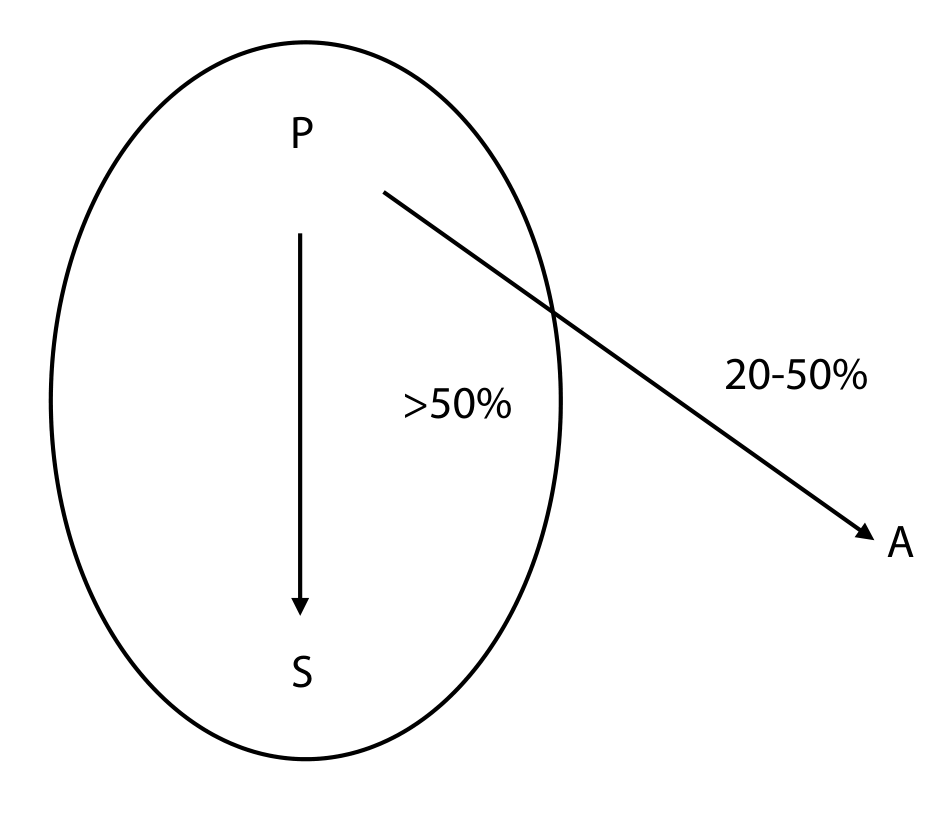
W1 Group structure: P, S (>50%) and A (20-50%)

W2)   Net assets of subsidiary

At reporting date

At acquisition

Post acquisition

Equity shares

1,000

1,000

SP

Ret. earnings

800

450

FV – PPE

400

400

Depreciation

(80)

-

2,120

1,850

270

W3)   Goodwill

FV of consideration (shares/cash/loan stock)

1,340

NCI at acquisition

(30% x 1,850)

555

1,895

FV of net assets at acquisition (W2)

(1,850)

Goodwill at acquisition

45

W4)   Non-controlling interests

NCI @ acqn (W3)

555

Add: NCI% x S’s post-acqn profits (W2)

(30% x 270)

81

636

W5)   Group retained earnings

100% P

1,450

Add: P’s % of S’s post acqn retained earnings (70% x 1,270(W2))

189

Add: P’s % of A’s post acqn retained earnings (W6)

10

Less: Dividend (W6)

(5)

1,644

W6)   Investment in associate

Cost

200

Add: P% x A’s post-acqn profits

(25% x 80 x 6/12)

10

Less: Dividend

(25% x 20)

(5)

205

2 Group Statement of profit or loss – ‘Share of profit of associate’

A share of profit of associate is calculated as shown below and shown as a single line item immediately before profit before finance and income taxes.

% of A’s profit for the year

X

Less: goodwill impaired during the year

(X)

X

NOTE: Any dividend received from the associate included in the parent’s dividend income within the investing section is removed when equity accounting.

3 Adjustments - group and associate

YouTube video

If there has been trading between the group and the associate, then any profit on inventory sold between the parties that is still held at the reporting date will need to be removed, however we adjust for the group share only.

If the parent sells to the associate:

Dr   Group retained earnings/Cost of sales

Cr   Investment in associate (reduce goods to cost to the group)

If the associate sells to the parent:

Dr   Group retained earnings/Share of profit of associate

Cr   Group inventory (reduce goods to cost to the group)

NOTE: The associate is considered to be outside of the group and so no adjustment is made for outstanding receivable/payable balances or sales/cost of sales as is seen when trading occurs between the parent and subsidiary.

Practice question

TR owns 20% of the equity share capital of BF and accounts for BF as an associate.

  • Goods purchased by TR from BF during the year: $200,000
  • Goods remaining in TR’s inventory at year end: 50%
  • BF’s mark-up on cost: 25%

Which journal entry should TR record in its consolidated financial statements for the unrealised profit?

Example 4 – Group SPL incl. associate

Helvellyn
$m

Scafell
$m

Revenue

1,645

1,280

Cost of sales

(1,205)

(990)

Gross profit

440

290

Operating costs

(190)

(120)

Operating profit

250

170

Interest expense on borrowings and lease liabilities

(55)

(30)

Profit before income taxes

195

140

Income tax expense

(35)

(30)

Profit

160

110

The following information is relevant in the preparation of the group financial statements:

On 1 January 2020, Helvellyn acquired 80% of the equity shares of Scafell, a public limited company, for a cash consideration of $90 million. The fair value of the identifiable net assets acquired was $85 million and the fair value of the non-controlling interest was $25 million. The fair value of the net assets at acquisition was not materially different to their book value.

On 1 June 2020 Helvellyn acquired 25% of the equity shares of Armboth and exerted significant influence through its representation on the board of directors. Armboth’s profits for the year were $200 million.

It is the group policy to measure the non-controlling interest at acquisition at fair value.

During the year, Helvellyn sold goods to Armboth for $40 million at a margin of 20%. At the reporting date Armboth still held half of the goods in inventory.

Goodwill has been impairment tested at year-end and found there to be no impairment in Scafell but the investment in Armboth has fallen by $ 1 million.

Assume that profits accrue evenly during the year.

Calculate the goodwill on acquisition of Scafell

Prepare a consolidated statement of profit or loss for the Helvelyn group for the year-ended 31 December 2020

Show answerHide answer

(a)   Goodwill

$’000

FV consideration

90

FV NCI

25

FV net assets @ acquisition

(85)

Goodwill @ acquisition

30

CONSOLIDATED STATEMENT OF PROFIT AND LOSS AND OTHER COMPREHENSIVE INCOME

P

S

Adj.

Group

Revenue

1,645

1,280

2,925

COS

(1,205)

(990)

(2,196)

PUP (P to A)

(1)

Gross profit

729

Operating expenses

(190)

(120)

(310)

Operating profit

419

Associate (25% x (200 x 6/12)) – 1 (impairment)

24

Profit before financing and income taxes

443

Interest expense on borrowings and lease liabilities

(55)

(30)

(85)

Profit before income taxes

358

Income tax expense

(35)

(30)

(65)

Profit

110

293

Parent (β)

271

NCI = 20% x 110

22

4 IAS 28 Associates

YouTube video

Other situations where significant influence exists are when the investor:

  • Representation on the board

  • Participation in policy making process

  • Material transaction between the two entities

  • Interchange of managerial personnel

  • Provision of essential technical information

Example 5 – Significant influence

Haycock has recently purchased financial interests in several companies.

How would each of the following purchases be accounted for?

Subsidiary

Associate

Investment

Purchase of 15% of the equity shares of Mosedal where all decisions are made at board level, but Haycock does not have any representation on the board.

Purchase of 19.9% of the equity shares of Glaramara where all decisions are made at board level and Haycock has appointed two of the five directors on the board.

Purchase of 45% of the equity shares of Birks where due to an agreement with the other shareholders, Haycock has the majority of the voting rights.

Purchase of 25% of the equity shares of Whinlatter with the remaining 75% owned by one shareholder that Haycock has no links with.

Purchase of 15% of the equity shares of Catbells, who Haycock provides essential technical information to on a regular basis during the year.

Show answerHide answer

Mosedal – investment as there is no significant influence as Haycock does not have any board representation.

Glaramara – associate as there is significant influence via the two directors of the five in total on the board.

Birks – subsidiary as there is control due to holding the majority of the voting rights.

Whinlatter – investment as there is no significant influence given that there is only one other shareholder with whom we have no links with at all.

Catbells – associate as there is significant influence due to the provision of essential technical information.

Practice questions

Associates (IAS 28)

10 questions

Answer the questions one at a time. Your progress is saved so you can leave and come back.

Open chapter practice