
Consolidated statement of financial position

1 GROUP ACCOUNTS
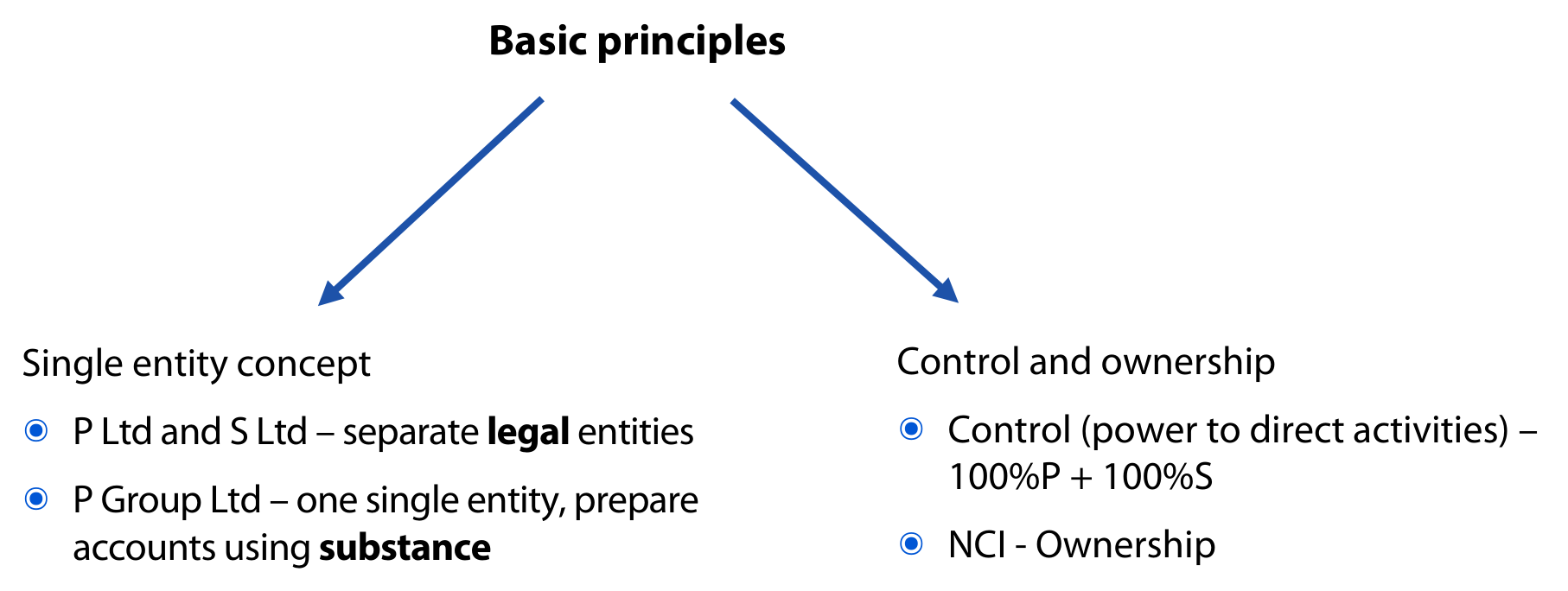
A parent is an entity that has one or more subsidiaries.
A subsidiary is an entity which is controlled by another entity (known as the parent).
The key concept in determining whether or not an investment constitutes a subsidiary is that of control.
Control is the power to govern the financial and operating policies of an entity so as to obtain benefit from its activities.
Control is usually achieved by the purchase of more than 50% of a company’s equity share capital.
IFRS 10 Consolidated Financial Statements defines control and tells us how to consolidate.
A parent/subsidiary relationship can exist even where the parent owns less than 50% of the voting power of the subsidiary since the key to the relationship is control and the power to direct the activities. Other situations where control exists are when the investor:
Can exercise the majority of the voting rights in the investee
Is in a contractual arrangement with others giving control
Holds < 50% of the voting rights, but the remainder are widely distributed
Holds potential voting rights which will give control
2 Subsidiary
A subsidiary is an entity that is controlled by another entity (parent).
An entity has control over an entity when it has the power to direct the activities, which is assumed to be when the entity has > 50% of the voting rights.
The parent company must prepare consolidated financial statement if it has control over one or more subsidiaries.
The underlying principles of consolidation are:
Substance over legal form
Control and ownership
3 Basic consolidation
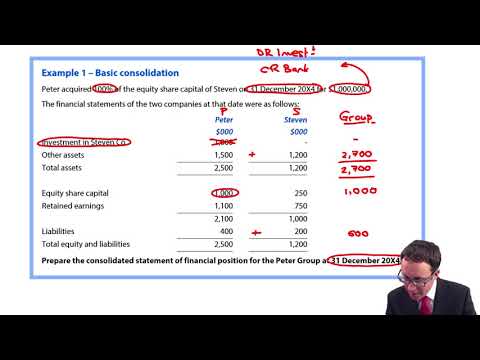
3.1 Basic steps
100% P + 100% S assets and liabilities, ignoring the investments in subsidiary
100% P share capital and share premium only (reporting to parent’s shareholders)
Retained earnings (balancing figure)
Basic consolidation
Peter acquired 100% of the equity share capital of Steven on 31 December 20X4 for $1,000,000.
The financial statements of the two companies at that date were as follows:
Peter | Steven | ||
Investment in Steven Co | 1,000 | - | |
Other assets | 1,500 | 1,200 | |
Total assets | 2,500 | 1,200 | |
Equity share capital | 1,000 | 250 | |
Retained earnings | 1,100 | 750 | |
2,100 | 1,000 | ||
Liabilities | 400 | 200 | |
Total equity and liabilities | 2,500 | 1,200 |
Prepare the consolidated statement of financial position for the Peter Group at 31 December 20X4.
Show answerHide answer
Basic consolidation (continued)
Following Peter’s acquisition of the 100% of Steven’s equity share capital of Steven on 31 December 20X4, both companies continued to trade. The financial statements of the two companies at the end of the following year 31 December 20X5 were as follows:
Peter | Steven | ||
Investment in Steven Co | 1,000 | - | |
Other assets | 1,900 | 1,450 | |
Total assets | 2,900 | 1,450 | |
Equity share capital | 1,000 | 250 | |
Retained earnings | 1,400 | 900 | |
2,400 | 1,150 | ||
Liabilities | 500 | 300 | |
Total equity and liabilities | 2,900 | 1,450 |
Prepare the consolidated statement of financial position for the Peter Group at 31 December 20X5.
Show answerHide answer
4 Non-controlling interest

Control is exerted through a shareholding of greater than 50%, so therefore it is not always necessary to fully own a subsidiary.
Shareholdings of 75% will still give the parent the power to direct the activities of the subsidiary and therefore it must prepare consolidated financial statements.
As the parent’s 75% holding still maintains control, the assets and liabilities of the subsidiary are consolidated 100% on a line-by-line basis.
It is necessary to account for 25% ownership interest in the subsidiary which is referred to as the non-controlling interest. It is shown in the equity section of the consolidated statement of financial position.
The non-controlling interest is measured using either of the following methods:
Proportionate share of net assets
Fair value
Non-controlling interest
Pierre acquired 80% of Stefan’s equity share capital on 31 December 20X4 when Stefan’s retained earnings were $750,000.
The financial statements of the two companies at the end 31 December 20X5 were as follows:
Pierre | Stefan | ||
Investment in Stefan Co | 800 | - | |
Other assets | 1,900 | 1,450 | |
Total assets | 2,700 | 1,450 | |
Equity share capital | 1,000 | 250 | |
Retained earnings | 1,200 | 900 | |
2,200 | 1,150 | ||
Liabilities | 500 | 300 | |
Total equity and liabilities | 2,700 | 1,450 |
Prepare the consolidated statement of financial position for the Pierre Group at 31 December 20X5 assuming the non-controlling interest is measured using the proportionate share of net assets method
Show answerHide answer
5 Goodwill
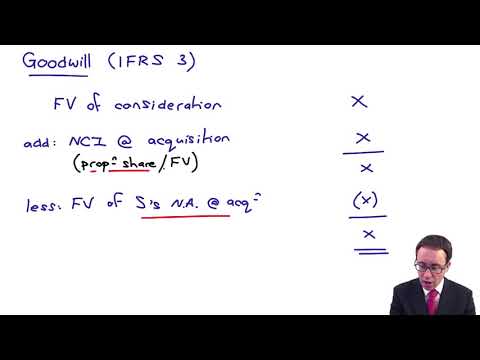
On acquisition of a subsidiary, the parent will usually pay more for the subsidiary than the value of the net assets (assets less liabilities). Why?
Customer loyalty
Good reputation
The difference between what the parent pays and what the net assets are truly worth is referred to as goodwill.
Goodwill
A parent company buys 75% of the equity shares in a subsidiary company for $156,000.
The remaining shares were valued at $52,000 and the net assets at acquisition were $170,000.
Calculate the goodwill arising on acquisition assuming that:
Non-controlling interest is measured using the proportionate share of net assets method
Non-controlling interest is measured using the fair value method.
Show answerHide answer
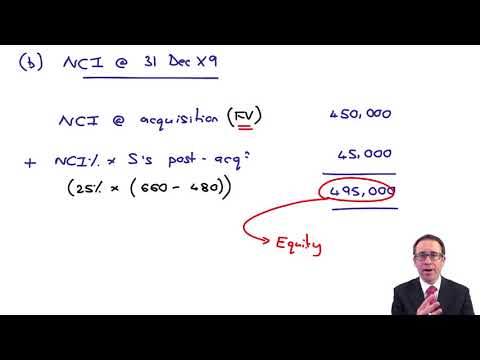
Basic consolidation (revision)
On 1 January 20X3 Gasta Co acquired 75% of the share capital of Erica Co for $1,380,000. The retained earnings of Erica Co at that date were $480,000. Erica Co's share capital has remained unchanged since the acquisition.
The following draft statements of financial position for the two companies have been prepared at 31 December 20X9.
Gasta Co | Erica Co | |
Investment in Erica Co | 1,380 | 0 |
Other assets | 4,500 | 2,400 |
Total assets | 5,880 | 2,400 |
Equity share capital | 2,000 | 1,000 |
Retained earnings | 2,040 | 660 |
4,040 | 1,660 | |
Liabilities | 1,840 | 740 |
Total equity and liabilities | 5,880 | 2,400 |
The non-controlling interest (NCI) was valued at $450,000 as at 1 January 20X3.
Required:
Calculate the goodwill arising on acquisition of Erica
Calculate the non-controlling interest at 31 December 20X9
Calculate the following figures which will be reported in Gasta’s consolidated statement of financial position as at 31 December 20X9.
(i) Investment
(ii) Other assets
(iii) Share capital
(iv) Retained earnings
(v) Liabilities
Show answerHide answer
Allocating an impairment of the goodwill depends upon whether the group uses the proportionate share of net assets method or the fair value method to value the non-controlling interest.
If the goodwill is measured under the fair value method then the impairment is split between the parent and the NCI based upon the ownership percentages as the goodwill consists of the parent’s goodwill and NCI goodwill. The journal entry would be as follows:
DR Group retained earnings – P’s % of the impairment
DR NCI – NCIs % of the impairment
CR Goodwill – 100% of the impairment
If goodwill is measured using the proportionate share method the goodwill calculated consists of the partial goodwill (P’s share) and the impairment is allocated entirely to the group retained earnings as there is no NCI share of goodwill.
6 Other components of equity
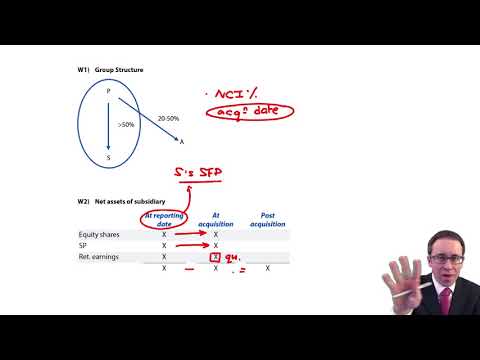
Each other component of equity (e.g. created by the upwards revaluation of PPE) has a separate calculation still based on ownership, so the calculation follows the same principles for that as the group retained earnings.
A subsidiary's revaluation surplus is treated exactly like its retained earnings: only the movement since acquisition is shared, and the balance the subsidiary already had at acquisition stays out of the group figure altogether. The group takes its own surplus in full plus its share of that post-acquisition movement, and the non-controlling interest takes its share of the same movement — leaving the non-controlling interest out of a revaluation is easy to do when the whole increase appears in one line of the subsidiary's own statement.
Group other components of equity
100% P | X |
Add: P’s % of S’s post acqn movement | X |
X |
7 Workings
W1) Group Structure
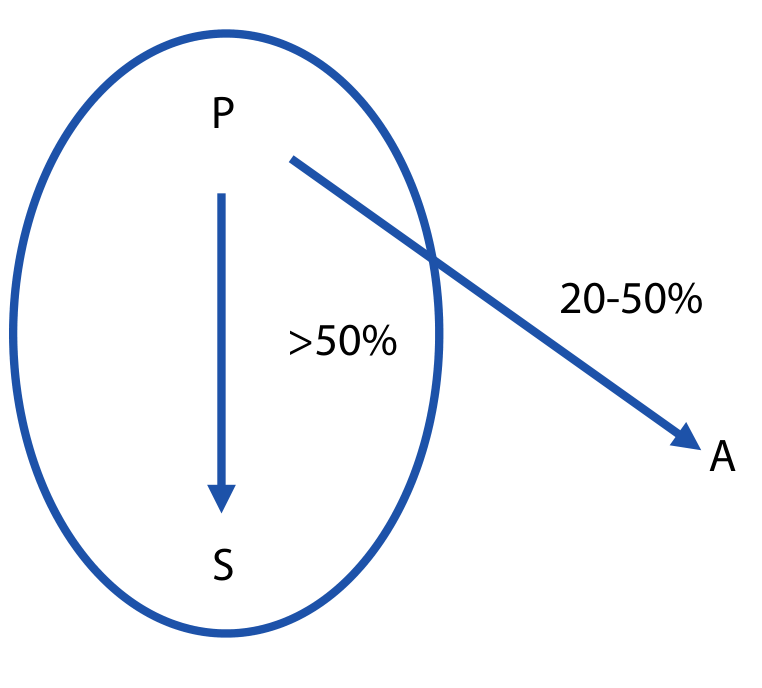
W2) Net assets of subsidiary
At reporting date | At acquisition | Post acquisition | |||
Equity shares | X | X | |||
SP | X | X | |||
Ret. earnings | X | X | |||
X | X | X |
W3) Goodwill
FV of consideration (shares/cash) | X |
NCI at acquisition | X |
X | |
FV of net assets at acquisition (W2) | (X) |
Goodwill at acquisition | X |
W4) Non-controlling interests
NCI @ acquisition (W3) | X |
Add: NCI% x S’s post-acqn profits (W2) | X |
X |
W5) Group retained earnings
100% P | X |
Add: P’s % of S’s post acqn retained earnings (P’s% x (W2)) | X |
X |

Workings
Matthews purchased 80% of Jones for $600,000 two years ago when Jones’s retained earnings showed a balance of $100,000.
Matthews | Jones | ||
Non-current assets | 1,000 | 500 | |
Investment in Jones | 600 | - | |
Current assets | 800 | 600 | |
Total assets | 2,400 | 1,100 | |
Equity share capital ($1) | 500 | 200 | |
Retained earnings | 800 | 400 | |
1,300 | 600 | ||
Liabilities | 1,100 | 500 | |
Total equity and liabilities | 2,400 | 1,100 |
Additional information:
Matthews measures the non-controlling interest using the fair value method.
The fair value of Jones’s equity shares acquired was $200,000 at acquisition
Prepare the consolidated statement of financial position for the Matthews group for the year-ended 31 December 20X5.
Show answerHide answer
Matthews Group | |
|---|---|
Non-current assets | 1,500 |
Goodwill (W3) | 500 |
Current assets | 1,400 |
Total assets | 3,400 |
Equity share capital ($1) | 500 |
Retained earnings (W5) | 1,040 |
1,540 | |
Non-controlling interest (W4) | 260 |
1,800 | |
Liabilities | 1,600 |
Total equity and liabilities | 3,400 |
Workings
W1) Group Structure
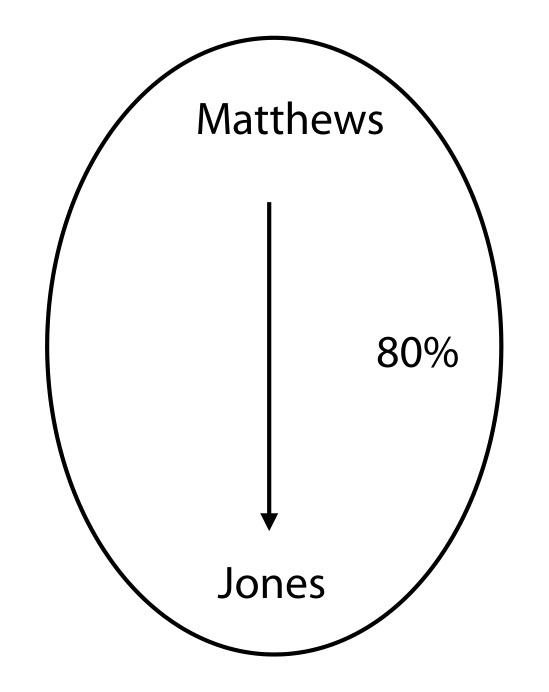
W2) Net assets of subsidiary
At reporting date | At acquisition | Post acquisition | |||
Equity shares | 200 | 200 | |||
Ret. earnings | 400 | 100 | |||
600 | 300 | 300 |
W3) Goodwill
FV of consideration (shares/cash) | 600 |
NCI at acquisition (FV) | 200 |
800 | |
FV of net assets at acquisition (W2) | (300) |
Goodwill at acquisition | 500 |
W4) Non-controlling interests
NCI @ acqn (W3) 200
Add: 20% x 300 (W2) 60
260
W5) Group retained earnings
100% P 800
Add: 80% x 300 (W2) 240
1,040
8 Adjustments – group and subsidiary
8.1 Intra-company balances
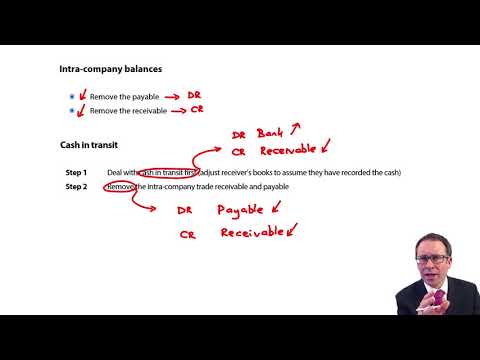
Remove the payable
Remove the receivable
8.2 Cash in transit
Step 1 Deal with cash in transit first (adjust receiver’s books to assume they have recorded the cash)
Step 2 Remove the intra-company trade receivable and payable
8.3 Inventory in transit
Dr Inventory (SFP) X
Cr Payables (SFP) X
8.4 Unrealised profits

Inventory PUP - Need to remove the intra-group profit included in inventory held @ year-end (cost structures)
Cr Inventory (SFP) X
Dr Retained earnings (of seller) X
If S is seller → Adjust (W2)
If P is seller → Adjust (W5)

Unrealised profits
Statements of financial position as at 31 December 20X5
James | Molly | ||
$’000 | $’000 | ||
Non-current assets | |||
PPE | 900 | 500 | |
Investment in Molly | 800 | - | |
Current Assets | 700 | 600 | |
2,400 | 1,100 | ||
Share Capital | 500 | 200 | |
Retained earnings | 800 | 400 | |
Current liabilities | 1,100 | 500 | |
2,400 | 1,100 |
Additional information:
James bought 80% of the equity shares in Molly for $800,000 when the retained earnings were $150,000.
Non-controlling interest is measured using the fair value method.
The fair value of the non-controlling interest was $200,000 at the acquisition date.
During the year Molly sold goods to James at $120,000 based on a mark-up of 20%. Half of the goods remain in inventory at the year-end.
Prepare the James Group consolidated statement of financial position as at 31 December 20X5.
Show answerHide answer
James | |
$’000 | |
Non-current assets | |
PPE | 1,400 |
Goodwill (W3) | 650 |
Current Assets | 1,290 |
3,340 | |
Share Capital | 500 |
Retained earnings (W5) | 992 |
Non-controlling interest (W4) | 248 |
Current liabilities | 1,600 |
3,340 |
Workings
W1) Group Structure
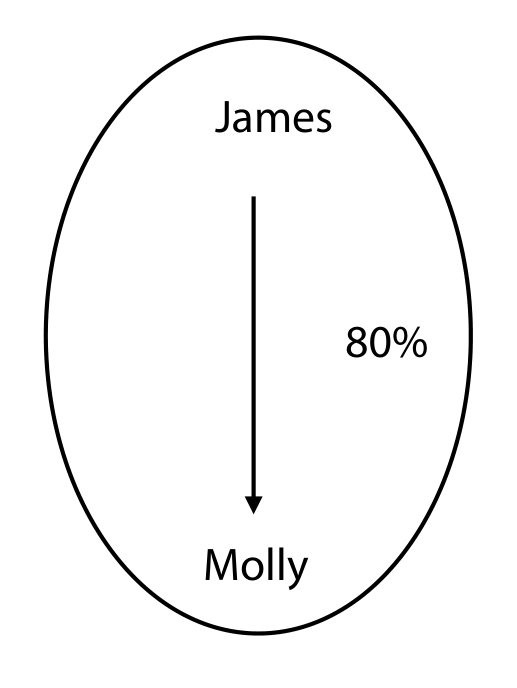
W2) Net assets of subsidiary
At reporting date | At acquisition | Post acquisition | |||
Equity shares | 200 | 200 | |||
Ret. earnings | 400 | 150 | |||
PUP | (10) | ||||
590 | 350 | 240 |
W3) Goodwill
FV of consideration (shares/cash) | 800 |
NCI at acquisition (FV) | 200 |
1,000 | |
FV of net assets at acquisition (W2) | (350) |
Goodwill at acquisition | 650 |
W4) Non-controlling interests
NCI @ acqn (W3) 200
Add: 20% x 240 (W2) 48
248
W5) Group retained earnings
100% P 800
Add: 80% x 240 (W2) 192
992
Non-current asset PUP - Need to remove the intra group profit on intra -company transfers of non-current assets
Cr PPE (CSFP) X
Dr Retained earnings (of seller) X
If S is seller → Adjust (W2)
If P is seller → Adjust (W5)


Fair value adjustments (IFRS 3)
Bring in FV of identifiable assets and liabilities on a line by line basis into the group SFP (PPE, inventory, contingent liabilities)
Adjust S’s net assets (W2) @ SFP date and @ acquisition column.
Adjust S’s net assets (W2) @ acqn column (extra depn, sale of inventory)
A parent company acquires a subsidiary at the start of the reporting period, where the fair value of the PPE is $50,000 higher than its book value and the remaining life of the PPE is 10 years.
The fair value adjustment is recorded within the workings at the end of the first year as follows:
(W2) Net assets of the subsidiary
At reporting date | At acquisition | Post acquisition | |
Equity shares | X | X | |
Ret. earnings | X | X | |
FV (PPE) | 50 | 50 | |
Extra depn. | (5) | ||
X | X | X |
And the fair value is also reflected on the face of the statement of financial position as follows:
Non-current assets
$000s | |
|---|---|
Property, plant and equipment (100% P + 100% S + 50 – 5) | X |
9 Other issues
9.1 Consideration
A parent may acquire a controlling interest in a subsidiary in other fashions as opposed to just a cash payment. Other considerations are as follows:
Share for share exchange
Deferred cash consideration
Contingent consideration
9.2 Share for share exchange

Calculate the number of subsidiary shares acquired
Calculate the number of P shares issued
Value the P shares issued
Record the journal entry
Share exchange
Harry acquired 80% of the 10 million ordinary $1 shares of Sally by offering a share exchange of one for every four shares acquired. The fair value of Harry’s shares is $3 per share.
Calculate the cost of investment for the acquisition and prepare the journal entry to record the share issue.
Show answerHide answer
9.3 Deferred consideration

A parent may agree to pay cash in the future following the acquisition of the subsidiary. This deferred consideration is recorded on acquisition at present value.
Deferred consideration
Pony acquired 80% of the 30 million $1 equity shares of Star on 1 January 20X5. The consideration was through the offer of a share exchange of two shares issued for every three shares acquired and a cash payment of $1 per share payable on 31 December 20X5. The fair value of the Pany’s equity shares was $2 at 1 January 20X5.
The present value of $1 received in one year’s time is $0.91 at a rate of 10%.
Calculate the cost of the investment in Star at 1 January 20X5
Show answerHide answer
The deferred consideration needs to be unwound to its final value and is done so using the interest rate originally applied to discount back the original entry and is recorded as follows:
Dr Finance cost
Cr Deferred consideration liability
NOTE: The adjustment does not impact the fair value of consideration.
9.4 Contingent consideration

Contingent consideration is cash to be paid by the acquirer at a point in the future that is dependent on conditions being met, i.e. subsidiary profits have increased by 10% since acquisition.
The contingent consideration is measured at fair value and this fair value would be given in the exam.
9.5 Mid-year acquisitions
Calculate the subsidiary’s retained earnings at acquisition, assuming subsidiary profits in the year accrue evenly.
9.6 Uniform accounting policies
Subsidiary must adopt the parents accounting policies in the group accounts. Accounted for by adjusting the value of assets/liabilities and (W2).
9.7 Coterminous year-ends
Financial statements within three months of the parents year-end can be used and adjusted for any significant events.
9.8 Non-consolidation
There is no grounds for a parent that has control of a subsidiary to not consolidate the subsidiary’s results. If the parent gains control of a subsidiary that it is then looking to dispose of and meets the criteria as a ‘held for sale’ it will treat the subsidiary under IFRS 5 within the consolidated accounts. If this subsidiary is then still part of the group after 12-months then it will be consolidated as normal from the acquisition date.
Consolidated statement of financial position
10 questionsAnswer the questions one at a time. Your progress is saved so you can leave and come back.
Open chapter practice