Skip to contentSkip to search

Provisions, contingent assets and contingent liabilities (IAS 37)

VIVA Subject Guide
YouTube video
The three conditions for recognising a provision

1 Measurement

YouTube video
  • Best estimate of expenditure

  • Expected values (various different outcomes)

  • Discount to present value if materially different
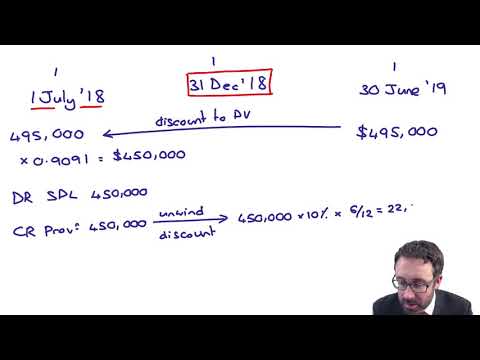
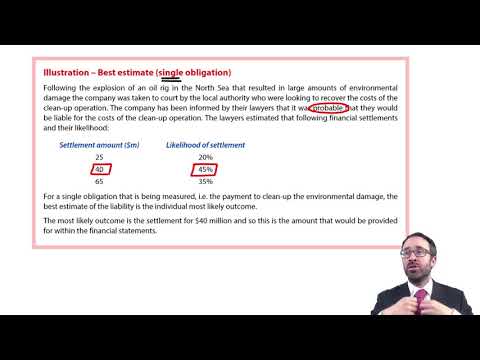
Illustration – Best estimate (single obligation)

Following the explosion of an oil rig in the North Sea that resulted in large amounts of environmental damage the company was taken to court by the local authority who were looking to recover the costs of the clean-up operation. The company has been informed by their lawyers that it was probable that they would be liable for the costs of the clean-up operation. The lawyers estimated that following financial settlements and their likelihood:

Settlement amount ($m)

Likelihood of settlement

25

20%

40

45%

65

35%

For a single obligation that is being measured, i.e. the payment to clean-up the environmental damage, the best estimate of the liability is the individual most likely outcome.

The most likely outcome is the settlement for $40 million and so this is the amount that would be provided for within the financial statements.

Illustration – Best estimate (large population)

A company sells second hand cars with a six-month warranty that promises to repair the cars if any faults occur following the sale. The company has estimated that 80% of the cars sold in the last six-months will require no repairs, however 15% will require minor repairs and the remaining 5% will require major repairs.

The company has estimated that if all the cars were to have minor repairs then this would cost $100,000 and if all the cars were to have major repairs then this would cost $500,000.

For a large population of items, the best estimate of the provision is based on an expected value of the possible outcomes. The expected value of the repair costs is $40,000 [(80% x $nil) + (15% x $100,000) + (5% x $500,000)] and so this is the amount that would be provided for within the financial statements.

YouTube video

Example 1 – Discounting and provisions

HR Co has a year end of 31 December 2018, and it was notified that on the 1 July 2018 a former employee brought about a legal claim for unfair dismissal. HR Co’s legal team have said that it is probable that that HR Co would lose the case, resulting in a payment of $495,000 on 30 June 2019.

HR Co has a cost of capital of 10% per annum. A one year discount factor at 10% is 0.9091.

Calculate the amounts to be recognised in the financial statements of HR Co for the year ended 31 December 2018

Show answerHide answer

The provision is initially recognised at its present value on 1 July 2018 of $450,000 (= $495,000 x 0.9091 (rounded to nearest $000)).

The provision is then unwound at 10% for six months to calculate the interest expense on provisions of $22,500 ($450,000 x 10% x 6/12)

SFP

SPL

$

$

Provision

472,500

Interest expense on provisions

22,500

Illustration – PPE and provisions

An item of PPE was acquired at a cost of $100m on 1 January 20X1, with a useful life of ten years. As part of local legislation, the PPE must be decommissioned the equipment at the end of the ten-year useful life. The current estimate decommissioning the PPE in ten years' time is $10m.

A cost of capital of 10% per annum is to be used to discount the $10m to present value. The present value of $1 receivable in ten years' time at a discount rate of 10% per annum is $0.386.

The accounting treatment of both the PPE and the provision at the end of the reporting period, 31 December 20X1, is as follows:

PPE

Initial cost = $110m ($100m + $10m)

Depreciation = $11m per annum ($110/10 years), to be recognised through profit or loss (SPL)

Carrying value = $99m ($110m - $11m), to be recognised on the statement of financial position (SFP)

Provision

Initial recognition (1 Jan 20X1) at present value = $3.86m (£10m x 0.386)

Finance cost = $0.386 ($3.86m x 10%), to be recognised through profit or loss (SPL)

Provision at the reporting date (31 December 20X1) = $4.246m ($3.86m + $0.386m), to be recognised on the statement of financial position

2 Subsequent treatment

  • Review the provision annually

  • Only use the provision for expense originally created

Illustration – Settlement of provision
A provision of $10 million was correctly provided for in the financial statements in the prior year based upon the information held at the reporting date. At the end of the current year the provision was settled for $12 million in cash.
The payment of the $12 million cash would reduce the provision down to zero and create an additional expense of $2 million in profit or loss (administrative expenses), being the difference between the amount provided for of $10 million and the amount settled of $12m.
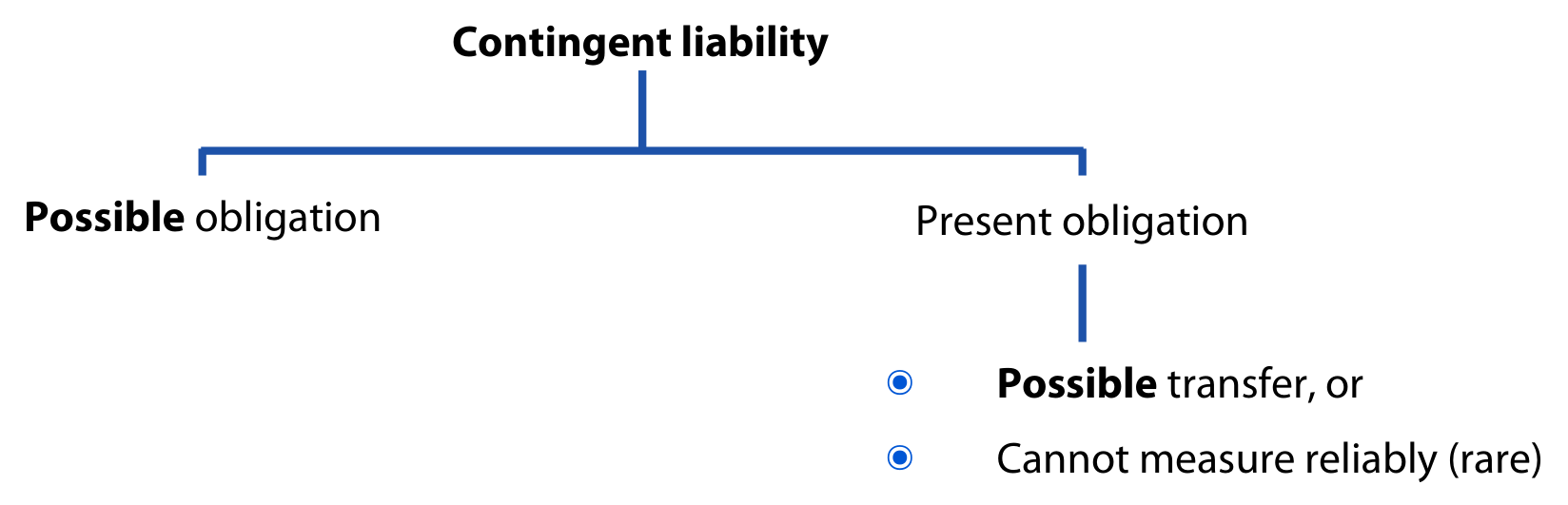
Contingent liability: possible obligation or present obligation

Practice question

G-Star Co is finalising its financial statements and must assess two matters under IAS 37:

1. It provides assurance-type warranties on its products. Experience indicates that about 5% of items sold will generate a valid warranty claim.

2. A customer has sued G-Star Co for an alleged breach that occurred before the reporting date. Legal advisers assess an outflow as possible but not probable, and not remote.

What is the correct accounting treatment for these two matters?

Provisions and contingencies

Justina supplies fish to a local restaurant. In August 2009 she supplied the restaurant with some shell-fish, and now she has heard that some of the restaurant’s customers have suffered attacks of food-poisoning. The restaurant has claimed that this is because of Justina’s shell-fish, and has commenced a legal action against her.

Algirdas, a local solicitor who specialises in food-poisoning cases, has advised Justina that she has a 42% chance of losing the case, and that, if she does lose, she will probably have to pay $300,000 to settle the liability.

What is the nature of Justina’s liability, if any, and how should it be treated in her financial statements for the year ended 31 August, 2009?

Show answerHide answer

If she has a 42% chance of losing, then she must have a 58% chance of winning. It is, therefore, not probable that she has an obligation. No provision would be appropriate.

However, there is a possible obligation, arising from some past event, which may involve the outflow of economic resource.

The appropriate treatment in Justina’s financial statements for the year ended 31 August, 2009 would therefore seem to be to treat the matter as a contingent liability.

This involves:

  • a disclosure note of the past event,

  • the legal action outstanding,

  • an explanation of the uncertainties upon which the outcome depends, and

  • an estimate of the costs, were she to lose the case

3 Specifics

YouTube video

Future operating losses

No provision can be made for anticipated losses as there is no obligation.

Onerous contracts

An onerous contract is whereby the cost of fulfilling the contract exceed the benefits received from the contract (e.g. non-cancellable operating lease).

A provision is recognised at the lower of:

  • Present value of continuing under the contract, and

  • Present value of exiting the contract

Example 4 – Onerous contract

Daiva has a contract to buy 900 metres of cloth each month for $7 per metre. From each 3 metres of cloth she can make a dress which she can sell for $30. She also incurs labour costs of $4 per dress. Alternatively she can sell the cloth immediately for $6.25 per metre.

If she decides to cancel the cloth purchase contract without notice she must pay a cancellation penalty of $700, for each of the next two months.

In December 2009 the market price of dresses fell to $22.

She is considering ceasing production since she believes that the market will not improve.

There is 2 months notice stated in the contract in case of breach of a contract.

  1. Is there a present obligation?

  2. What will appear in respect of the contract in Daiva’s financial statements for the year ending 31 December, 2009.

Show answerHide answer

DR Bank

$675

DR Right of use asset

$555.56

CR Lease liability (PVFLP)

$625

CR PPE (CV)

$600

CR Gain on transfer (β)

$5.56

Or:

Gain (total) = 675 (proceeds) – 600 (CV) = 75

Gain (rights retained) = 75 x 625/675 = 69.44

Gain (rights transferred) = 75 – 69.44 = $5.56

Restructuring

  • Sale or closure of a line of business

  • Ceasing activities in a geographical location

  • Relocating activities

  • Re-organisation (management or focus of operations)

A provision is recognised if there is a detailed formal plan and the plan has been announced.

The provision only includes costs which are necessarily to be incurred and not associated with continuing activities.

It is the announcement that creates the obligation, not the decision. A board decision that has not been communicated leaves the entity free to change its mind, so there is nothing to provide for; once a detailed plan has been announced to the people affected, the entity has raised a valid expectation that it will act and a provision is required. The same reasoning makes an established, published policy — for example one allowing customers to return goods they no longer want — an obligation, even though the entity was never legally obliged to offer it.

YouTube video

Example 5 – Restructuring

On 18 August 2017 the directors of Paulius decided to close the Kaunas Factory.

  1. Assuming that no steps were taken to implement the decision and the decision was not communicated to any of those affected by the Statement of Financial Position date of 31 August, 2017 what is the appropriate accounting treatment?

  2. What would be the appropriate accounting treatment for the closure if a detailed plan had been agreed by the board on 26 August 2017, and letters sent to notify suppliers? The workforce in Kaunas has been sent redundancy notices.

Show answerHide answer

(a)   There is neither a legal nor constructive obligation, because no obligating event has yet occurred. The directors could change their minds, and decide to keep the Kaunas factory open. Therefore, no provision is appropriate.

(b)   There is a detailed plan, the impact of which has been communicated to suppliers and the workforce. Paulius has therefore raised the valid expectation in the minds of those affected. Although not a legal obligation, there is a constructive obligation arising from some past event, involving the probable outflow of economic resource. A provision is therefore appropriate in the amount which represents the best estimate of the costs of closing the Kaunas factory.

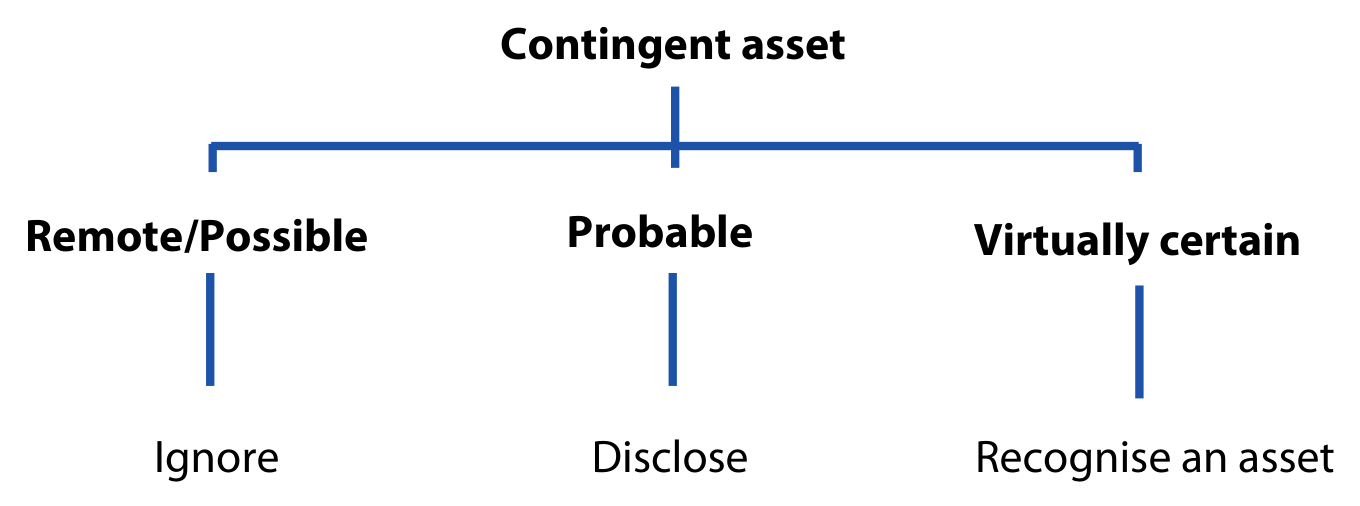
Contingent asset: remote/possible, probable, virtually certain
YouTube video

Illustration – Contingent asset

A business has a reporting date of 31 December and inventory worth $100,000 was stolen just prior to the reporting date. The business has made a claim on its insurance and has heard from the insurers who have said that it is probable that the full amount will be reimbursed, but no further confirmation of when any payment will be made has been received.

The business will disclose a contingent asset within the notes to the accounts as it is probable that the $100,000 will be received, however an asset cannot be recognised as it is not yet virtually certain as the final confirmation has not been received of when the payment will be received.

Practice questions

Provisions, contingent assets and liabilities (IAS 37)

10 questions

Answer the questions one at a time. Your progress is saved so you can leave and come back.

Open chapter practice