
Leases (IFRS 16)


IFRS 16 Leases is to be adopted for accounting periods starting on or after 1 January 2019. It can be adopted earlier but only if the entity has already adopted IFRS 15 Revenue from contracts with customers.
The new standard on leases is replacing the old standard (IAS 17) where the existence of operating leases meant that significant amounts of finance were held off the balance sheet. In adopting the new standard all leases will now be brought on to the statement of financial position, except in the following circumstances:
leases with a lease term of 12 months or less and containing no purchase options – this election is made by class of underlying asset; and
leases where the underlying asset has a low value when new (such as personal computers or small items of office furniture) – this election can be made on a lease-by-lease basis.
The accounting for low value or short-term leases is done through expensing the rental through profit or loss on a straight-line basis.
Low-value assets
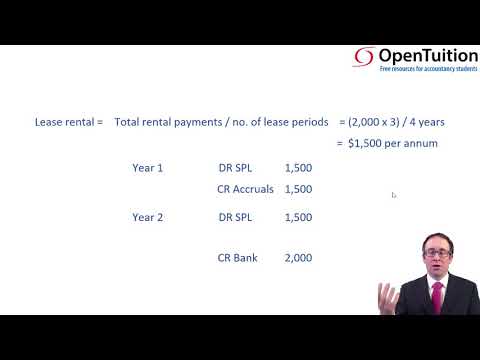
Banana leases out a machine to Mango under a four year lease and Mango elects to apply the low-value exemption. The terms of the lease are that the annual lease rentals are $2,000 payable in arrears. As an incentive, Banana grants Mango a rent-free period in the first year.
Explain how Mango would account for the lease in the financial statements.
Show answerHide answer
1 Lessee accounting

1.1 Initial recognition
At the start of the lease the lessee initially recognises a right-of-use asset and a lease liability. [IFRS 16:22]
Right of use asset | Lease liability |
Measured at the amount of the lease liability plus any initial direct costs incurred by the lessee. | Measured at the present value of the lease payments payable over the lease term, discounted at the rate implicit in the lease |
Lease liability | Fixed payments less incentives |
Note: if the rate implicit in the lease cannot be determined the lessee shall use their incremental borrowing rate |
1.2 Subsequent measurement
Right of use asset | Lease liability |
Cost less accumulated depreciation | Financial liability at amortised cost |
Note: Depreciation is based on the earlier of the useful life and lease term, unless ownership transfers, in which case use the useful life. |
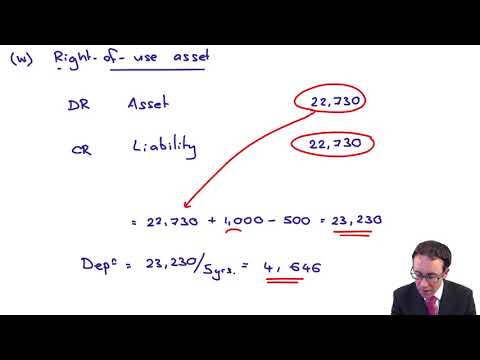
The right-of-use asset is depreciated over the shorter of the lease term and its useful life, unless ownership transfers at the end of the lease, in which case the useful life is used — Plum below leases a machine with a six-year life for five years, so five years. Watch the payment dates too, and read what the present value you are given covers. Where it includes the payment made on the first day, as in Plum, that payment is deducted first and interest is charged on the balance. Where it is the present value of the future payments only, as in the Peach illustration, the first payment is not in it, so interest is charged on that figure as it stands (3% × 14,868 = 446). Deducting the first payment from a figure that never included it takes it out twice.
Lessee accounting
On 1 January 2015, Plum entered into a five year lease of machinery. The machinery has a useful life of six years. The annual lease payments are $5,000 per annum, with the first payment made on 1 January 2015. To obtain the lease Plum incurs initial direct costs of $1,000 in relation to the arrangement of the lease but the lessor agrees to reimburse Plum $500 towards the costs of the lease.
The rate implicit in the lease is 5%. The present value of the minimum lease payments is $22,730.
Demonstrate how the lease will be accounted in the financial statements over the five year period.
Show answerHide answer
Exam questions on leases can prove to be tricky and the following illustration highlights where a subtle change in terminology can lead to difficulties. The key point to identify in this illustration is that the present value figure given is not for the total lease payments but of the future lease payments, i.e. those incurred after the commencement of the lease.
2 Sale and leaseback

A sale and leaseback transaction occurs when one entity (seller) transfers an asset to another entity (buyer) who then leases the asset back to the original seller (lessee).
The companies are required to account for the transfer contract and the lease applying IFRS 16, however consideration is first given to whether the initial sale of the transferred asset is a performance obligation under IFRS 15.
If the transfer of the asset is not a sale then the following rules apply:
Seller-Lessee | Buyer-Lessor |
Continue to recognise the asset | Do not recognise the asset |
Recognise a financial liability (= proceeds) | Recognise a financial asset (= proceeds) |
If the transfer of the asset is a sale then the following rules apply:
Seller-Lessee | Buyer-Lessor |
Derecognise the asset | Recognise purchase of the asset |
Recognise lease liability (PV of lease rentals) | Apply lessor accounting |
Recognise a right-of-use asset, as a proportion of the previous carrying value of underlying asset | |
Gain/loss on rights transferred to the buyer |

Sale and leaseback (1)
Apple required funds to finance a new ambitious rebranding exercise. It’s only possible way of raising finance is through the sale and leaseback of its head office building for a period of 10 years. The lease payments of $1 million are to be made at the end of the lease period
The current fair value of the building is $10 million and the carrying value is $8.4 million. The interest rate implicit in the lease is 5%.
Advise Apple on how to account for the sale and leaseback in its financial statements if the office building were to be sold at the fair value of $10 million and:
Performance obligations are not satisfied; or,
Performance obligations are satisfied.
Show answerHide answer
Note: Sale and leaseback transactions are only examinable where the asset is sold at fair value.

Sale and leaseback (2)
Pear acquired an item of machinery at a cost of $750,000 on 1 January 20X4. The machine had an estimated useful life of 10 years and no residual value.
On 1 January 20X6, the machine was sold at its fair value of $675,000 and leased back over 8 years. The present value of future lease payments has been calculated at $625,000.
Calculate the gain on the sale and leaseback to be recognised by Pear in the year-ended 31 December 20X6.
Show answerHide answer
Leases (IFRS 16)
10 questionsAnswer the questions one at a time. Your progress is saved so you can leave and come back.
Open chapter practice