Skip to contentSkip to search

Financial instruments (IFRS 9)

VIVA Subject Guide
YouTube video

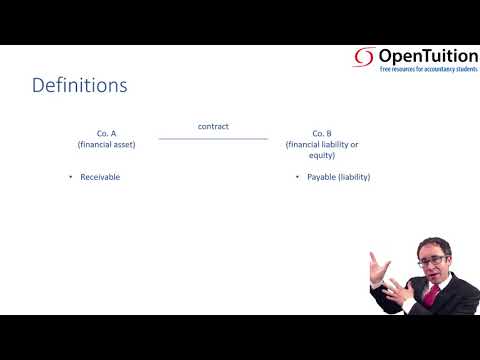
Company A

Company B

Financial asset

Financial liability, or equity

Purchase shares in co. B

→

Issues shares

Purchase co. B debt

→

Issues debt

Sells goods to B

→

Buys good from A

1 Financial assets

YouTube video

1.1 Initial measurement

  • Initially recognise at fair value including transaction costs, unless classified as fair value through profit or loss

1.2 Subsequent measurement

Equity instruments

Fair value through profit or loss (default)

  • Transaction costs are recognised immediately through profit or loss

  • Re-measure to fair value at the reporting date, with gains or losses through profit or loss

Fair value through other comprehensive income

If there is a strategic intent to hold the asset the option to hold at fair value through other comprehensive income is available. Re-measure to fair value at reporting date, with gains or losses through other comprehensive income.

Debt instruments

Amortised cost

A financial asset is measured at amortised cost if it fulfils both of the following tests:

  • Business model test – intent to hold the asset until its maturity date; and,

  • Contractual cash flow test – contractual cash receipts on holding the asset.

Fair value through other comprehensive income

The investment in debt can be classified as FVTOCI if the objective of the business model is to instead collect the cash receipts and sell the financial asset.

1.3 Derecognition

Financial assets are derecognised when sold, with gains or losses on disposal through profit or loss. Gains or losses previously recognised through other comprehensive income are transferred to retained earnings through the statement of changes in equity.

YouTube video
YouTube video

Financial assets

Norman has the following financial assets during the financial year.

  1. Norman bought 100,000 shares in a listed entity on 1 November 2015. Each share cost $5 to purchase and a fee of $0.25 per share was paid as commission to a broker. The fair value of each share at 31 December 2015 was $3.50.

  2. Norman bought 200,000 shares in a listed entity on 1 March 2015 for $500,000, incurring transaction costs of £40,000. Norman acquired the shares as part of a long term strategy to realise the gains in the future. The fair value of the shares was £620,000 at 31 December. The shares were subsequently sold for $650,000 on 31 January 2016.

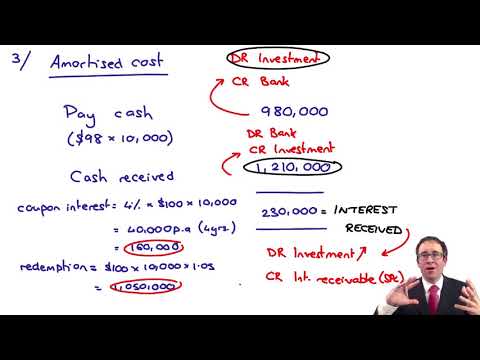
  3. Norman bought 10,000 debentures at a 2% discount on the par value of $100. The debentures are redeemable in four years’ time at a premium of 5%. The coupon rate attached to the debentures is 4%. The effective rate of interest on the debenture is 5.73%.

Explain how each of the above financial assets will be accounted for in the financial statements.

Show answerHide answer
  1. The investment in shares is initially recognised at $500,000 on the statement of financial position as an asset.

The transaction costs are recognised immediately through profit or loss as the shares are classified as fair value through profit or loss.

At the reporting date the shares are re-measured to their fair value of $350,000 on the statement of financial position.

A loss on the investment is recognised through profit or loss of $150,000.

  1. The investment in shares is initially recognised at $540,000 on the statement of financial position as an asset.

The transaction costs are included in the value of the asset as it is held strategically for the long-term and therefore classified as fair value through other comprehensive income.

At the reporting date the shares are re-measured to fair value of $620,000 on the statement of financial position.

The gain on the investment of $80,000 is shown through other comprehensive income.

On disposal of the shares a gain of $30,000 is recognised through profit or loss and the $80,000 held in other comprehensive income is transferred to retained earnings through the statement of changes in equity as a reserve transfer.

  1. The investment in debt is classified as amortised cost as there are contractual coupon interest receipts each year and the intent is to hold the asset until all the cash has been collected.

The investment in debt is initially measured at $980,000 on the statement of financial position.

The effective rate of interest is used to calculate the interest income each year. In the first year the interest income is $56,154 ($980,000 x 5.73%) and is recognised through profit or loss.

The cash receipts of $40,000 are used to reduce the value of the investment on the statement of financial position.

The investment in debt is held at $996,451 at the reporting date on the statement of financial position.

2 Financial liabilities

YouTube video

2.1 Initial measurement

  • Initially recognise at fair value less transaction costs (‘net proceeds’)

2.2 Subsequent measurement

  • Amortised cost

  • Fair value though profit or loss

2.3 Derecognition

  • Financial liabilities are derecognised when they have been paid in full or transferred to another party.

Financial liabilities

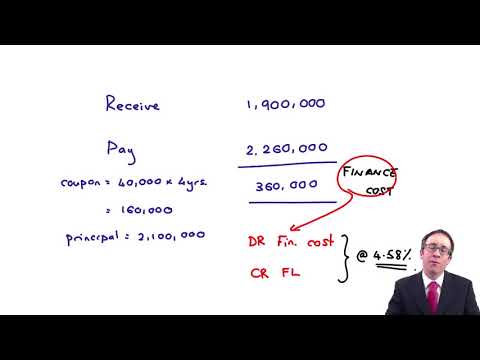
Norma issues 20,000 redeemable debentures at their $100 par value, incurring issue costs of $100,000. The debentures are redeemable at a 5% premium in 4 years’ time and carry a coupon rate of 2%. The effective rate on the debenture is 4.58%.

Calculate the amounts to be shown in the statement of financial position and statement of profit or loss for each of the four years of the debenture.

Show answerHide answer

SPL

Year 1

Year 2

Year 3

Year 4

Interest expenses on borrowings and lease liabilities

87

89

91

93

SFP

Year 1

Year 2

Year 3

Year 4

2% debentures (W)

1,947

1,996

2,047

-

Working

Year

B/f

Interest

(4.58%)

Cash

C/f

1

1,900

87

(40)

1,947

2

1,947

89

(40)

1,996

3

1,996

91

(40)

2,047

4

2,047

93

(2,140)

-

3 Convertible debentures

YouTube video

If a convertible instrument is issued, the economic substance is a combination of equity and liability and is accounted for using split equity accounting.

The liability element is calculated by discounting back the maximum possible amount of cash that will be repaid assuming that the conversion doesn’t take place. The discount rate to be used is that of the interest rate on similar debt without and conversion option.

The equity element is the difference between the proceeds on issue and the initial liability element.

The liability element is subsequently measured at amortised cost, using the interest rate on similar debt without the conversion option as the effective rate. The equity element is not subsequently changed.

The split is done once, at issue, and the equity element is then left alone. If a question tells you the whole of the proceeds has already been credited to equity, or to a reserve, the entry required is the correcting one — moving the liability element out of equity and into financial liabilities — and not the initial recognition entry written out again. Getting that the wrong way round moves debt and equity in opposite directions and takes any gearing calculation with it.

Convertible debentures

Alice issued one million 4% convertible debentures at the start of the accounting year at par value of $100 million.

The rate of interest on similar debt without the conversion option is 6%.

Explain how Alice should account for the convertible debenture in its financial statements for each of the three years.

Show answerHide answer

Alice is required to account for the convertible debentures on initial recognition based on substance and using split equity accounting.

The liability is calculated on the assumption that there is no conversion option on the debt, so essentially treated as a 100% loan redeem for cash. The initial liability is recognised at the present value of the future cash flows, discounted at the rate of interest on similar debt without the conversion option.

This gives a figure of $94.7 million (see working below).

The difference between the liability and the net proceeds is recognised within equity at $5.3 million.

The subsequent accounting treatment of the debt is at amortised cost, whilst the equity balance is not adjusted until conversion takes place in the future.

Working

Year

Cash flow

($m)

DF

(@ 6%)

PV

($m)

1

4

(4% coupon x $100 million (par))

0.943

3.772

2

4

0.890

3.56

3

104

($4m plus $100 million (par at redemption)

0.840

87.36

94.692

=$94.7 million

4 Disclosure (IFRS 7)

YouTube video

Financial instruments, particularly derivatives, often require little initial investment, though may result in substantial losses or gains and as such stakeholders need to be informed of their existence. The objective of IFRS7 is to allow users of the accounts to evaluate:

  • The significance of the financial instruments for the entity’s financial position and performance

  • The nature and extent of risks arising from financial instruments

  • The management of the risks arising from financial instruments

Nature and extent of financial risks

Financial risk arising from the use of financial instruments can be defined as:

  • Credit risk

  • Liquidity risk

  • Market risk

Disclosures with regards to these risks need to be both qualitative and quantitative.

Exam preparation question 1 – Financial liability

Extracts from the trial balance of Noreen Co at 31 December 20X8 are as follows:

$000

$000

Retained earnings as at 31 December 20X7 (draft)

1,250

Proceeds of the 4% loan notes

4,000

Interest paid

160

Noreen Co issued loan notes with a coupon rate of 4% on 1 January 20X8 at their face value of $4m. $200,000 of direct costs related to the issue were incurred and charged to profit or loss. The loan will be redeemable in five years’ time at a substantial premium which gives an effective rate of 7%. The annual repayments of are paid on 31 December each year.

Required

Prepare extracts from the statement of financial position as at 31 December 20X8.

Prepare a schedule of adjustment that must be made to Noreen’s draft retained earnings as a result of any adjustments related to the loan notes.

Show answerHide answer

Exam preparation solution 1 – Financial liability

Statement of financial position as at 31 December 20X8

$’000s

Equity

Retained earnings (b)

1,184

Non-current liabilities

4% loan notes (W)

3,906

Adjustments to retained earnings

$

Draft retained earnings

1,250,000

Issue costs

200,000

Interest

(266,000)

1,184,000

Workings

b/f

Interest (@7%)

Coupon

c/f

3,800,000

266,000

(160,000)

3,906,000

(=4,000,000 – 200,000)


Exam preparation question 2 – Convertible debentures and the SOCIE

The following extracts from the trial balance have been taken from the accounting records of Henderson Co as at 31 March 20X8:

Dr

$

Cr

$

Equity shares ($1)

35,000,000

Share premium

7,500,000

Retained earnings at 31 March 20X7

5,600,000

Dividends paid

275,000

The following notes are relevant:

  1. During the year it was discovered that fraudulent financial reporting had been carried out by the financial controller, which had previously been undetected. The auditors have discovered that trade receivables of $0.9m have been found to be not existent and are required to be written off. Of the $0.9m total balance, $0·2m relates to the year ended 31 March 20X8, with $0.7m relating to earlier periods.

  2. The equity shares and share premium balances in the trial balance extract include a fully subscribed 1 for 4 rights issue at $1.50 per share. The rights issue took place on 1 January 20X8 when the market value of the shares was $2.10.

  3. On 1 April 20X7, Henderson Co issued $10m 4% convertible loan notes. The conversion terms are that on 31 March 20X9, one share can be converted for every $2 of loan notes held. Similar loan notes, without the conversion option, incur interest at 6%. Interest is payable annually in arrears.

Relevant discount rates are as follows:

Present value of $1 in:

4%

6%

1 year

0.962

0.943

2 years

0.925

0.890

  1. Henderson Co’s profit for the year is showing on the statement of profit or loss for the year-ended 31 March 20X8 as $448,000.

Required
Prepare a statement of changes in equity for Henderson Co for the year ended 30 June 20X8.

Show answerHide answer

Exam preparation solution 2 – Convertible debentures and the SOCIE

Share
capital
$

Share
premium
$

Retained
earnings
$

Convertible
option
$


Total
$

31 March 20X7

28,000,000

4,000,000

5,600,000

37,600,000

Prior year error

(700,000)

(700,000)

Restated balance

4,900,000

36,900,000

Share issue (W1)

7,000,000

3,500,000

10,500,000

Profit for the year

448,000

448,000

Dividend

(275,000)

(275,000)

Convertible option (W2)

366,800

366,800

31 March 20X8

35,000,000

7,500,000

5,073,000

366,800

47,939,800

Workings

  1. Share issue

Closing no. shares (total)

35,000,000

No. shares after

5

Total number of shares issued (1/5 x 35,000,000)

7,000,000

No. shares issues

(1 for 4)

1

Opening no. shares (total)

28,000,000

No. shares before

4

Share capital = 7,000,000 x $1 = $7,000,000

Share premium = 7,000,000 x $0.50 = $3,500,000

  1. Convertible debt

- PV of debt

CF

$

Discount rate

PV

$

X8 (coupon interest at 4%)

400,000

0.943

377,200

X9 (coupon interest at 4% plus principal of $10m)

10,400,000

0.890

9,256,000

9,633,200

- Equity option

$

Proceeds

10,000,000

PV of debt

9,633,200

Equity option (β)

366,800

Exam preparation question 3 – Financial asset

On 1 January 2020 Norbert purchased a four-year loan note at a discount of 10% to its par vale of $10m. The coupon rate attached to the loan note is 3% and the interest is received annually in arrears. Using the amortised cost method of accounting for the loan note yields an effective rate of 6%.

Required
Calculate the interest income in the statement of profit or loss for the year ended 31 December 2021.

Show answerHide answer

Exam preparation solution – Financial asset

Interest income = $554,000 (nearest $’000)

b/f

Interest income

(6%)

Interest received

(3%)

c/f

31 Dec 2020

9,000

540

(300)

9,240

31 Dec 2021

9,240

554

(300)

9,494

Practice questions

Financial instruments (IFRS 9)

10 questions

Answer the questions one at a time. Your progress is saved so you can leave and come back.

Open chapter practice