
Relevant cash flows for DCF

1 Introduction
In the previous chapter we looked at the arithmetic involved in investment appraisal using the Discounted Cash Flow approach.
However, the main problem in examination questions is arriving at the cash flows in the first place. In this chapter we will consider how to establish the cash flows of investments in order to be then able to apply the DCF techniques.
2 Relevant costs
The general rule is that we are interested in all future, incremental (or extra), cash flows to the company as a result of undertaking the investment.
We are not interested in the following:
money already committed (or sunk costs)
historic costs
non-cash flows (especially depreciation)
book values
interest costs (because these are dealt with by the discounting)
We are interested in both direct and opportunity cash costs and revenues.
Direct costs are those costs directly related to the investment e.g. the new machine will incur running costs of $10,000 p.a..
Opportunity costs are costs that occur elsewhere in the company due to acceptance of an investment e.g. buying a new machine will result in losing revenue of $10,000 p.a. that is currently being earned by the company from another machine.

A research project which to date has cost the company $150,000 is currently under review.
If the project were allowed to proceed, it will be completed in approximately one year, when the results would be sold to a government agency for $300,000.
Shown below are the additional expenses which the managing director estimates will be necessary to complete the work.
Materials:
The materials required have just been purchased at a cost of $60,000. They are toxic and, if not used in this project must be disposed of at a cost of $5,000.
Labour:
Skilled labour is hard to recruit. The workers concerned have been transferred to this project from a production department, and the production manager claims that if the men were returned to him they could generate sales of $150,000 in the next year. The prime cost of these sales would be $100,000 including $40,000 for the labour cost itself. The overhead absorbed into this production would amount to $20,000.
Research staff:
It has already been decided that when work on this project ceases, the research department will be closed. Research wages for the year are $60,000, and redundancy and severance pay has been estimated at $15,000 now, or $35,000 in one years time.
Equipment:
The project utilises a special microscope which cost $18,000 three years ago. It has a residual value of $3,000 in another two years, and a current disposal value of $8,000. If used in the project it is estimated that the disposal value in a years time will be $6,000.
Share of general building services:
The project is charged with $35,000 p.a. to cover its share of general building expenses. Immediately the project is discontinued, the space occupied by the project could be sub-let for an annual rental of $7,000.
Advise the managing director as to whether or not the project should be allowed to proceed, explaining your reasons for the treatment of each item.
(Ignore the time value of money)
3 Working capital
It is very common in questions to be told that in addition to the cash needed to buy a machine, cash is also needed immediately to finance working capital requirements.
The working capital requirements relate to such things as the carrying of inventory of raw materials and the financing of receivables resulting from the sales.
Unless told differently, we always assume that the working capital results in a cash outflow at the time it is needed, that the requirement remains for the life of the investment, but that it is released (and therefore results in a cash inflow) at the end of the project.
Note that in several recent exam questions the examiner has stated within the question that the machine in question will be replaced at the end of its life. This implies that the product will still continue to be made and that therefore the working capital will still be needed. In this case you should not recover the working capital at the end of the project.
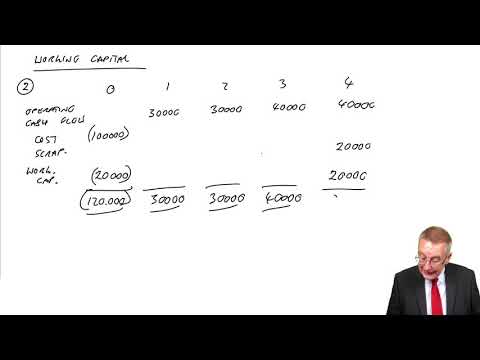
A machine costs $100,000 to purchase. In addition a further $20,000 working capital will be required at the start of the project.
The project is expected to last 4 years and to have a scrap value of $20,000 at the end of its useful life.
Net operating cash flows are expected to be $30,000 p.a. for the first two years and $40,000 p.a. for the following two years.
All operating flows are to be assumed to occur at the ends of year.
Calculate the net cash flow for each of the years in question (you are not required to discount or arrive at an investment decision).
A machine costs $15,000 and is expected to last for 4 years with a scrap value of $2,000 at the end of 4 years.
The sales revenue and operating costs for each of the 4 years have been estimated as follows:
Year | 1 | 2 | 3 | 4 |
Sales revenue | 5,000 | 11,000 | 8,000 | 9,000 |
Operating costs | 2,000 | 2,000 | 2,000 | 2,000 |
Working capital of 10% of the years revenue is required at the start of each year
Calculate the net cash flow for each of the years in question.
4 Taxation
If a company undertakes a new investment which generates higher profits, then there will be extra tax payable as a result. This extra tax payable is an extra cash flow resulting from the project and therefore needs including on our table of cash flows. (Note that if a new investment were to make a loss, then the company would as a result pay less tax than before. This tax saving is effectively a cash receipt (or cash inflow) resulting from the project.)
There are two tax effects on our appraisal.
In each year, any extra profit will result in extra tax payable.
Additionally, the initial capital investment will result in additional capital allowances being available to the company which will result in less tax payable (a tax saving).
In the examination you will be told the rate of tax, when the tax is payable and also the way in which capital allowances are given. Your task is to read the question carefully, perform the relevant calculations, and include the resulting tax cash flows in your table of cash flows.
When dealing with tax in this examination we make the following simplifying assumptions:
tax is calculated on operating cash flows (in practice it is on adjusted operating profits)
there is no advance tax payable
there is no tax on working capital (either the outflow or the inflow)
there is no ‘pool’ of assets for capital allowance calculations – capital allowances are calculated in isolation for the investment in question
no other taxes are relevant (e.g. capital gains tax)
An investment produces two tax flows and they are worked out separately. The extra operating cash flow attracts extra tax at the given rate; the capital allowances produce a tax saving, and it is the saving — the allowance multiplied by the tax rate — that goes in the cash flow table, never the allowance itself. Take the timing from the question as well: tax is payable a year in arrears only where the question says so.

A company has a year end of 31 December each year.
It is considering the purchase of a new machine on 1 January 2003 at a cost of $10,000.
The machine is expected to generate net operating cash flows of $5,000 during the first year , $7,000 during the second year, and $8,000 during the third year.
It is intended to sell the machine at the end of the third year for $6,000.
Additional working capital of $1,000 will be required at the start of the project.
Corporation tax is 30% payable one year in arrears.
Capital allowances are available at 25% p.a. on a reducing balance basis.
The cost of capital is 10%
Calculate the NPV of the project and advise as to whether it should be accepted or rejected.
5 Inflation
In order to calculate an NPV we need to estimate the cash flows which we expect will occur for each year of the investments life.
In practice (and, more importantly, in the examination) it is often the case that some cash flows would be expected to be constant each year were it not for the effect of inflation. E.g. we might need to pay rent for new premises of $10,000 each year. We do not expect to need different premises and therefore the rent would remain at $10,000 for each year subject to inflationary increases.
As a result it is often the case that future cash flows are quoted at the current amount together with an estimate for inflation. E.g. rent of $10,000 p.a. inflating at 5% p.a..
For our DCF calculations we need to discount the actual forecasted cash flows, and therefore it is often necessary for us to do the arithmetic inflating the cash flows by the rate of inflation in order to complete our cash flow table.
Inflate item by item, and compound. A cost given at today’s price and rising 5% a year is that price times 1.05 in year 1, times 1.05 twice in year 2, and so on; each cost carries its own rate, so the selling price, the materials and the labour are inflated separately rather than at one average. The working capital requirement behaves the same way — it rises each year with the revenue it supports, and only the increase is that year’s cash flow.
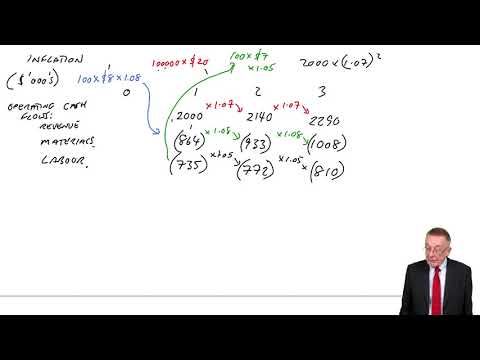
Ventspils plc are considering buying a new machine in order to produce a new product.
The machine will cost $2,800,000 and is expected to last for 3 years at which time it will have an estimated scrap value of $1,000,000
They expect to produce 100,000 units p.a. of the new product which will be sold for $20 p.u. in the first year.
Production costs p.u. (at current prices) are as follows:
Materials $8
Labour $7
Materials are expected to inflate at 8% p.a. and labour is expected to inflate at 5% p.a.
Fixed overheads of the company currently amount to $1,000,000. The management accountant has decided that 20% of these should be absorbed into the new product
The company expects to be able to increase the selling price of the product by 7% p.a.
An additional $200,000 of working capital will be required at the start of the project.
Capital allowances: 25% reducing balance
Tax: 25%, 1 year in arrears
Cost of Capital: 10%
Calculate the NPV of the project and advise as to whether or not it should be accepted.
6 Inflation – real rates

The method of dealing with inflation covered in the previous section is normally the most sensible and efficient approach, and is normally the approach expected in the examination. i.e. calculate the actual (or nominal) cash flows, and discount at the actual (or nominal) cost of capital.
However, very occasionally you might be presented with the situation where all flows are expected to inflate at the same rate of inflation. In these circumstances you can still use the method already discussed, but alternatively there is a ‘short-cut’ approach that can save time.
Instead of having to inflate each flow using the rate of inflation and then having to discount each at the cost of capital, the same result can be achieved by discounting the current price flows (or real cash flows) at an effective (or real) cost of capital.
The effective cost of capital is calculated using the formula:
(1 + i) = (1 + r) (1 + h)
where i = the actual cost of capital (the nominal rate)
r = the real cost of capital
h = the general inflation rate
(note that this formula is on the formula sheet provided in the examination - the Fisher formula)
A new machine will cost $120,000 and is expected to last 3 years with no scrap value.
It is expected that production will be 10,000 units p.a.
The selling price is $20 p.u. and the variable production costs $14 p.u. (both quoted in current prices).
Inflation is expected to be 5% p.a., and the cost of capital is 15% p.a..
Calculate the NPV of the project
inflating each flow to get the nominal cash flows, and discounting at the nominal cost of capital
discount the real (current price) flows at the real cost of capital
why, in theory, will the decision remain the same whatever the actual rate of inflation turns out to be.
Now read the following technical article available on the ACCA website:
“Advanced investment appraisal”
Relevant cash flows for DCF
10 questionsAnswer the questions one at a time. Your progress is saved so you can leave and come back.
Open chapter practice