
Discounted cash flow – further aspects

1 Introduction
This chapter deals with three specific situations of investment appraisal which are occasionally asked in the examination – capital rationing; replacement decisions; and, lease v buy decisions.
For each of these situations it is important to understand the nature of the problem and the way in which the standard techniques, which we have already covered, are applied.
2 Capital Rationing

Capital rationing is the term used to cover the situation when the company has limited funds available for investment. This can either be because there is only a limited amount available to be borrowed (hard capital rationing) or alternatively the company decides to itself place a limit on the amount that it is prepared to borrow (soft capital rationing).
The object of the exercise is to decide how best to invest a limited amount of capital available when there are several investments available.
The best solution will be the one giving the greatest total NPV.
The approach to be used depends on whether or not the projects are infinitely divisible.
2.1 Infinitely divisible projects
If projects are said to be infinitely divisible, it means that it is possible to invest in any fraction of a project (up to a maximum of 100% of the project). We also assume that if we invest in (say) 10% of a project then all the flows will be 10% of the full project flows and that therefore the resulting NPV will be 10% of the full project NPV.
The approach is as follows:
calculate the NPV per $ of initial investment (the profitability index)
rank the projects in terms of their profitability indexes
invest as much as possible in the project with the highest profitability index, then go to the project with the next highest, and so on until the capital available is exhausted.
2.2 Non-infinitely divisible projects
If projects are not infinitely divisible it is only possible to invest in whole projects.
In this situation there is no ‘quick’ method – the only approach is to look at all possible combinations of projects that are possible using the limited amount of capital available, and choose the combination that gives the highest total NPV.
A company has the following 4 projects available:
A | B | C | D | |
0 | (500) | (600) | (300) | (400) |
1 | 221 | 207 | 194 | 181 |
2 | 221 | 207 | 194 | 181 |
3 | 221 | 207 | – | 181 |
4 | – | 207 | – | – |
NPV @ 10% | 50 | 57 | 36 | 50 |
What should the company’s investment decision be if:
(a) There is no capital rationing
(b) Capital is restricted to $1,600 at time 0 and the projects are infinitely divisible
(c) Capital is restricted to $1,600 at time 0 and the projects are not infinitely divisible.
3 Replacement

We have looked in previous chapters at many examples where the decision was whether or not to invest in a new machine.
However, very often we may have decided to purchase a machine, but knowing that it will not last forever we have to decide how often to replace it.
For example, you might own a car which you expect will continue to work for 10 years before needing to be scrapped and replaced. However, the older it becomes the more expensive it will become to maintain and the lower price you will get for it when you sell it.
As a result, you may decide that it is better to replace it (say) every three years. By doing this you will avoid paying very high maintenance costs and will receive a higher sales price. The downside of course is that you would have to pay the price of a new one more frequently.
The purpose of the exercise is to determine the optimal replacement policy.
The approach will be illustrated using the following example.
A machine costs $72,000 and has a maximum life of 3 years.
The running costs each year are as follows:
Year | |
1 | 7,200 |
2 | 9,600 |
3 | 12,000 |
The estimated scrap values are as follows:
Year | |
1 | 24,000 |
2 | 16,600 |
3 | 9,600 |
The cost of capital is 15%
How often should the machine be replaced?
4 Lease versus Buy
When deciding whether or not an investment is worthwhile, we usually assume that we will be purchasing the asset.
However, having made the acquisition decision we could be required to consider financing the machine by way of leasing it rather than by outright purchase.
In order to make this financing decision we need to calculate the PV of the costs of buying the assets with the PV of the costs of leasing the asset. In both cases we will discount at the after-tax cost of borrowing and choose that method which gives the lower PV (and hence least cost).
Compare the two present values and stop there. An equivalent annual cost is the tool for the replacement problem earlier in this chapter, where the cycles being compared run for different numbers of years. A lease and a purchase set against each other over the same four years need no annual equivalent, and working one out earns nothing.
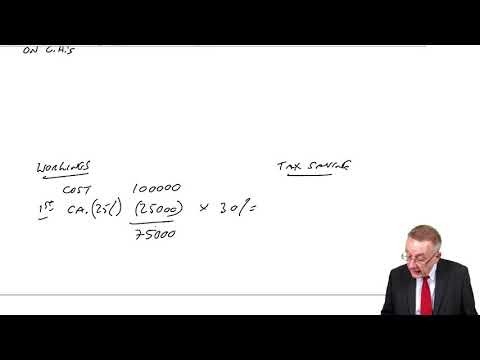
A company is considering whether to buy a new machine at a cost of $100,000 or alternatively to lease it for $35,000 p.a. (lease payments payable at the start of each year).
Buying it will involve borrowing money at an after tax interest cost of 7% p.a.
If the machine is bought, it will be bought on the last day of current financial year.
The machine will be needed for 4 years, and (if purchased) will have a scrap value after 4 years of $10,000.
Corporation Tax is 30% (payable one year after the end of the financial year)
Capital allowances are 25% (reducing balance).
Should the machine be leased or purchased?
Now read the following technical article available on the ACCA website:
“Equivalent annual costs and benefits”
DCF: further aspects (rationing, replacement, lease vs buy)
7 questionsAnswer the questions one at a time. Your progress is saved so you can leave and come back.
Open chapter practice