
Investment appraisal – methods

1 Introduction
In this and the following chapters we will be looking at how the Financial Manager should go about making capital investment decisions. For example, they may have to decide whether or not it is worthwhile investing $1,000,000 in a new factory. Alternatively they may have to make the choice between several available investments.
2 Discounted Cash Flow – Net Present Value

This approach looks at the expected cash flows from the investment in question. If over the life of the investment there is an expected cash surplus, then the project will be accepted, whereas if an expected cash deficit the project will be rejected.
To account for the fact that money will be tied up in the project over a period of years (and will therefore either result in interest being paid on money borrowed for the investment, or interest lost on the money invested), the cash flows are discounted at the cost of money (or cost of capital) to the company before calculating the net surplus or deficit and making the decision.
A machine will cost $80,000.
It has an expected life of 4 years with an anticipated scrap value of $10,000.
Expected net operating cash inflows each year are as follows:
1 20,000
2 30,000
3 40,000
4 10,000
The cost of capital is 10% p.a..
Calculate the Net Present Value of the investment and determine whether or not it should be accepted.
Make sure that you remember the terminology (discount factor; present values; net present value), and that you remember how to use the tables given in the examination for the discount factors.
Note that we usually assume that operating cash flows arise at the ends of years. In practice it is more likely that the flows are spread over each year, but assuming ends of years not only makes the arithmetic simpler, but also looks at a ‘worse-case scenario’ with regard to the timing.
In the previous example, what reservations might you have about your investment decision?
3 Discounted Cash Flow – Internal Rate of Return
One problem in practice with using a Discounted Cash Flow approach to investment appraisal is that it is virtually impossible to calculate accurately the Cost of Capital for a company.
In the previous example, we decided that using a Cost of Capital of 10% the project was worthwhile. However, suppose the Cost of Capital was not 10% but 11%. With a higher rate of interest we would expect the NPV to be lower. If still positive then we would still be happy to accept, but if it were negative then we should reject.
Even if it is positive at 11%, what about 12%? What about 13%?
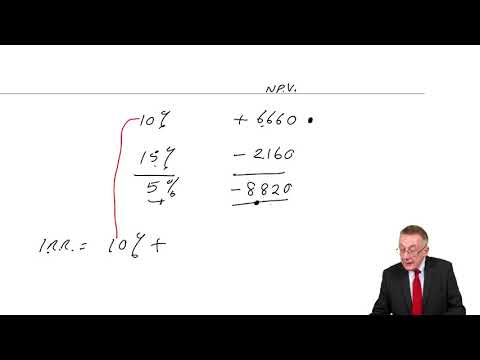
Because of the uncertainty regarding the Cost of Capital it would be useful to know the breakeven rate of interest i.e. the rate of interest at which the project would have an NPV of zero.
The rate of interest at which the NPV of the project is zero is known as the Internal Rate of Return (IRR).
In order to estimate the IRR, we calculate the NPV of the project at two different rates of interest and estimate a rate giving an NPV of zero assuming linearity. (In fact the relationship of the NPV to the rate of interest is not linear but curvilinear. However, the approximation resulting from an assumption of linearity is sufficient for our purposes.
For the project in example 1:
(a) Calculate the NPV of the project at an interest rate of 15%
(b) Estimate the IRR of the project using your results from part (a) and from Example 1.
(c) Interpret the result of (b).
4 Discounted Cash Flow – annuities and perpetuities

Most examples in the examination are like the one in example 1 - with differing cash flows each year, each of which needs to be discounted separately.
However, you will sometimes be presented with cash flows that are equal each year, in which case there is a faster and simpler approach to discounting.
An equal cash flow each year (e.g. $10,000 p.a. for 10 years) is known as an annuity.
If the annuity were expected to continue for ever, it is known as a perpetuity.
4.1 Annuities
The discount factor for an annuity may be calculated using the following formula:
Where:
r = discount rate
n = number of periods
However, it is rare in the examination to need to use the formula because tables are provided for annuity discount factors.
A machine will cost $45,000 and is expected to generate $8,000 for each of the following 8 years.
The cost of capital is 15% p.a..
Calculate the NPV of the investment.
The cost of capital is 12% p.a.
What is the present value of $20,000 first receivable in 4 years time and thereafter each year for a total of 10 years?
4.2 Perpetuities
Where r = rate of interest
(These are not provided in tables for you – you must remember the discount factor)
A machine costs $100,000 and is expected to generate $12,000 p.a. in perpetuity.
The cost of capital is 10% p.a.
What is the NPV of the project?
The rate of interest is 5%. p.a.
What is the present value of $18,000 first receivable in 5 years time and thereafter annually in perpetuity?
5 Other approaches to investment appraisal
In theory, the discounted cash flow approach is the best method of appraisal. This is because it considers the cash flows and the timing of these flows. It is cash that is needed to pay dividends to the shareholders, and cash that is needed to expand the company by the acquisition of new investments.
However, in practice, whatever may be best in theory, shareholders and managers will be interested in other things – in particular the effect that a new investment will have on the profits of the business.
For this reason, there are many other criteria employed for investment decisions in addition to (or instead of) discounted cash flow.
In your examination, you will be required almost always to use the DCF approach. However, do be aware of two other approaches that are common in practice – Accounting Rate of Return and Payback Period.
5.1 Accounting Rate of Return

This approach is an accounts based measure and considers the expected profitability of an investment.
The Accounting Rate of Return (ARR) is defined as:
The ARR is compared with a target rate of return to decide whether or not the investment is worthwhile.
The target rate of return will normally be the current Return on Capital Employed for the company.
A machine will cost $80,000.
It has an expected life of 4 years with an anticipated scrap value of $10,000.
Expected net operating cash inflows each year are as follows:
1 20,000
2 30,000
3 40,000
4 10,000
Calculate the ARR of the project.
5.2 Payback period
The payback period is defined as being the number of years it takes for a project to recoup the original investment in cash terms.
The payback period is compared with a target period – if the project pays for itself sooner then it should be accepted, if not then it should be rejected.
The payback period is useful when the future flows have a high level of uncertainty. The further into the future we are forecasting, then the more uncertain the flows are likely to be. By choosing projects with faster payback periods, we are more certain that the projects will indeed end up making a surplus.
Payback period and DCF techniques are often combined by calculating a discounted payback period – this involves discounting the cash flows and then calculating how many years it takes for the discounted cash flows to repay the initial investment.
Keep the three measures apart by what each one answers. Payback answers how long, in cash terms — it does not measure how profitable a project is, and it does not put a figure on the benefit of taking it. The accounting rate of return is the profit-based measure of the three, and the net present value is the one that gives the cash surplus the project is expected to add over its life.
A machine will cost $80,000.
It has an expected life of 4 years with an anticipated scrap value of $10,000.
Expected net operating cash inflows each year are as follows:
1 20,000
2 30,000
3 40,000
4 10,000
Calculate the payback period of the project.
Discounted cash flows (NPV, IRR, ARR)
10 questionsAnswer the questions one at a time. Your progress is saved so you can leave and come back.
Open chapter practice