
Management of working capital (1)

1 Introduction
The purpose of this chapter is to explain the nature of working capital and the importance of it to the financial manager. We will also consider various ratios and measures which may be useful to the financial manager in assessing how well it is being controlled.
2 What is working capital?
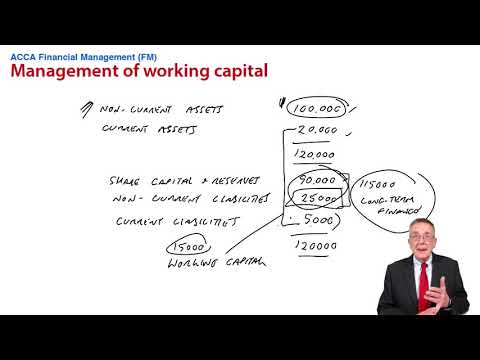
Working capital is the name given to net current assets which are available for day-to-day operating activities.
It normally includes inventories, receivables, cash (and cash equivalents), less payables.
Working capital = receivables + cash + inventory – payables
3 Investment in working capital
Working capital needs financing, just as does the investment in machines.
However, it is the investment in non-current assets that (hopefully!) earns profits for the company. Investment in working capital does not directly earn profits.
If this were the only consideration, then it would be better to invest all the finance available in non-current assets and to keep working capital to an absolute minimum.
On the other hand, all companies need some working capital in order to keep the business running
they need to allow customers to buy on credit ( and therefore have receivables) otherwise they would lose business to competitors.
they need to carry inventories of finished goods in order to be able to fulfil demand
they need to have a short-term cash balance in order to be able to pay their bills.
The company therefore faces a trade-off between profitability and liquidity, and it is up to the financial manager to decide on the optimal level of working capital and to ensure that it is managed properly.
4 The financing of working capital
Whatever level of working capital the business decides to hold, it has to be financed from somewhere.
The business must decide whether to use short-term or long-term finance.
Long-term finance is either raised from equity in the form of share issues etc., or from long-term borrowing.
Short-term finance generally involves overdraft borrowing and/or delaying payment to payables.
Short-term finance is often cheaper (although not always – interest rates on overdrafts can be very high, and delaying payment to payables can involve the loss of discounts).
However, short-term finance is risky as it is repayable on demand.
In the past it was generally thought that since working capital involved short-term assets it should be financed by short-term finance, whereas non-current assets – being long-term – should be financed by long-term finance.
A more modern view is that in fact the overall level of working capital remains fixed in the long-term (permanent working capital) and that there are day-to-day fluctuations above this permanent level (temporary working capital).
Permanent working capital, being long-term, should be financed by long-term sources of finance.
Temporary working capital should be financed by short-term sources of finance.
5 Working capital ratios
5.1 Liquidity ratios:
We would normally expect this to be > 1.
A current ratio of less than 1 could indicate liquidity problems.
The same idea as the current ratio, but without inventory on the basis that it is inventory that will take the longest time to turn into cash.
Clearly the Quick Ratio will be lower than (or equal to!) the Current Ratio, and a Quick Ratio of slightly less than 1 is not necessarily dangerous – it very much depends on the type of business.
5.2 Efficiency ratios:
This shows how quickly inventory is being sold
This shows how quickly debts are being collected
This shows how quickly payables are being paid
5.3 Problems with the use of ratios:
The use of statement of financial position is dangerous in that they represent only one point in time which may be unusual (due to, for example, seasonal factors)
There may be window-dressing
They only look at the past – not the future
They are of little value unless used in comparisons.
6 The Operating Cycle
The operating cycle (or cash operating cycle or working capital cycle) of a business is the length of time between the payment for materials entering into inventory and the receipt of the proceeds of sales.
It is useful to compare the operating cycle of a company from year to year, or with similar companies – a lengthening operating cycle will normally be cause for concern.
Every element of the cycle has its own base, and using one figure for all of them is where the marks go. Finished goods run on cost of sales, work in progress on the cost of production, raw materials on raw material purchases, receivables on credit sales and payables on credit purchases. Where the question gives you purchases, use them: cost of sales stands in only when a purchases figure is not available.
The table below gives information extracted from the annual financial statements of Management plc for the past year.
Management plc - Extracts from annual accounts
Inventories: raw materials | $108,000 |
work in progress | $75,600 |
finished goods | $ 86,400 |
Purchases of raw materials | $518,400 |
Cost of production | $675,000 |
Cost of goods sold | $756,000 |
Sales | $864,000 |
Receivables | $172,800 |
Payables | $ 86,400 |
Calculate the length of the working capital cycle (assuming 365 days in the year).
Solution
Days | ||||
1 | Receivables days | Average receivables | × 365 | |
Credit sales | ||||
2 | Inventory days | |||
(a) Finished goods | Average finished goods | × 365 | ||
Cost of sales | ||||
(b) W.I.P | Average WIP | × 365 | ||
Cost of production | ||||
(c) Raw material | Average raw material | × 365 | ||
Raw material purchases | ||||
LESS: | ||||
3 | Payables days | Average payables | × 365 | ( ) |
Credit purchases | ||||
Net operating cycle = | ||||
7 Overcapitalisation and Overtrading

Overcapitalisation is where the overall level of working capital is too high.
The solution is to reduce the level of working capital by better management of receivables, cash and inventory.
As a result the company will need less financing, or alternatively will have more finance available for profit-earning investment in non-current assets.
Overtrading (or under-capitalisation) is where the level of working capital is too low.
Consider the following example:
| A | B | C | D | |
|---|---|---|---|---|
| 1 | Current year | Next year | ||
| 2 | Non-current Assets | 500 | ||
| 3 | Current Assets | |||
| 4 | Inventory | 100 | ||
| 5 | Receivables | 200 | ||
| 6 | Cash | 50 | ||
| 7 | 350 | |||
| 8 | ||||
| 9 | Current liabilities | |||
| 10 | Payables | 150 | ||
| 11 | 200 | |||
| 12 | 700 | |||
| 13 | ||||
| 14 | Long term Capital | 700 |
The company intends to double in size over the next year. They raise $500 long-term capital and invest it all in fixed assets
In this situation the company has severe liquidity problems, even though they may well be trading very profitably.
The solution is to raise additional long-term finance. Assuming the company is trading profitably then this should be possible.
Working capital management
10 questionsAnswer the questions one at a time. Your progress is saved so you can leave and come back.
Open chapter practice