
The financial management environment


1 Introduction
One of the main areas of importance for the financial manager is the raising of finance.
In this chapter we look at the framework within which he operates and the institutions and markets that can help him in this respect.
2 Financial intermediation
Companies need to raise money in order to finance their operations. However, it is often difficult for them to raise money directly from private individuals and therefore they often turn to institutions and organisations that match firms that require finance with individuals who want to invest.
One example of a financial intermediary is a bank. They make loans to companies using the money that has been deposited with them by individuals.
2.1 The features of the service that they are providing are as follows:
Aggregation:
Individuals are each depositing relatively small amounts with the bank, but the bank is able to consolidate and lend larger amounts to companies.
Maturity Transformation:
Most individuals are depositing money for relatively short periods, but the bank is able to transform this into longer term loans to companies in the knowledge that as some individuals withdraw their deposits, others will take their place.
Diversification of risk:
Many individuals may be scared of lending money directly to one particular company because of the risk of that company going bankrupt. However, a bank will be lending money to many companies and will therefore be reducing the risk to themselves and therefore to the individuals whose money they are using.
Ordinary banks (or clearing banks) are one example of a financial intermediary, as explained above.
2.2 Other examples of financial intermediaries include:
Pension funds
Investment Trusts / Unit Trusts
State Savings Banks
3 The financial markets
The financial markets include both the capital markets and the money markets. The following activity takes place on these markets:
Primary market activity – the selling of new issues to raise new funds. Secondary market activity – the trading of existing financial instruments.
3.1 The main capital markets are:
The Official List at the London Stock Exchange.
The Alternative Investment Market (AIM), which has fewer regulations and less cost than the Official List and is therefore attractive to smaller companies.
The Eurobond market where bonds denominated in any currency other than that of the national currency of the issuer are traded. Eurobonds are generally issued by large international companies and have a 10 to 15 year term.
These markets provide long-term capital in the form of equity capital, ordinary and preference shares for example, or loan capital such as debentures. Companies requiring funds for five years or more will use the capital markets.
3.2 The money markets.
The money market is not actually a physical market but is the term used to describe the trading between financial institutions, primarily done over the telephone.
The main areas of trading include:
The discount market | where bills of exchange are traded. |
|---|---|
The inter-bank market | where banks lend each other short-term funds. |
The eurocurrency market | where banks trade in all foreign currencies, usually in the form of certificates of deposit. The need for this trading arises when, for instance, a UK company borrows funds in a foreign currency from a UK bank. |
The certificate of deposit market | where certificates of deposit are traded. |
The local government market | where local authorities trade in debt instruments. |
The inter-company market | where companies lend directly between themselves. |
The finance house market | where short-term loans raised by finance houses are traded. |
These markets are for short-term lending and borrowing where the maximum term is normally one year.
Companies requiring medium term (one to five years) capital will generally raise these funds through banks.
4 Stock exchange operations
4.1 The functions and purpose of the Stock Exchange
The main function of the Stock Exchange is to ensure a fair, orderly and efficient market for the transfer of securities, and the raising of new capital through the issue of new securities. In order to do this the Stock Exchange has stringent regulations which are designed to ensure that:
Only suitable companies are allowed to have their securities traded on the Stock Exchange;
All relevant information is made publicly available as soon as possible – in this way investors can make informed decisions.
All investors deal on the same terms and at the same prices.
The more efficient and fair the Stock Exchange is seen to be, the more willing people will be to invest their money in the Exchange and the more successful it will become.
4.2 How are shares bought and sold?
If an investor wants to buy or sell shares he contacts a “broker”. The broker will either act as an agent and deal through a “market maker” or he may deal himself, in which case he is known as a “broker dealer”. The broker will charge a fee for his services, whilst a market maker will generate a profit through the “bid – offer spread”, which is simply the difference between the price he is willing to pay for a share and the price at which he is willing to sell it.
Most trading is done over the telephone and once a market maker strikes a bargain, that bargain falls due for settlement in ten days’ time. This is known as the rolling settlement system.
4.3 How are shares valued?
Shares are valued by market forces at the price at which there are as many willing sellers as there are willing buyers. For instance, if a share is overvalued there will be more people keen to sell their holding than there will be willing to buy, and this will inevitably depress the market price.
Some trading will be done for speculative reasons:
A “bull” is someone who believes that prices will rise. He buys shares in the hope of selling them in the future for a profit.
A “bear” is someone who believes prices will fall. He sells shares in the belief he will be able to buy them back later for less.
When there are more bulls than bears prices will rise, and when there are more bears than bulls prices will fall.
Such speculative dealing has an important role as:
it reduces fluctuations in the market; for instance, as the market falls and prices fall, more and more speculators will become “bullish” and start to buy again, thus arresting the fall in the market
it ensures that there is always a ready market in all shares; in other words, there will always be someone willing to buy or sell at the right price.
5 Financial market efficiency
An efficient market is one in which the market price of all securities traded on it reflects all the available information. A perfect market is one which responds immediately to the information made available to it.
An efficient and perfect market will ensure that quoted share prices are as fair as possible, in that they accurately and quickly reflect a company’s financial position with respect to both current and future profitability.
5.1 The Efficient Market Hypothesis
The Efficient Market Hypothesis (EMH) considers whether market prices reflect all information about the company. Three potential levels of efficiency are considered.
Weak-form efficiency:
Share prices reflect all the information contained in the record of past prices. Share prices follow a random walk and will move up or down depending on what information about the company next reaches the market.
If this level of efficiency exists it should not be possible to forecast price movements by reference to past trends.
Semi-strong form efficiency:
Share prices reflect all information currently publicly available. Therefore the price will alter only when new information is published.
If this level of efficiency has been reached, price movements could only be forecast if unpublished information were known. This would be known as insider dealing.
Strong-form efficiency:
Share prices reflect all information, published and unpublished, that is relevant to the company.
If this level of efficiency has been reached, share prices cannot be predicted and gains through insider dealing are not possible as the market already knows everything!
Given that there are still very strict rules outlawing insider dealing, gains through such dealing must still be possible and therefore the stock market is at best only semi-strong form efficient.
Take each statement back to the level it names. Weak form is about past prices only, so it tells you that studying past trends cannot produce a gain, and nothing else. Semi-strong form means the price moves when information is published. Strong form already contains unpublished information, so under it insider knowledge cannot produce a gain either — which is the chapter’s own reason for concluding that real markets are at best semi-strong.
5.2 The level of efficiency of the stock market has implications for financial managers:
The timing of new issues:
Unless the market is fully efficient the timing of new issues remains important. This is because the market does not reflect all the relevant information, and hence advantage could be obtained by making an issue at a particular point in time just before or after additional information becomes available to the market.
Project evaluation:
If the market is not fully efficient, the price of a share is not fair, and therefore the rate of return required from that company by the market cannot be accurately known. If this is the case, it is not easy to decide what rate of return to use to evaluate new projects.
Creative accounting:
Unless a market is fully efficient creative accounting can still be used to mislead investors.
Mergers and takeovers:
Where a market is fully efficient, the price of all shares is fair. Hence, if a company is taken over at its current share value the purchaser cannot hope to make any gain unless economies can be made through scale or rationalisation when operations are merged. Unless these economies are very significant an acquirer should not be willing to pay a significant premium over the current share price.
Validity of current market price:
If the market is fully efficient, the share price is fair. In other words, an investor receives a fair risk/return combination for his investment and the company can raise funds at a fair cost. If this is the case, there should be no need to discount new issues to attract investors.
6 Money market interest rates
Different financial instruments offer different interest rates. In order to understand why this is, it is necessary to appreciate the factors which determine the appropriate interest rate for a particular financial instrument.
6.1 The factors which determine interest rates:
The general level of interest rates in the economy.
The level of risk:
The higher the level of risk the greater return an investor will expect. For instance, an investor in a building society is taking very little risk and hence receives only a small return. Conversely, a purchaser of shares is taking a significant risk and hence will expect a greater return. This is known as the risk-return trade off.
The additional return required before someone would be indifferent between investing in an equity share or a deposit account will differ from individual to individual, as we all have a different attitude to risk. Therefore the relationship between risk and return is different for each individual.
The duration of a loan:
If it is assumed that in the long-term interest rates are expected to remain stable then the longer the length of the loan the higher the interest rate will be. This is quite simply because lending money in the longer term has additional risk for the lender as for instance the risk of default increases.
The need for the financial intermediaries to make a profit:
For instance, a depositor at a building society will receive a lower rate of interest than a borrower will be charged.
Size:
If a large sum of money is lent or borrowed, there are administrative savings; hence a higher rate of interest can be paid to a lender and a lower rate of interest can be charged to a borrower than would normally be the case.
6.2 Yield curves
The yield of a security will alter according to the length of time before the security matures. This is known as the term structure of interest rates.
If, for example, a graph were drawn showing the yield of various government securities against the number of years to maturity, a yield curve such as the one below might result.
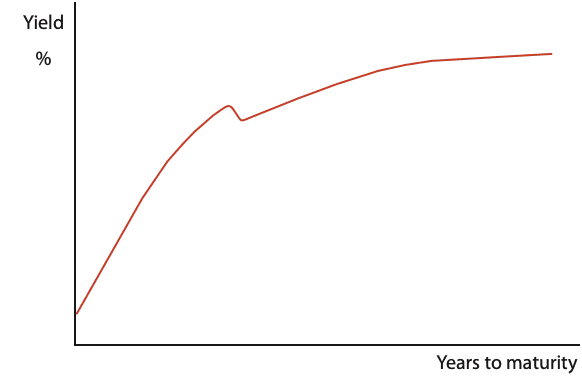
It is important for financial managers to be aware of the shape of the yield curve, as it indicates to them the likely future movements in interest rates and hence assists in the choice of finance for the company.
6.3 The shape of the curve can be explained by the following:
Expectations theory:
If interest rates are expected to increase in the future, a curve such as that above may result. The curve may invert if interest rates are expected to decline. Everything else being equal, a flat curve would result if interest rates are not expected to change.
Liquidity preference theory:
Yields will need to rise as the term to maturity increases, as by investing for a longer period the investor requires compensation for deferring the use of cash invested. The longer the period for which they are deprived of cash, the more compensation they require
Segmentation theory:
Different investors are interested in different segments of the yield curve. Short-term yields, for example, are of interest to financial intermediaries such as banks. Hence the shape of the yield curve in that segment is a reflection of the attitudes of the investors active in that sector. Where two sectors meet there is often a disturbance or apparent discontinuity in the yield curve as shown in the above diagram.
7 Total shareholder return
The total shareholder return over one year is defined as being the dividend received during the year plus/minus the change in the share price over the year, expressed as a percentage of the share price at the beginning of the year.
The share price of XYZ plc at 1 January 2015 was $4.80 per share. During the year a dividend of $0.20 per share was paid, and the share price at the end of the year was $5.10.
Calculate the total shareholder return over the year
The share price of PQR plc at 1 January 2015 was $6.50 per share. During the year a dividend of $0.50 per share was paid, and the share price at the end of the year was $6.40.
Calculate the total shareholder return over the year
8 Fintech
Fintech (FINancial TEChnology) describes the use of technology to improve financial activities.
Although traditional banks have made use of it by the introduction of internet banking using computers and mobile phones, most innovation has been in services that are ‘disrupting’ the traditional financial service industry by offering alternative ways that serve to avoid the use of the traditional businesses.
For example, companies now exist that provide banking services entirely on-line without the need to have physical bank branches. Other companies give the ability to transfer money in different currencies between countries entirely on-line and are therefore able to charge lower fees. Similarly, companies have been created that allow the trading of shares and of crypto-currencies entirely on-line, again proving attractive to customers because of the instant access and the lower fees.
Fintech is being used to automate banking services, trading in shares etc., investing, and insurance.
As a result, traditional financial service providers now have much greater competition and are being forced to change their long-standing practices.
There are two possible dangers in this rapid move to Fintech that these new businesses need to keep abreast of.
One is the obvious security threat due to hacking etc. when business is being conducted online and these Fintech companies need to ensure that they implement the necessary security procedures.
The other is government regulation. Traditional financial services are highly regulated by the relevant states, and the states need to ensure that the regulations are updated sufficiently to include the new fintech operators. In particular the regulations relating to money laundering (the conversion of money earned illegally into ‘supposedly’ legal money).
You are expected in the exam to understand what is meant by Fintech, to be aware of the benefits to users, and also to be aware of the dangers that need to be addressed. It is not an area where you can be asked to perform calculations.
The financial management environment
10 questionsAnswer the questions one at a time. Your progress is saved so you can leave and come back.
Open chapter practice