
Management of working capital (2) – Inventory

1 Introduction
The purpose of this chapter is to examine approaches to managing inventory efficiently. The two most important approaches are the EOQ model and the ‘Just-in-time’ approach.
2 The EOQ model

There are many approaches in practice to ordering inventory of goods from suppliers. Here we will consider one particular approach – that of ordering fixed quantities each time.
For example, if a company needs a total of 12,000 units each year, then they could decide to order 1,000 units to be delivered 12 times a year. Alternatively, they could order 6,000 units to be delivered 2 times a year. There are obviously many possible order quantities.
We will consider the costs involved and thus decide on the order quantity that minimises these costs (the economic order quantity).
3 Costs involved
3.1 The costs involved in an inventory ordering system are as follows:
the purchase cost
the reorder cost
the inventory-holding cost
3.2 Purchase cost
This is the cost of actually purchasing the goods. Over a year the total cost will remain constant regardless of how we decide to have the items delivered and is therefore irrelevant to our decision.
(Unless we are able to receive discounts for placing large orders – this will be discussed later in this chapter)
3.3 Re-order cost
This is the cost of actually placing orders. It includes such costs as the administrative time included in placing an order, and the delivery cost charged for each order.
If there is a fixed amount payable on each order then higher order quantities will result in fewer orders needed over a year and therefore a lower total reorder cost over a year.
3.4 Inventory holding cost
This is the cost of holding items in inventory. It includes costs such as warehousing space and insurance and also the interest cost of money tied up in inventory.
Higher order quantities will result in higher average inventory levels in the warehouse and therefore higher inventory holding costs over a year.
4 Minimising costs
One obvious approach to finding the economic order quantity is to calculate the costs p.a. for various order quantities and identify the order quantity that gives the minimum total cost.
Janis has demand for 40,000 desks p.a. the purchase price of each desk is $25. There are ordering costs of $20 for each order placed. Inventory holding costs amount to 10% p.a. of inventory value.
Calculate the inventory costs p.a. for the following order quantities, and plot them on a graph:
(a) 500 units
(b) 750 units
(c) 1000 units
(d) 1250 units
5 The EOQ formula
A more accurate and time-saving way to find the EOQ is to use the formula that will be provided for you in the exam, if needed.
The formula is:
Where Co = fixed costs per order
D = annual demand
CH = the stockholding cost per unit per annum
(Note: you are not required to be able to prove this formula)
For the information given in Example 1,
(a) use the EOQ formula to calculate the Economic Order Quantity.
(b) calculate the total inventory costs for this order quantity.
6 Quantity discounts

Often, discounts will be offered for ordering in large quantities. The problem may be solved using the following steps:
Calculate EOQ ignoring discounts
If it is below the quantity which must be ordered to obtain discounts, calculate total annual inventory costs.
Recalculate total annual inventory costs using the order size required to just obtain the discount
Compare the cost of step 2 and 3 with the saving from the discount and select the minimum cost alternative.
Repeat for all discount levels
For the information given in Example 1 the supplier now offers us discounts on purchase price as follows:
Order quantity | discount |
0 to < 5,000 | 0 % |
5,000 to < 10,000 | 1 % |
10,000 or over | 1.5 % |
Calculate the Economic Order Quantity.
7 The Just-in-time system
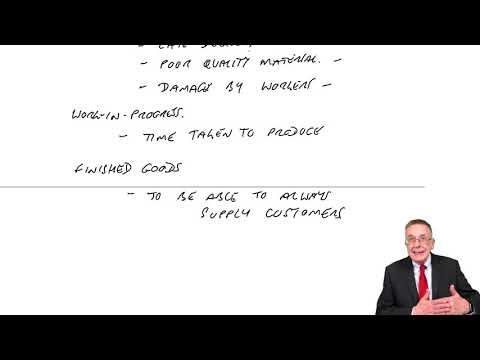
Under this approach, minimum inventories are held of Finished Goods, Work-in-Progress, and Raw Materials.
The conditions necessary for the business to be able to operate with minimum inventories include the following:
7.1 Finished Goods:
a short production period, so that goods can be produced to meet demand (‘demand-pull’ production)
good forecasting of demand
good quality production, so that all production is actually available to meet demand
7.2 Work-in-Progress:
a short production period. If the production is faster, then the level of WIP will automatically be lower.
the flexibility of the workforce to expand and contract production at short notice
7.3 Raw Materials:
the ability to receive raw materials from suppliers as they are needed for production (instead of being able to take from inventory). This requires the selection of suppliers who can deliver quickly and at short notice.
guaranteed quality of raw material supplies (so that there are no faulty items holding up production).
the flexibility of suppliers to deliver more or less at short notice.
tight contracts with suppliers, with penalty clauses, because of the reliance placed on suppliers for quality and delivery times.
A ‘just-in-time’ approach is a philosophy affecting the whole business. The benefits are not just cost savings from lower inventory-holding costs and less risk of obsolete inventory, but benefits in terms of better quality production (and therefore less wastage), greater efficiency, and better customer satisfaction.
When a scenario asks how to shorten the operating cycle, read its own figures first: a raw material holding period much longer than the production cycle is the signal for the just-in-time approach set out above. The mark is not in naming it but in what it requires — suppliers who deliver at short notice, guaranteed quality so that nothing halts production, and contracts tight enough to hold them to both.
Inventory management (EOQ)
10 questionsAnswer the questions one at a time. Your progress is saved so you can leave and come back.
Open chapter practice