
Double Entry Bookkeeping

1 Introduction
In the previous chapter we looked at the fact that every transaction has two effects, and also looked at the layout of the financial statements.
In order to be able to produce the financial statements at the end of the period, a record needs to be made of every individual transaction as it occurs. This is known as bookkeeping, and in this chapter we will look at the standard way in which bookkeeping is done.
2 The nominal ledger
Every item in the Statement of Financial Position or Statement of Profit or Loss will have an ‘account’ in which we will keep a record of that item. The ‘account’ used to always be a page in a book, but these days may be a page in a book, or, more likely, a record on a computer.
The book or file containing the accounts is known as the nominal ledger (or general ledger), and the accounts are called ledger accounts.
If the account is in a book then when we open the book there are two pages facing us. We use both of the pages for the recording, and we represent the two pages as below:
T Account | |||
Debit | Credit | ||
The left hand page is always called the debit side, and the right hand page is called the credit side.
If we make an entry on the debit side, we say that we debit the account. If we make an entry on the credit side, we say that we credit the account.
For every transaction there will be two entries – one on the debit side of an account and one on the credit side of another account. We call this double entry.
3 The general rules of double entry
A debit entry represents one of the following:
an increase in an asset
a decrease in a liability
an item of expense
A credit entry represents one of the following:
an increase in a liability
a decrease in an asset
an item of income
4 Worked example
We will work through the following entries together (use big t-accounts, because we will do other things later with the same accounts):
The following are the transactions of Kristine’s business during her first month of trading.
Record each transaction in t-accounts.
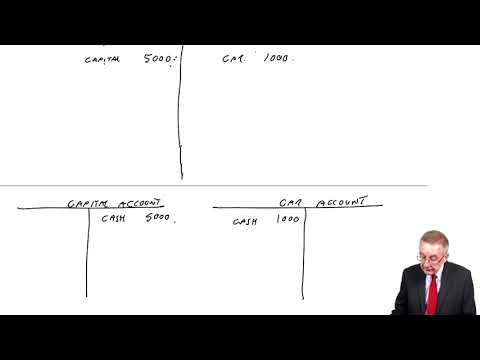
Kristine starts a business and pays in $5,000 as capital
The business buys a car for $1,000 cash
They buy goods for resale for $500 cash
They buy more goods for resale for $600 on credit from Mr A
They pay rent of $200 cash
They sell half the goods for $800 cash
They sell the remaining goods on credit for $900 to Mrs X
They pay $400 cash on account of the amount owing to Mr A
They receive $500 from Mrs X
Kristine withdraws $100 cash from the business
5 Balancing the accounts

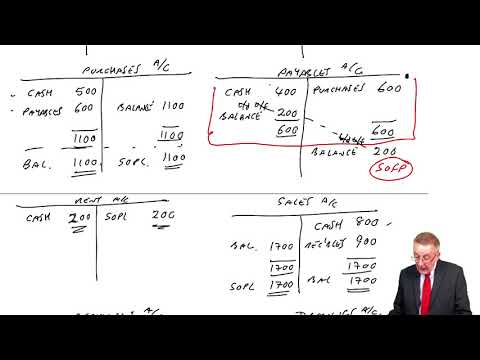
In the previous example we have now recorded all the entries. However, before we can go further we need to calculate the net figure, or balance, on each account.
With such a small example, the balances may be obvious. However we should balance it neatly.
The rules for balancing are:
draw total lines on both sides of the t-account
add up the bigger of the two sides and put this total on both sides of the account
fill in the missing figure on the smaller of the two sides – this figure is the balance on the account
carry forward this balance by also writing it on the opposite side of the account, below the total lines.
The figures above the total lines can now be effectively ignored, because we have replaced them by the net figure or balance, below the total lines.
Go back to the previous example and balance off the accounts.
6 The trial balance
Although we now know the balance on each account, there are many mistakes that we could have made. For instance, when recording the transactions we could have accidentally debited and credited with different figures. A very common error is to enter (say) $1,200 in one account but $2,100 in the other account. This is known as a transposition error.
There is a very simple and quick check we can make to see if the debits and credits are equal.
The check is to list the balances on every account. The total of the debit balances should equal the total of the credit balances.
We call this list the Trial Balance.
Prepare a Trial Balance from the previous example
Note that the trial balance is not a T-account – simply a list.
Note also although there must be errors if the trial balance does not balance (and we would have to check everything to find the errors), there can be errors that will not be found by preparing a trial balance.
Errors that will not be revealed from the Trial Balance:
7 Closing off the accounts
Now that we have recorded all of the transactions and have checked that the double entry is correct, we are in a position to produce the financial statements.
We do this by examining each account in turn and ‘closing off’.
The rules for this are as follows:
Statement of Financial Position items:
These are assets and liabilities. They exist at the end of the period, and still exist at the beginning of the next period.
We therefore simply leave the balance on the account.
Statement of Profit or Loss items:
These are total income or expense for the period. We have now finished with the current period but wish to use the same accounts to record the income and expenditure of the next period.
We do this by opening a new account in the nominal ledger called Statement of Profit or Loss.
For items of income, the entry is:
Debit the Income t-account, and
Credit the Statement of Profit or Loss t-account
For items of expenditure, the entry is:
Debit the Statement of Profit or Loss t-account, and
Credit the Expense t-account
For the previous example, open a Statement of Profit or Loss t-account and close off all the accounts.
8 Preparation of the Financial Statements
Having closed off all of the t-accounts, the balance remaining on the Statement of Profit or Loss account is the profit (or loss) for the period.
We can now produce a ‘pretty’ version of the Statement of Profit or Loss suitable for presentation to the owner by re-writing the figures from the t-account in the standard format.
The balances remaining on the accounts all represent Statement of Financial Position items. We can now list them in the standard format to produce our Statement of Financial Position.
Note that this preparation of the Statement of Financial Position and Statement of Profit or Loss does not result in any additional entries in the t-accounts.
For the previous example, prepare a Statement of Financial Position and a Statement of Profit or Loss
9 ‘Tidying up’ the owner.
Although the financial statements are now finished, the amount owing to the owner at the end of the period is split between three accounts in the nominal ledger – the Capital Account, the Drawings Account, and the Statement of Profit or Loss Account.
Our very last task is to put all the balances together so that we leave on the Capital Account a balance equal to the final amount owing.
We achieve this by making the following two entries:
Debit Statement of Profit or Loss t-account, and
Credit Capital Account
with the balance on the Statement of Profit or Loss account.
Debit Capital account, and
Credit Drawings account
with the balance on the Drawings account.
Go back to the original t-accounts and finish them by tidying up the owner’s accounts.
Double Entry Bookkeeping
5 questionsAnswer the questions one at a time. Your progress is saved so you can leave and come back.
Open chapter practice