
Accruals and Prepayments

1 Introduction
In the previous chapter we went through the steps for recording transactions through to the preparation of the financial statements.
However, there are four types of adjustments that the accountant will normally have to make when preparing the financial statements to deal with items that will not have been recorded on a day by day basis by the bookkeeper.
These adjustments are: accruals and prepayments; depreciation; bad and doubtful debts; and inventory.
We will deal with these adjustments separately – accruals and prepayments in this chapter, and the others in the subsequent chapters.
2 Prepayments

A prepayment is a payment in advance. For example, it is normal to pay car insurance for a whole year at the beginning of the year. If our year-end were to occur half-way through the insurance period, then we would only have actually used half of the insurance. The other half of the payment would be paid in advance, and in theory – were we to close down – would be repayable to the company. In practice, it would not be repaid because we would stay in business and use the rest of the insurance in the following period. For this reason we do not show the amount of the over-payment as an account receivable, but show it separately in the Statement of Financial Position as a prepayment.
The bookkeeper will have recorded the whole amount of the payment. However, if again we had paid for a year but only used half a year so far, then it would be wrong to show the full payment as an expense in the Statement of Profit or Loss.
We will illustrate the accounting treatment for prepayments by means of an example. At the end of this chapter we will summarise all the entries needed.
Karen started business on 1 January 2000.
During the year to 31 December 2000, she made the following payments for insurance:
5 January 2000 $800 for the 6 months to 30 June 2000
15 June 2000 $2,000 for the 12 months to 30 June 2001
Show extracts from the Statement of Profit or Loss and Statement of Financial Position
Write up the t-account for Insurance for the year to 31 December 2000
Close off the t-account
Show answerHide answer
3 Accruals
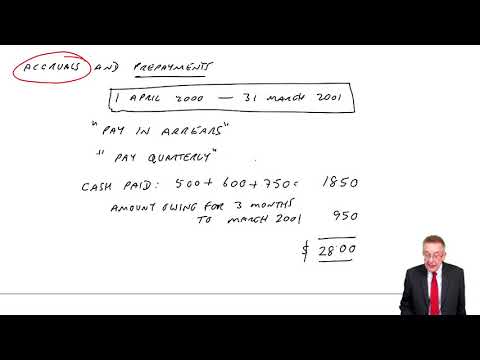
An accrued expense (or accrual) is the name we give to an amount owing for which we have not received an invoice. For example, suppose we receive electricity bills every 3 months, at the end of March, June, September, and December. If our accounting year end occurs at the end of July, then we will owe for the electricity used in July, even though we will not receive an invoice until after the end of September. The bookkeeper will only have entered the bills received, and it is therefore up to the accountant to make an adjustment for the amount still owed.
Again, we will illustrate the entries by an example and summarise the rules at the end of the chapter.
Amit started business on 1 April 2000, and during the year to 31 March 2001 he made the following payments in respect of telephone:
18 July 2000 $500 for the 3 months to 30 June 2000
22 October 2000 $600 for the 3 months to 30 September 2000
14 January 2001 $750 for the 3 months to 31 December 2000
As at 31 March 2001, Amit estimated that $950 was owing for the 3 months to 31 March 2001. He had however not received a bill from the telephone company.
Show extracts from the Statement of Profit or Loss and Statement of Financial Position.
Write up the t-account for Telephone for the year to 31 March 2001
Close off the account
Show answerHide answer
4 Subsequent accounting periods
In both of the two previous examples, we were dealing with the first year of trading. At the end of the year we left balances on the t-accounts for Prepayments (in the case of Karen) and on Accruals (in the case of Amit).
As a result, we would start the next accounting period with a balance brought forward, and we should therefore consider what entries are needed in the second period.
We will use the same examples as before, continuing into a second year.
Firstly Karen:

During the year to 31 December 2001, Karen made the following payment in respect of insurance:
12 June 2001 $2,400 for the 12 months to 30 June 2002
Show extracts from the Statement of Profit or Loss and Statement of Financial Position
Write up the t-accounts for Insurance and for Prepayments for the year to 31 December 2001
Close off the accounts
Show answerHide answer
Now Amit,

During the year to 31 March 2002 he made the following payments in respect of telephone:
12 April 2001 $950 for the 3 months to 31 March 2001
15 July 2001 $1,000 for the 3 months to 30 June 2001
24 October 2001 $1,200 for the 3 months to 30 September 2001
12 January 2002 $1,350 for the 3 months to 31 December 2001
As at 31 March 2002, Amit estimated that $1,500 was owing for the 3 months to 31 March. He had however not received a bill from the telephone company.
You are required to:
Show extracts from the Statement of Profit or Loss and Statement of Financial Position
Write up the t-accounts for Telephone and for Accruals for the year to 31 March 2002
Close off the accounts
Show answerHide answer
5 Summary of entries
(a) Prepayments
Reverse any Prepayments brought forward:
DR Expense Account (e.g. Insurance, Rates)
CR Prepayments Account
Enter any payments during the period:
DR Expense Account
CR Cash Account
Enter any prepayments at the end of the period:
DR Prepayments Account
CR Expense Account
Close-off the accounts:
Transfer the balance on the expense account to the Statement of Profit or Loss.
DR Statement of Profit or Loss t-account
CR Expense Account
Leave the balance on the prepayments account and show in the Statement of Financial Position.
(b) Accruals
Reverse any accruals brought forward:
DR Accruals Account
CR Expense Account (e.g. Telephone, Electricity)
Enter any payments during the period:
DR Expense Account
CR Cash Account
Enter any accruals at the end of the period:
DR Expense Account
CR Accruals Account
Close-off the accounts:
Transfer the balance on the expense account to the Statement of Profit or Loss.
DR Statement of Profit or Loss t-account
CR Expense Account
Leave the balance on the accruals account and show in the Statement of Financial Position.
Accruals and Prepayments
6 questionsAnswer the questions one at a time. Your progress is saved so you can leave and come back.
Open chapter practice