
The Statement of Financial Position and Statement of Profit or Loss


1 Introduction
In this chapter we will look at what information the Statement of Financial Position and Statement of Profit or Loss are giving and also examine the standard layout and terminology that will be required from you in the examination.
2 The dual (or double) effect of transactions
Let us consider the effect of the following transactions on a sole trader:
The owner puts $10,000 into a separate bank account for the business:
The business owns
The business owes
The business buys a shop for $2,000
The business owns
The business owes
The business buys goods for resale (in cash) for $1,000
The business owns
The business owes
The business buys more goods for resale (on credit) for $2,000
The business owns
The business owes
The business buys a car for $3,000 (cash)
The business owns
The business owes
The business sells half of the goods for $2,400 (cash)
The business owns
The business owes
The business sells the remainder of the goods for $2,800 on credit
The business owns
The business owes
The business pays $600 of the amount owing, on account
The business owns
The business owes
The business pays electricity of $200
The business owns
The business owes
The business receives half of the amount owing to it, on account.
The business owns
The business owes
The owner takes $1,200 from the business
The business owns
The business owes
Check on profit:
In each case, the summary we have prepared is effectively a Statement of Financial Position and shows the owner: how much they are owed, why they are owed it, and how the amount is held within the business.
The check made on the profit is effectively a Statement of Profit or Loss. This shows the owner how the profit was actually made.
3 The Statement of Financial Position
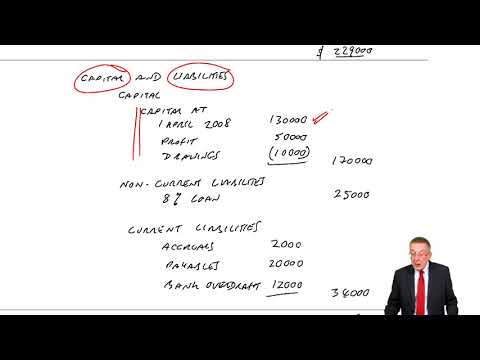
Below is an example of the layout of a Statement of Financial Position for a sole trader:
Statement of Financial Position as at 31 March 2009
$ | $ | ||
ASSETS | |||
Non-current assets | |||
Land and Buildings | 100,000 | ||
Plant and Equipment | 50,000 | ||
Fixtures and Fittings | 20,000 | ||
Motor Vehicles | 30,000 | ||
200,000 | |||
Current assets | |||
Inventories | 10,000 | ||
Accounts receivable | 12,000 | ||
Prepayments | 3,000 | ||
Cash | 4,000 | ||
29,000 | |||
$ 229,000 | |||
CAPITAL AND LIABILITIES | |||
Capital | |||
Capital at 1 April 2008 | 130,000 | ||
Profit for year to 31 March 2009 | 50,000 | ||
Less: withdrawals | (10,000) | ||
170,000 | |||
Non-current liabilities | |||
8% Loan | 25,000 | ||
Current liabilities | |||
Accruals | 2,000 | ||
Accounts payable | 20,000 | ||
Bank overdraft | 12,000 | ||
34,000 | |||
$ 229,000 |
Terminology:
Asset an economic resource controlled by the business
Non-current asset an asset the business intends to keep (longer than 12 months)
Current asset not a non-current asset (!)
Inventory an asset bought by the business intended for sale
Accounts receivable amount owed to the business by customers
Prepayment a payment made by the business in advance
Capital amount owing by the business to the proprietor (owner)
Drawings (or withdrawals) anything taken from the business by the owner
Liability amount owing by the business
Current liability a liability due within 12 months of Statement of Financial Position date
Non-current liability a liability due more than 12 months from the date of the Statement of Financial Position
Accounts payable liability due to suppliers
Bank overdraft liability due to the bank (a “negative” bank balance
4 The Statement of Profit or Loss
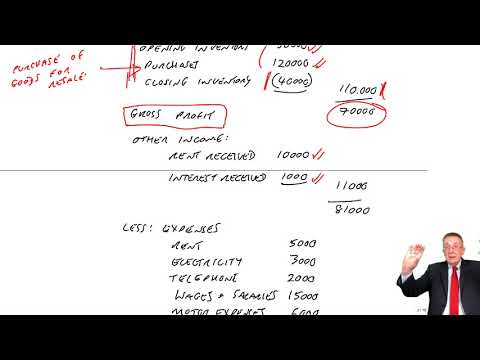
Below is an example of the layout of a Statement of Profit or Loss for a sole trader:
Statement of Profit or Loss for the year ended 31 March 2009
$ | $ | ||
Sales revenue | 180,000 | ||
Cost of sales: | |||
Opening Inventory | 30,000 | ||
Purchases | 120,000 | ||
150,000 | |||
Closing Inventory | (40,000) | ||
110,000 | |||
Gross Profit | 70,000 | ||
Other income: | |||
Rent received | 10,000 | ||
Interest received | 1,000 | 11,000 | |
81,000 | |||
Expenses: | |||
Rent | 5,000 | ||
Electricity | 3,000 | ||
Telephone | 2,000 | ||
Wages and salaries | 15,000 | ||
Motor expenses | 6,000 | ||
31,000 | |||
Net profit | $50,000 |
Terminology
Revenue
Purchases
Trading Account
5 The difference between Capital and Revenue items

You should note from the previous exercises that when we pay for anything, there are two possible reasons. Either we buy an asset, which appears on the Statement of Financial Position, or we pay an expense, which appears on the Statement of Profit or Loss.
We call the purchase of assets (for the Statement of Financial Position) Capital Expenditure, whereas the payment of expenses (for the Statement of Profit or Loss) is called Revenue Expenditure.
6 The Accounting Equation
You should note from the earlier illustrations that at any point in time:
ASSETS = CAPITAL + LIABILITIES
It follows from this that:
ASSETS – LIABILITIES = CAPITAL
The term “net assets” is often used to refer to
assets – liabilities, and so:
NET ASSETS = CAPITAL
Over a period of time (for example, over a year), the net assets of a business will change. Since the above equation is true at any point in time, it also holds true that over a period of time:
INCREASE IN NET ASSETS = INCREASE IN CAPITAL
There are only three reasons why the capital of a business should change over time:
More capital introduced (this will increase the capital)
Profit for the period (this will increase the capital)
Drawings during the period (this will reduce the capital)
Therefore, finally, over a period of time,
INCREASE IN NET ASSETS = CAPITAL INTRODUCED + PROFIT - DRAWINGS
On 1 January, net assets of a business were $25,000. On 31 December they had increased to $32,000. During the year the owner had introduced more capital of $10,000 and had made drawings of $7,000.
You are required to calculate the profit for the year
Show answerHide answer
On 1 January, the net assets of a business were $118,000. On 31 December, the net assets were $150,000. During the year the owner had introduced no additional capital, and the profit for the year was $54,000
How much were the drawings during the year?
Show answerHide answer
The Statement of Financial Position and Statement of Profit or Loss
5 questionsAnswer the questions one at a time. Your progress is saved so you can leave and come back.
Open chapter practice