
Organisational culture

1 Cultural web

Whereas PESTEL and Porter’s 5 forces relate to influences outside the business, within the business its culture is very important. Charles Handy defined the culture as “the way we do things around here.”
You will be aware of the effect of culture. For example whenever you join a new organisation, whether school or college or work, you tend to go carefully for the first couple of days or couple of weeks until you see how people behave, and then you usually try to fit in.
The influences on culture could be represented by the cultural web.
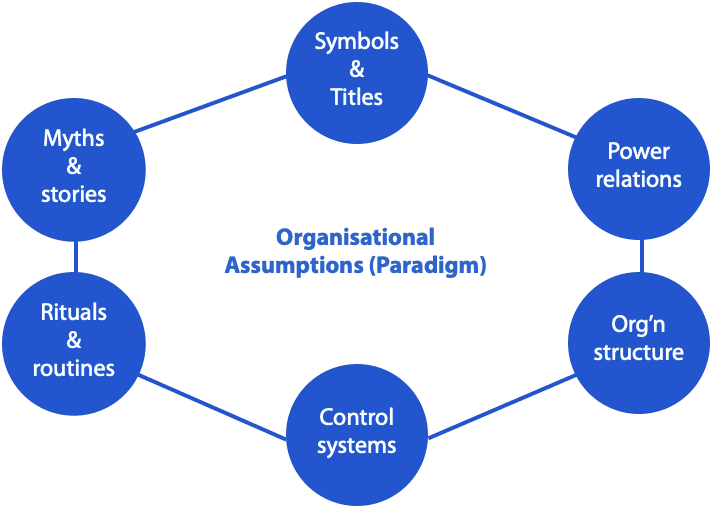
Starting at the top, symbols and titles. Are you an organisation with many presidents and vice-presidents? Where everyone has a particular title implying that the organisation might be rather formal? Where symbols might be those such as a private dining room for top managers, or reserved parking spaces, or particular perks which only those of a certain grade obtain? Some organisations are quite hierarchical like that, others try to be much more egalitarian.
Power relations. Do top managers keep most power to themselves or is it dispersed? Are you told what to do or is it more likely you will be asked to contribute your ideas about what should be done?
Organisational structure. Some organisations are ‘tall narrow’ with many layers, each layer being carefully supervised by the supervisor or manager above. Other organisations are ‘flat wide’ organisations, with relatively few vertical layers and each manager therefore having to look after a relatively large number of people, but inevitably because they are looking after more people, people have to be better at looking after themselves without intense supervision.
Control systems. For example, how carefully do you have to account for your time. Some organisations, perhaps for billing purposes, insist that people record what they are doing every 12 minutes. Other organisations don’t control individual activities quite so closely and are more interested in the overall results.
Rituals and routines. For example, in some organisations when a sale is made, the person who has made the sale has to stand up and ring a bell. Other people then applaud. To some of you this may seem childish. But those organisations which do it presumably think it’s worthwhile in terms of morale-boosting and challenging others who have not yet made the sale. In some organisations you are expected to socialise, say on a Friday evening after work.
Myths and stories. How the company in the past won a particular contract which was very valuable, the way in which a clever presentation was made or the way in which they worked hard against the clock to ensure that a job was finished on time. Myths and stories are often used to illustrate desirable behaviour.
Organisational assumptions. For example, the assumption that we are the best, that we are never beaten, that we only produce work of the highest quality.
In definition questions, separate the terms precisely: culture is the accepted way of behaving and working; governance is the system by which activities are directed and controlled.
2 Types of culture – Handy’s classification
Charles Handy identified four types of organisational culture. Each of these categories was given the name of a Greek god. Those names are very useful but you ought to know them for the exam anyhow.
Power culture. First, there is the power culture (Zeus). In the power culture power is concentrated in the hands of essentially one person, the boss - probably the person who started the company, or at least the person whose name is probably the same as the company. This person’s word is law. There is very little delegation, very little decentralisation. Almost all decisions are made by that person.
Role culture. It becomes difficult to sustain a power culture as the business grows, there is simply too much to know, too much to do, and it may then change into a role culture (Apollo). In the role culture there is effectively a management structure with different people having different roles. The problem with the role culture is that sometimes the title and the job description, are regarded as more important than actually getting the job done. Often associated with role culture are very strict job descriptions and if something isn’t in the description then people will refuse to do it even if it hurts a client or customer.
Task culture. The task culture (Athena) is where there is a great emphasis on getting the job done and achieving the task. People do not depend so much on their job specifications or their particular place in a hierarchy. Really, everyone pulls together for the sake of the organisation and to please clients and customers.
Person culture. A relatively rare type of culture is the person organisation (Dionysus). Here you have people who are essentially pursuing a private ambition in the context of an organisation. It’s not very important in business. An example might be a surgeon in a hospital. The surgeon gets enormous job satisfaction from performing operations and making people better. To some extent surgeons might not be terribly interested in interacting with the rest of the organisation. They are there primarily to fill their personal ambitions and the rest of the organisation is almost an essential evil.
3 Schein - three levels of culture
Schein usefully identified three levels of culture.
Artifacts. The topmost and the most superficial level is that of artifacts. These are essentially what you see: the way people dress, the way they behave, the structure of the company as set out in the organisation chart, the way in which you have to have your expenses approved. These are most obvious things that you see when you join an organisation but in some ways the least important.
Espoused values. At a slightly deeper level are espoused values. These are the stated goals, strategies, and philosophies. The mission statement of a company, for example, may set out what the company’s purpose is and how it perceives itself within the marketplace, how it values employees, how it tries not to harm the environment.
Underlying assumptions. The most fundamental level is the basic underlying assumptions. These are very important but are often the most difficult to identify and to understand. They will often not be stated, but there is an assumption about the quality of work, about never missing deadlines, about our willingness to work overtime even if not paid in order to hit a deadline, the assumption that we are the best. It can take time before these basic underlying assumptions are understood by new members of organisations.
4 National cultures
Hofstede examined how people from different countries are likely to develop different organisational cultures and how national culture influences how people work and expect to be managed. Hofstede identified the following variables:
Power/distance. Do people expect to be told what to do and then do it without question? Or do people come from a national culture where that approach would not be expected and probably not be acceptable, where they expect to have a more participative role to contribute to decisions?
Uncertainty avoidance. Some national cultures shy away from taking risks; those people may prefer certainty. They don’t come from a background which expects people to take gambles and which supports failure. It’s sometimes said that the American business culture is one where failure, and effectively therefore uncertainty, is well tolerated, that there is no disgrace in trying and failing, and the only disgrace is in not trying. It could be that this is what partly contributes to the dynamism of the American economy.
Individualism-collectivism. To what extent are all people within the organisation expected to agree with particular decisions and to conform to what other people are doing, or are they expected to go their own way? To a large extent Japanese culture expects collectivism. Everyone is expected to agree on what’s being done and an individual approach is frowned upon. In some countries individual approaches are likely to be praised and they have great respect for the maverick.
Masculinity. This looks at the extent to which social gender roles are important. Cultures with high masculinity value assertiveness, competition, material success, and being dominant, whereas in those cultures feminine values of modesty, reaching consensus, understanding, and relationships are not valued so highly.
Organisational culture
5 questionsAnswer the questions one at a time. Your progress is saved so you can leave and come back.
Open chapter practice