
An organisation’s stakeholders

1 Stakeholders
The term “stakeholder” refers to any person or institution in any way affected by organisation. Stakeholders can be broken down into three groups though this is not particularly helpful in any further analysis.
Internal stakeholders are those who are definitely inside the organisation. A good example would be the employees and the managers.

Connected stakeholders are outside the organisation but connected by way of a contract of some sort. Good examples here will be suppliers, customers, shareholders and lenders.
External stakeholders are entirely outside the organisation with no contractual relationship. A good example for this is will be the people living nearby a factory. They are obviously affected, but have very limited contractual rights over what the factory does. The government is also an external stakeholder.
Why is the study of stakeholders important? Really the reason is that usually what stakeholders want will be in conflict. Shareholders want higher profits but employees want higher wages; customers want better quality at lower prices, shareholders want higher profits; customers may want the operation to run 24 hours a day, 7 days a week but employees might want to only work 5 days a week, 8 hours a day. If your organisation was an airport the local populace would want you to run fewer flights (and certainly not after about 11 o’clock at night), whereas your customers and your shareholders may want you to run services more frequently.
There is no easy way of resolving these conflicts. Basically it comes down to management trying to get stakeholders to compromise. They have to try and keep most people happy most of the time, bearing in mind, however, that some stakeholders may be able to stop co-operating altogether. For example when employees want better wages, they could go on strike and ultimately this can affect the profits which are enjoyed by the shareholders. Management has to be aware that there are conflicts and try its best to manage these.
The study of stakeholders allows us to introduce the agency relationship that, in particular, exists between two major categories of stakeholder: shareholders (owners) and directors/management.
Once a company becomes larger, shareholders usually take no part in the day-to-day running of the business. Instead, the directors do that. In the relationship, the shareholders are the principals and the directors the agents. It is the legal duty of agents to act in the best interests of the principals but it is tempting and easy for directors to begin putting themselves ahead of the shareholders. For example, directors might award themselves large bonuses, first class air travel, board meetings in exotic and pleasant locations. They might decide to embark on a risky project that will reduce profits if it goes wrong but nevertheless leave their salaries intact. These choices will reduce shareholder returns but potentially enrich directors.
At one time, the management of the relationship between shareholders and directors was very poor. After several large financial scandals new rules were introduced to increase the supervision of directors so that their decisions are more likely to be in the best interests of the shareholders. More details of the rules are covered in the chapter on Corporate Governance.
2 Mendelow’s matrix
About the only tool or model available for the analysis of stakeholders is Mendelow’s matrix.
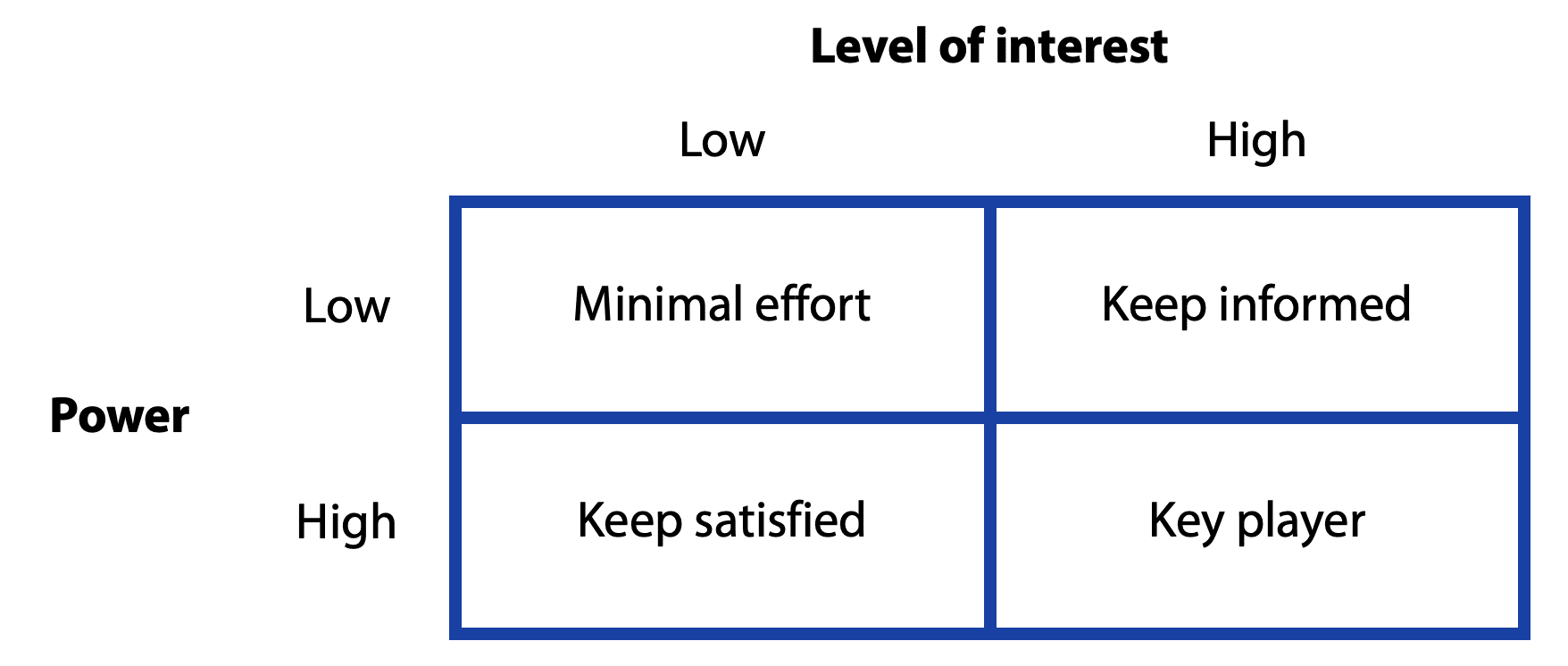
It sets out on one axis the power that a stakeholder can wield and along the other axis their interest, by which we mean how likely is it that the stakeholder will take action. Stakeholders who have high power and high interest are known as key players. Management really needs to keep those people happy. They have the power and they have the willingness to take action if they are upset.
Some stakeholders have high power but they are not likely to take action even if management does something which they dislike. They may be unwilling to take action because of professional or ethical reasons. For example, medical staff in hospitals are very unlikely to take industrial action. Management doesn’t have to be quite so careful with these people. However they have to be kept satisfied, otherwise they could be provoked to take action and turn into key players.
People with low power but high interest have to be kept informed. They can’t do much about it themselves but they might be able to influence key players to take action on their behalf.
Finally we have people with low power and low interest. Management can nearly ignore these people. After all, what are they going to do if they don’t like what’s happening? They are unlikely to want to take action anyhow. They require minimal effort by management.
For Mendelow scenario questions, judge power and interest separately from the facts. A customer with alternatives may have high power over a supplier but low interest in that particular relationship.
Stakeholders
8 questionsAnswer the questions one at a time. Your progress is saved so you can leave and come back.
Open chapter practice