
Corporate governance and ethical considerations

1 Corporate governance
1.1 Governance theories
Agency theory: directors act as agents of shareholders. Because directors may pursue their own interests, monitoring, incentives and accountability are needed.
Stewardship theory: directors are trusted stewards who are motivated to protect the organisation and promote its long-term interests.
Stakeholder theory: governance should consider all groups affected by the organisation, rather than shareholders alone.

Corporate governance refers to how companies are directed and controlled.
The real problem is the separation of ownership and control.

As mentioned in an earlier chapter shareholders own the company, but unless the company is very small they will not normally be dealing with the day-to-day running of the company. Instead shareholders appoint directors to do that. Technically the directors are the agents of the shareholders. The shareholders are the principals in this relationship and the directors should act in the best interests of the shareholders. Another way of describing this is stewardship. The directors are the stewards of the company assets. They look after them on behalf of the shareholders. But how do we know if the directors are acting in this way?
Directors have day-to-day management responsibilities and shareholders may only get a set of financial statements (accounts) once a year and attend an annual general meeting once a year. It can therefore be very difficult for the shareholders to know whether or not the directors are running the company in the shareholders’ best interests. There have been many examples of directors abusing the trust put in them by the shareholders. They can award themselves excessive amounts of salary and share options, give themselves generous perks; they can make loans from the company to themselves; they can take undue risks because, if the risk pays off the directors’ salaries may increase, but if the risk doesn’t pay off it’s the shareholders who will lose the most, and the directors’ positions can remain relatively secure.
Corporate governance rules have recently been tightened up so that shareholders can better monitor what the directors are doing and how their company is actually performing.
For governance-theory scenarios, use the director’s stated focus: personal self-interest indicates agency theory; a duty to a broad range of affected groups indicates stakeholder theory.
2 Principles of Corporate Governance
2.1 Principles of corporate governance
The Organisation of Economic Cooperation Development (OECD) promotes six Principles of a corporate governance framework:
It should promote transparent and fair markets and support effective supervision and enforcement.
It should protect shareholders' rights and ensure all are fairly treated (ie including minority shareholders).
It should provide for stock markets to contribute to good corporate governance (eg by prohibiting insider trading).
It should recognise the rights of all stakeholders, not just shareholders.
It should ensure timely and accurate disclosure of all material matters, including financial position, performance, ownership and governance.
It should ensure the strategic guidance of the entity, effective monitoring of management by the board and the board’s accountability to the entity and their shareholders.
2.2 The UK Corporate Governance Code
The OECD principles are put into effect in a variety of ways in different countries. The UK Corporate Governance Code published by the Financial Reporting Council (FRC) is an example of best practice. The Principles of the Code emphasise the value of good corporate governance to the long-term success of the company.
Main principles of the UK Code
Board leadership and company purpose
Every company should be headed by an effective board which is collectively responsible for the long-term success of the company. All directors must act with integrity, lead by example and promote the desired culture.Division of responsibilities
There should be a clear division between the running of the board and the executive responsibility for the running of the company’s business. No one individual should dominate decision making. This means that the roles of CEO and chairman should not be performed by one person as that concentrates too much power in that person. The chairman is responsible for leadership of the board
Non-executive directors (NEDs) must be appointed to the board and they should constructively challenge and help develop proposals on strategy. NEDs sit in at board meeting and have full voting rights, but do not have day to day executive or managerial responsibility. Their function is to monitor, advise and warn the executive directors. There should be roughly a 50/50 balance between executive and non-executive directors.
Composition, succession and evaluation
Appointments to the board should be subject to a formal, rigorous and transparent procedure led by a nomination committee. A majority of the committee should be independent NEDs.
The board and its committees should have a combination of skills, experience and knowledge. The length of service of the board as a whole should be considered and membership regularly refreshed. The post of chairman should not be held beyond nine years.
The board should undertake a formal and rigorous annual evaluation of its own performance and that of its committees and individual directors.
All directors should be submitted for re-election annually.
Audit, risk and internal control
The board should establish formal and transparent policies and procedures to ensure the independence and effectiveness of internal and external audit and the integrity of financial statements.
This means that an Audit Committee (NEDs again) should be established to liaise with both internal and external auditors. Before audit committees, the finance director liaised with auditors, but this was not satisfactory because the finance director was often the person responsible for accounting problems. Therefore, auditors were often reporting problems to the person who caused them. The directors are responsible for establishing an internal control system and must review the need for internal audit.
The board should present a fair, balanced and understandable assessment of the company’s position and prospects and should establish procedures to manage risk, oversee internal controls and determine the nature and extent of the principal risks the company is willing to take to achieve its long-term strategic objectives.
Remuneration
Remuneration should be sufficient to attract, retain and motivate directors of sufficient quality… but avoid paying more than is necessary.
A significant proportion of executive directors’ remuneration may be structured to link rewards to corporate and individual performance. In other words, profit related pay is encouraged so that directors do not receive high pay irrespective of company performance.
There should be a formal and transparent procedure for developing policy on executive remuneration and for fixing the remuneration packages of individual directors. No director should be involved in deciding his or her own remuneration. This means that a remuneration committee (NEDs) should be formed to fix directors’ remuneration.
Compliance-based or principles-based
The UK Corporate Governance code and that of most European countries is principles-based This means that broad principles are laid down and it is the board’s responsibility to apply those principles as they see fit to their particular company. This approach allows flexibility to deal with a wide variety of circumstances.
The USA takes a compliance approach where very specific requirements and rules have to be signed off by the board and often also the auditors. This approach, embodied in the Sarbanes Oxley Act, allows much less flexibility but it does increase the strictness with which the rules are applied.
Comply or explain
The Code has no force in law and is enforced on listed companies through the Stock Exchange. Listed companies are expected to ‘‘comply or explain’’ and this approach is the trademark of corporate governance in the UK. Listed companies have to state that they have complied with the code or else explain to shareholders why they haven’t. This allows some flexibility and non-compliance might be acceptable in some circumstances.
3 Corporate Social Responsibility
3.1 CSR in contemporary organisations
Corporate social responsibility (CSR) means accepting responsibility for the social and environmental effects of business decisions, not merely complying with the legal minimum. Appropriate standards of CSR support trust, stakeholder loyalty, risk management and long-term organisational sustainability.
See Chapter 21 for stakeholder responsibilities and sustainable business.
We stated earlier that shareholders own companies and they appoint directors to run the companies for the benefit of the shareholders. That is certainly the legal position, but recently people have questioned whether running companies purely for the benefit of shareholders is all that should be done. This has given rise to the somewhat fashionable idea of corporate social responsibility.
To what extent should the interests of other stakeholders be taken into account? For example, certainly companies should be run within the law and no doubt there are laws relating to minimum wages, maximum working weeks, and permitted levels of pollution. If companies adhere to those laws should they go further? Should they pay people much in excess of the minimum? Should they reduce the hours that people have to work? Should they tighten up even further on the discharges made from the factory?
Many observers argue that companies should go further than simply meet the minimum obligations as set by law. But this can be a difficult area. First of all, going further with these social responsibilities normally reduces the profit of a company. Profit is of itself a good thing as profit enables a company to exist more permanently, to put money into research and development, to give more stable employment. And of course, the higher the profit, the higher the taxes, and taxes are then spent for the good of society as a whole. Companies should certainly not be embarrassed about making profits.
Secondly it can be argued that instead of a company, say, making charitable donations, shareholders if they get larger dividends can make those donations themselves, and furthermore, they can make those donations to parties they feel most deserving.
Thirdly, do directors have the legal authority to make non-essential payments? This is the directors using company assets which are ultimately the assets of the shareholders. People could argue that they have no right to give those away or to spend them needlessly.
Lastly who decides the beneficiaries? Are the beneficiaries simply the pet charities and interests of the directors? What exactly is a democratic relationship when it comes to decide who benefits from the extra donations or the extra benefits distributed amongst non-shareholders?
4 Ethics – importance
There are valid arguments about whether or not a company should adopt corporate social responsibility. But when it comes to ethics there is very little argument, and one doesn’t have to appeal to a moral or ethical stance to see that companies should be ethical. An ethical stance can be justified on a purely economic basis. This rests on the fact that if the company acts unethically or immorally it will usually be found out and, when it is found out, it is usually punished, either through the operation of the law, compensation, or by the loss of goodwill and reputation. Therefore, an ethical company reduces risk.
Everyone can make mistakes but if you own up to mistakes then you are limiting the damage, and you are reducing the risk that further damage will be done and you will reduce the punitive damages that may later be awarded against you.
If risk is lower so too is cost. Ethical organisations often have to spend less ensuring that regulations are followed. Lower risks also means that banks and other providers of capital will be willing to supply the money at lower rates. In general lower returns are required because risk and return go together.
If your reputation is good, you are more likely to find good, willing partners with whom you can co-operate perhaps to form joint ventures or perhaps just to be satisfied customers.
A good reputation will tend to attract better employees. If possible, no one really wants to be associated with a company that has a poor reputation.
Finally, a good reputation should increase goodwill and increase sales. Companies that are regarded as being unethical tend not to be trusted and certainly not liked by customers. Customers will always be trying to find an alternative.
Therefore for very sound commercial reasons, it pays companies to be ethical.
5 Ethics, the law and regulation
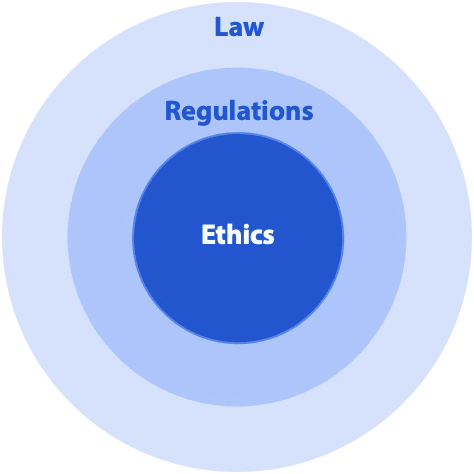
Ethics are a set of rules on how we should behave. In addition to ethics we receive rules from laws and from regulations, for example the regulations of a professional body such as ACCA.
This diagram shows how they are related. We have to comply with the law, but then, in addition we might have to comply with more demanding regulations and finally, we must comply with the system of ethics. Again, the assumption is that ethics will impose higher demands and duties than the law or regulations.
5.1 Professional discipline
A professional body may investigate complaints and impose sanctions such as a reprimand, fine, conditions, suspension or expulsion. Suspected criminal conduct may be reported to the authorities, but prosecution is normally brought by the state.
5.2 Threats and safeguards
The main threats are self-interest, self-review, advocacy, familiarity and intimidation. A threat that is not at an acceptable level must be removed, reduced by safeguards, or avoided by declining or ending the activity.
6 Ethical principles
Ethics can be approached either by consequentialism or duty (the deontological approach)
6.1 Consequentialism
For example: utilitarianism ‘the greatest good for the greatest number’. This might sound attractive and logical, but could, for example, be used to justify killing someone and using their body parts to save many others. So the approach of, say, one person dies to save six others is unlikely to be acceptable to most of us, even though it might represent the greatest good for the greatest number.
6.2 Duty (deontological approach)
Behaviour should be based on absolute moral values. We have a duty to follow those values or codes.
7 Relativist or absolute?
7.1 Relativism
There are many acceptable ethical standpoints. This approach provides some flexibility and more tolerance but might lead to too little guidance as to what is acceptable and an ‘anything goes’ approach. However, this approach is capable of providing some level of tolerance and cooperation towards those with different values
7.2 Absolutism
Behaviour should be based on absolute moral values, but what is their source? Although the followers of a given code have a sure basis for their ethics, perhaps the main danger is that of serious conflict between followers of different absolute ethical codes.
8 Examples of ethical problems facing managers.
Profit/public good eg pharmaceuticals. Pharmaceuticals are expensive to develop and companies need profits. However, what approach should be taken to providing medicine to people who cannot afford to buy it at a price which yields a profit?
Profit/health and safety eg aircraft. New aircraft (and new drugs) are tested very extensively, but at some point a line is drawn and the products are launched. If more testing were carried out the product might be slightly safer, but more testing costs more and delays any benefits arising form the product.
Equal opportunities eg recruitment. Increasingly laws, certainly in the EU are intervening in matters of employment to reduce the likelihood of racial, sex, religious, sexual orientation and age discrimination.
Payments:
Extortion
Bribery
Grease money
Gifts
Most people have no difficulty accepting that extortion is wrong. It is the obtaining of money or advantage by violence, intimidation and blackmail.
Bribery is also normally regarded as unethical. It is money given to bring about an illegal or dishonest act.
Grease money is more controversial. This is where you provide money to get someone, usually an official, to do what they should do anyhow. It is used to speed up legal transactions.
Gifts are normal business practice in some cultures, but could be regarded as a form of bribery in others.
9 Promotion of ethical behaviour
The following values should promote ethical behaviour in organisations:
Openness
For example, employees must be open with their managers if an accounting error is found. Trying to cover it up could not be considered ethical.
Trust
For example, employees must trust that their managers, because of their knowledge and experience, give good guidance and direction.
Honesty
This does no need much expansion, but it is important that honesty with colleagues, suppliers and customers is encouraged.
Respect
This will encourage the proper treatment of stakeholders and reduce the chance that they are treated unethically.
Empowerment
Employees should be empowered to ‘do the right thing’ and to refuse to behave in a way they know to be contrary to the organisation’s ethical code.
Accountability
Accountability means that people do not try to avoid issues or obligations. If you are given something to do, you should try to do it to the best of your ability.
10 The public interest
IFAC (The International Federation of Accountants) defines public interest as:
“The net benefits derived for, and procedural rigour employed on behalf of all society in relation to any action, decision or policy”
The ‘public’ includes investors, shareholders, employees, pensioners consumers, suppliers, tax payers, electorates and citizens.
Although the impact of accountants varies amongst these groups, there is a fundamental obligation for the accountancy profession to act in the public interest. ‘Interests’ include:
Increased economic certainty in the marketplace
Sound decision-making
Sound and transparent financial information
Comparability across different organisations and jurisdictions
Sound corporate governance
Effective performance management
Increased efficiency and better resource utilisation
Accountancy professionals play a vital role in delivering the public interests shown above and they should:
Provide sound financial and non-financial reporting to shareholders, investors, taxpayers and all parties in the market place directly and indirectly impacted by financial and non-financial reporting from all organisations - including public sector organisations.
Provide truthful, effective communication with parties (boards, shareholders management and others) directly and indirectly related to the corporate government processes for which they are responsible.
Essentially, acting in the public interest can be viewed as accountants and others exercising social responsibility. Their duties do not simply rest with their clients, employers or shareholders and they are encouraged or required to make positive impacts on all stakeholders.
11 Corporate codes of ethics
A corporate code of ethics can be defined as: a written set of guidelines issued by an organisation to its workers and management to help them conduct their actions in accordance with its values and ethical standards.
A code that is implemented and supported by top management can bring the following advantages to an organisation:
Areas covered can include:
Equal opportunity/discrimination
Bullying
Use of the internet
Reporting wrong-doing
Bribery
Money-laundering
Response to conflicts of interest
The code must be fully supported by top management if it is to be effective. Staff training is also needed to illustrate decision-making processes. A code that is properly implemented can bring the following advantages to an organisation:
Emphasises the organisation’s values.
Guidance to employees and directors.
Risk reduction through avoidance of regulatory and legal problems.
Good public relations and reputation.
Here is an excerpt from Amazon’s code of ethics:
I. Compliance with Laws, Rules and Regulations
Employees must follow applicable laws, rules and regulations at all times.
II. Conflicts of Interest
...employees are expected .. to act ... in the best interests of Amazon.com. A "conflict of interest" exists when an employee's personal interest interferes with the best interests of Amazon.com. For example, a conflict of interest may occur when an employee or a family member receives a personal benefit as a result of the employee's position with Amazon.com. ... the Legal Department will consider the facts and circumstances of the situation to decide whether corrective or mitigating action is appropriate.
III. Insider Trading Policy
Employees of the Company may not a) trade in stock or other securities while in possession of material non-public information or b) pass on material non-public information to ... or recommend to others that they trade in stock or other securities based on material non-public information.
IV. Discrimination and Harassment
Amazon.com provides equal opportunity in all aspects of employment and will not tolerate any illegal discrimination or harassment of any kind...
V. Health and Safety
Amazon.com provides a clean, safe and healthy work environment. Each employee has responsibility for maintaining a safe and healthy workplace by following safety and health rules and practices and reporting accidents...Violence and threatening behaviour are not permitted. ...
VI. Price Fixing
Employees may not discuss prices or make any formal or informal agreement with any competitor regarding prices ...
VII. Bribery; Payments to Government Personnel
Employees may not bribe anyone for any reason, whether in dealings with governments or the private sector. ....
VIII. Record-keeping, Reporting, and Financial Integrity
Amazon.com's books, records, accounts and financial statements must be maintained in appropriate detail..
IX. Questions; Reporting Violations
Employees should speak with anyone in their management chain or the Legal Department when they have a question about the application of the Code of Conduct ...The Amazon.com Legal Department has developed ... reporting guidelines for employees who wish to report violations of the Code of Conduct. ... Amazon.com will not allow retaliation against an employee for reporting misconduct by others in good faith...Employees who violate the Code of Conduct will be subject to disciplinary action up to and including discharge.
12 Ethical conflict and its resolution
An ethical conflict arises when a person encounters one or both of the following:
Obstacles to following an appropriate course of action due to internal or external pressures.
Conflicts in applying relevant professional and legal standards.
Here are some examples of ethical conflicts:
You are a pharmaceutical company developing new drugs. How much testing should be carried out before the drugs can be marketed? More testing might identify unwanted side-effects, but more testing will delay treatment for people who are very ill.
Your factory is old and inefficient and you are thinking of moving to new one with more efficient use of energy, in another area of the country with better transport connections. Carbon foot-print will be reduced, but existing employees will lose their jobs.
You run an airline. You transport passengers for business and leisure and to visit overseas family members. However, airlines also cause noise and air pollution.
House-builders create accommodation for families, but they might build over attractive land and displace wild-life.
You are an accountant reporting to a lender on the prospects of a client. A poor report will lead to business closure and redundancies but an optimistic report might lead to the lender losing their investment.
You might be asked by a manager to remain silent about certain matters that would have an adverse impact on the financial accounts of an organisation, thereby testing the employee’s loyalty to his or her manager on the one hand, and the responsibilities as a professional on the other
You might may consider that the employer’s policies are unethical and may find it difficult to reconcile personal values with those of the organisation.
Once an ethical conflict is encountered, a member may be required to take steps to best achieve compliance with the rules, fundamental principles and the law. The IFAC Code offers a framework through which ethical dilemmas may be addressed.
When faced with ethical conflicts, the decision taker should:
Consider the facts of the situation.
Consider the ethical principles involved.
Consider relevant internal procedures. Many organisations will have well-developed procedures that should be followed in the first instance.
Consider the alternative courses of action:
Escalate internally; consider grievance procedures.
Document every action you take to resolve the conflict.
Escalate externally to auditor, legal advisors, professional body.
Consider the consequences of each alternative course of action.
Ultimately, if resolution seems unlikely, disassociate yourself from the issue – in writing if necessary. Legal advice may be needed if this affects your employment status or if you are implicated in any way with the issue.
Note that in some cases there might be a statutory duty to report on problems (eg money laundering).
Corporate governance and ethics
7 questionsAnswer the questions one at a time. Your progress is saved so you can leave and come back.
Open chapter practice