
An organisation’s environment

1 Environmental influences – PEST(EL)
This paper is called “Business and Technology”. Businesses exist within an environment, so it is useful to categorise the environmental influences that they may experience. The PESTEL model looks at environmental influences which are very large and powerful: the macro-environment. PESTEL stands for Political, Economic, Social, Technological, and relatively recently, Ecological and Legal. It’s easy to see how these will influence how a business gets on.

Political
For example joining/leaving the EU, political tensions, war, alliances and change of government can all influence many businesses.
Economic
It goes without saying that economic changes can have very serious influences on business and under “economic” will come effects such as interest rates, exchange rates, tax rates, and whether the world economy seems to be doing well or is in decline.
Social
Social changes include what’s known as ‘demographic changes’, that is, changes in the population. And in many Western countries, this is characterised by relatively few young people and more and more old people in the population. This can have serious implications when it comes to recruitment or in calculating the pension or medical liabilities of businesses.
Also under the heading of social influences are taste, fashion, fad, values and attitudes. For example, in many countries vegetarian and vegan lifestyles currently seem to be increasing in popularity. Nowadays people have got used to relatively cheap air travel and there is an expectation that travel will be easily available. Fewer people watch regular broadcast television as streaming services, such as Netflix, have become more popular.
1.1 Government responses to demographic change
Demographic change affects the size, age profile and skills of the workforce, as well as demand for products and public services. Governments may respond by reforming pensions and retirement ages, adjusting migration policy, supporting childcare and families, investing in education and retraining, and expanding healthcare and social-care capacity.
Technological
Technological changes are easy to understand. You only have to consider what the Internet has done to many businesses. Banks, for example, need fewer branches, as more and more people opt to deal with their accounts online. Many bookshops and music shops have been affected by Amazon which makes sales online through a sophisticated website.
Companies are also making much more use of the information they can gather about customers and their purchases, preferences and habits so that much more focussed marketing offers can be made. If you use a loyalty card in a supermarket, be assured that the company notes everything you purchase, storing it in a data warehouse (with other customers’ data) and will the company will be mining the data in the hope of finding useful marketing information.
Another example of technological change is seen in vehicle manufacturing where ranges of electric or hybrid vehicles and battery technology are being developed and which will play a big part in the future.
Ecological/environmental
Ecological influences are relatively new considerations. These are effectively green issues. Some businesses are affected more than others. Airlines for example, are coming under increasing pressure because it is claimed that jet travel makes damaging emissions high in the atmosphere. More and more businesses are paying attention to packaging, to waste disposal and to their carbon footprints.
These efforts should improve the long-term sustainability of the business. More efficient use of material resources and energy should ultimately benefit shareholders. So will avoiding fines by regulators and the cost of putting right environmental disasters. The reputation of a company is likely to be improved because the business is seen to be environmentally responsible. This should lead to more sales and higher profits.
See Chapter 21 for sustainable business and corporate responsibility.
Legal
Legal is sometimes included under political influences but obviously new laws, such as consumer protection, safety laws, and employment protection legislation can have profound effects on how businesses operate.
2 Competitive forces
Having considered the macro-environment using PESTEL, we can ‘zoom in’ and consider matters relating to specific industry sectors. Porter’s 5 Forces model is a popular and useful framework with which to analyse industry sectors and industry attractiveness.
Industry attractiveness refers to how easy a business will find it to make reasonable profits. By reasonable profits we mean profits large enough to compensate investors for their risk, and also to make enough money to reinvest to keep the company successful.
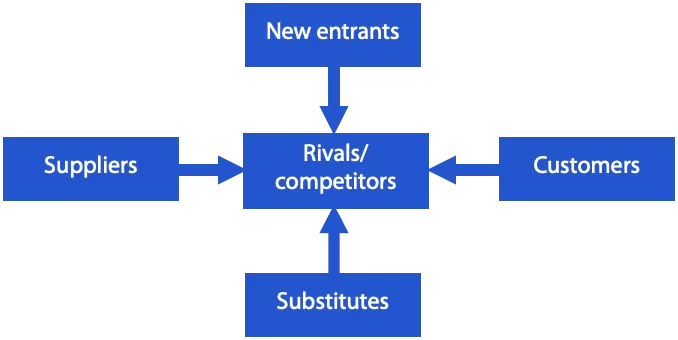
The first of the forces is competition or rivalry. This can range from perfect competition where sellers have no choice as to the selling price that is charged (they are governed by the market price) all the way through to monopoly. A monopoly gives sellers much more choice as to what price can be charged, though the price will normally alter demand. And remember, just because you have a monopoly doesn’t mean you will make profits - you might be the monopoly supplier of something nobody wants. However, by and large, the nearer an industry gets to monopoly, the easier a time its participants will have. Therefore, provided it’s legal, it could be a useful strategy to take over a rival or to force it out of business by, perhaps, lowering prices temporarily.
Now we will look at buyer pressure. If buyers are very powerful, then they can exert pressure on prices, quality and delivery times. Selling almost all output to a few powerful buyers will be an uncomfortable situation. The more buyers you have and the harder it is for them to switch between different suppliers, the better. Businesses should try to build in switching costs, that is, real costs or impediments that mean that buyers prefer to stay with existing suppliers.
Similarly, on the other side when you are buying goods from suppliers, if you have to buy a special component from a monopoly supplier, you will be in an uncomfortable position. That supplier could raise prices and you have to pay. Or even worse, that supplier could be taken over by one of your competitors, and then you will have no supplies at all. Ideally a firm should try to multi-source and if they get really worried about assurance of supply they should think about setting up their own supply organisation or perhaps taking over an existing supplier.
Potential entrants are sitting on the edge of the industry and may be attracted into it if they can see that good profits can be made. Anything which keeps out potential entrants is known as a ‘barrier to entry’. Occasionally, potential entrants are deterred because there is a legal monopoly within the business. Sometimes regulations make it hard for potential entrants to get into a business. For example, setting up as a bank is relatively difficult because of the various regulatory authorities that have to give their permission. The need for high capital expenditure and for know-how are two other impediments to potential entrants.
Substitute products arise usually by the advance of technology. Often the appearance of substitutes will surprise a business and take it off-guard. For example, landline telephone companies thought that they were almost in a monopoly position because the cost of digging up roads and laying landlines into houses, apartments and businesses would have been a considerable barrier to entry. However, then mobile telephones, cell phone technology, was invented, and good telephone coverage can be achieved with much less expense. There is not much you can do to avoid substitutes. Once technology is invented, it can’t really be sent suppressed. Most old industries have to join the new industries as well. So, now, many conventional telephone companies also have mobile phone networks in an attempt to retain their overall market share in telecommunications.
3 Porter’s value chain
Porter’s value chain is used to examine how a business makes profits or margin.
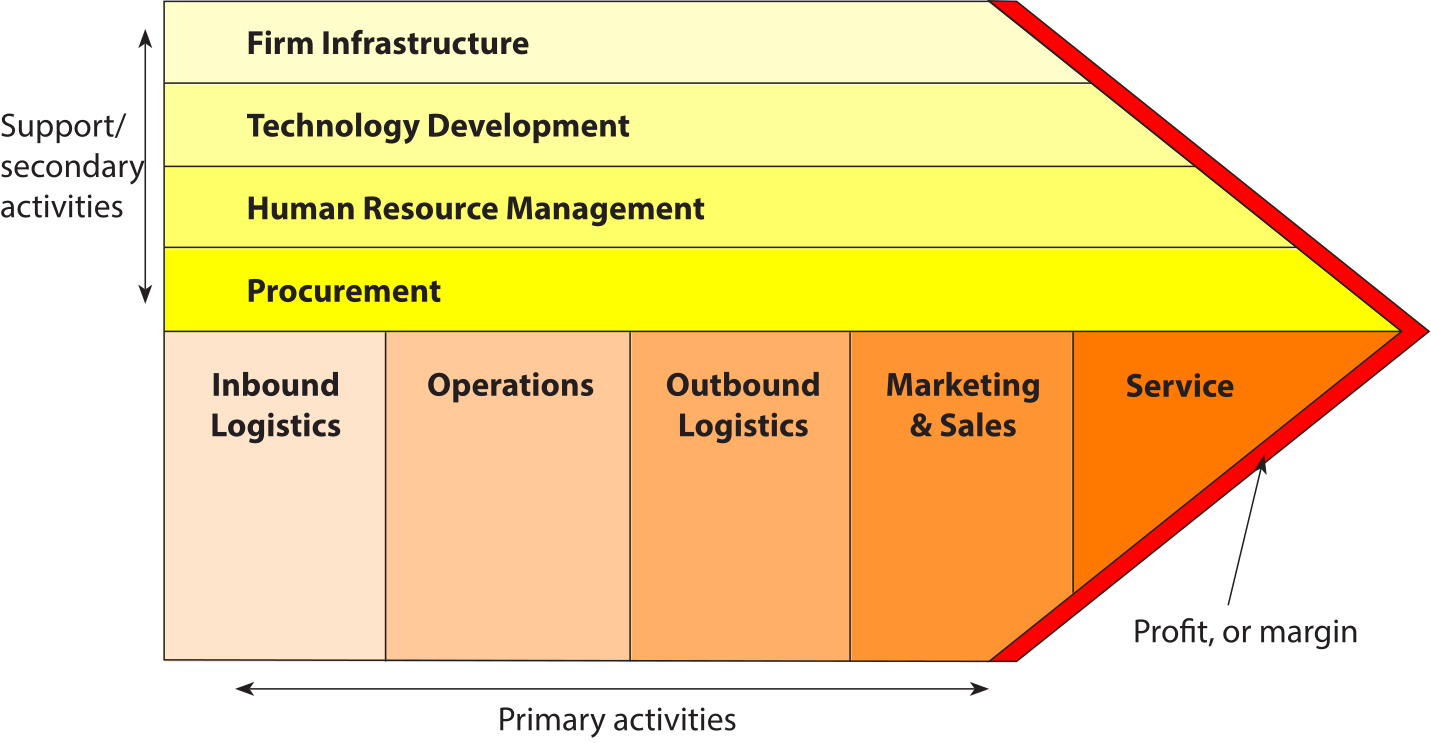
Across the bottom of the diagram, are set out inbound logistics, operations, outbound logistics, marketing and sales, and service. These are the primary activities. More or less these activities will equate to direct costs.
At the top of the diagram are firm infrastructure, technology development, human resource management, and procurement. These are the support activities. By and large they equate to indirect costs.
It has to be stressed that activities are shown in the diagram. However, every activity has an associated cost, and if all activities are represented there, so should all costs, and these could be allocated and apportioned, and so mapped to somewhere on to this diagram. Rent, for example could be apportioned over the operations (ie the factory), the warehouse, head office, and the marketing and sales department. Similarly with depreciation, heating costs, wages and salaries.
So, all the organisation’s costs can appear on this diagram. Let’s say these amounted to $10 million. The goods and services produced by the organisation will be sold, let’s say for $15 million. How come therefore buyers are willing to spend $15 million on what cost the organisation only $10 million? For what possible reason are customers willing to spend an extra $5 million over and above what the goods or services cost to produce?
The extra $5 million has to be explained somehow. It is known as ‘value-added’, and it is explained by arguing that the organisation accomplishes more for its customers than simply carrying out the activities and incurring the costs that can be spread over the sections of the value chain. The organisation must be doing something else. For example, it could be bringing skills and know-how to the process. Effectively it is bringing competencies to the process. It could bring convenience to the buyer, allowing the buyer to keep everything bought from the organisation as a variable cost rather than taking on board many of the fixed costs. It may bring economies of scale and the buyer is willing to pay for this because it will be impossible for the buyer to replicate these on a smaller scale.
The organisation must understand what it is that adds value, as this is the reason it can make profits. It is the secret of their competitive advantage. For example, the organisation might have very efficient manufacturing which allows it to sell goods a lower prices than competitors. Or it might have very good research and development which allows it to design better products that could be sold at a premium price.
The organisation must also understand how the different sections of the value chain are linked. It could be that if more were spent on human resource management perhaps less would need to be spent on operations because employees are better trained. If more were spent on technology development perhaps less could be spend on after sales service because the quality of the finish goods was higher.
Understanding the value chain is essential for organisations so that they know how their profit is generated. It has to be said, however, that sometimes organisations make mistakes identifying what it is about their activities that adds, value for the customer and they make changes which reduce their ability to make profits.
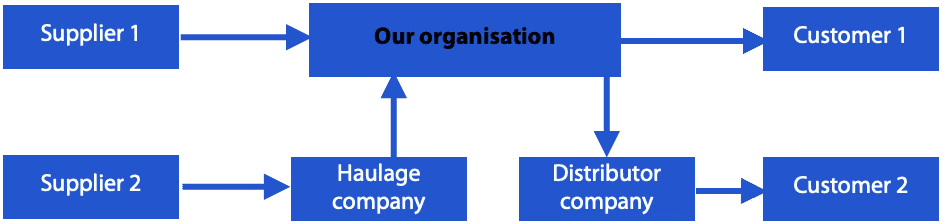
Each organisation has its own value chain, but what customers buy is usually the end-result of the efforts of many organisations: raw material producers, component manufacturers, logistics companies, assembly, and retail distribution and sales. Each organisation should be contributing to the value of the final product and the whole set of organisations is called a value network.
4 SWOT Analysis
An organisation’s Strengths, Weaknesses, Opportunities and Threats can be summarised using a SWOT analysis.
In SWOT questions, classify the factor from the organisation’s viewpoint before choosing an answer: strengths and weaknesses are internal; opportunities and threats are external.
Strengths and weaknesses are internal. For example, the organisation might have strong finance but a weak portfolio of products.
Opportunities and threats are external. For example, there might be a threat from a large overseas competitor coming into the country, but there could be opportunities to take over an ailing competitor.
Organisations should seek to match strengths to opportunities. For example, strong finance would allow the takeover of a weak competitor.
They should avoid relying on areas where they are weak, or should try to make good the weakness to defend themselves.
The organisation's environment
5 questionsAnswer the questions one at a time. Your progress is saved so you can leave and come back.
Open chapter practice