
The nature and structure of organisations

1 Organisations

An organisation can be defined as:
“A social arrangement which pursues collective goals, which controls its own performance, and which has a boundary separating it from its environment.”
This is, perhaps, a deceptively simple definition. Probably the most important word is ‘social’. Organisations consist of people and we are all social animals. We have to get on with our colleagues; ideally we would like our boss, or at least respect our boss. We have to get on with customers; we have our own ambitions; we have our own motivations.
Early management theory tended to neglect the social side of organisations and management and had a rather cold, militaristic approach. Modern theories have changed this considerably.
Another important aspect of the definition is that of ‘collective goals’. There has to be an assumption that people within an organisation are ultimately aiming at the same end results, if they are not, then chaos is likely to rule. One of the functions of management is to arrange the business and the people in it so that everyone is pulling in the same direction, and the collective goals are reached.
Business organisations are organisations that focus either on making profits (like a conventional commercial company) or on improving society (like a charity).
2 Systems
The definition of an organisation included the terms ‘boundary’ and ‘environment’. These terms come from systems theory.
The environment is what the organisation sits or lives in. For example a business lives in its national or country environment and perhaps in the international environment. The boundary separates the environment from the organisational system. Input normally goes into the organisation and output comes out of the organisation; some sort of processing takes place within the organisation.
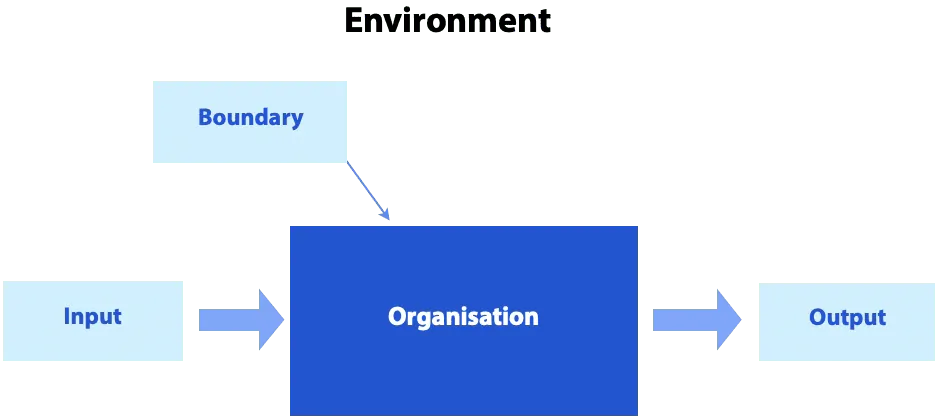
All organisations or systems can be divided into subsystems. For example, an organisation will have a sales and marketing department, an accounting department, a manufacturing department and so on. Subsystems can then be further split down into even smaller subsystems. For example, the accounting department will consist of the receivables ledger, the payables ledger, the cash book, the nominal ledger and so on.
Some systems are known as ‘closed systems’: they take no input from the environment and give no output to it. These are very theoretical and do not have a long life. It will be difficult to see an organisation continuing to compete successfully if it paid no heed to technological advances, to what its rivals were doing, or to what its customers wanted.
Open organisations, on the other hand, do receive input from the environment and produce output which is sent to the environment. These are the only ones of any practical importance.
3 Types of organisation
You need to be aware of the characteristics of several types of organisation.
Commercial organisations are profit-seeking. They can be sole traders, partnerships, limited liability partnerships and limited companies. The main advantage of limited liability partnerships and limited companies is that if the organisation hits hard times and has to go to liquidation, the owners of the organisation are protected. Creditors and banks can pursue only the assets which are in the company and the owners’ liability, but not the organisation’s, is limited. In contrast, sole traders and partners have unlimited liability for all the business’s debts.
Commercial organisations are usually classified as:
Primary sector: the extraction and production of raw materials.
Secondary sector: manufacturing.
Tertiary sector: provision of sales and services.
Sometimes a quaternary sector is split out from the tertiary: research and development industries, such as IT and pharmaceutical research.
The second type of organisation is a not-for-profit organisation. An example of a not-for-profit organisation could be a charity, such as a charitable hospital. Instead of producing a profit and loss account, they tend to produce income and expenditure accounts. Ultimately their income has to exceed or match their expenditure or they will run out of money.
Public sector organisations are owned by the state either at a national level or at a local level. Examples could be the defence department, many health services and educational systems. In some economies other industries or businesses are also owned by the state. For example, many national airlines are state-owned. Public sector organisations can be profit-seeking, but often are not.
Non-governmental organisations tend to be not-for-profit organisations but with an international brief. Many United Nations organisations will fall into this category.
Co-operatives are owned by the people who work in the organisation. Some farmers, for example, set up co-operatives to market their products more effectively than they could on their own. Usually they seek some sort of profit, but the ownership is shared widely amongst the people who are working in the organisation.
4 Organisation structures
4.1 Organisation structures can be described as:
entrepreneurial,
functional,
divisional,
matrix or
boundary-less
Entrepreneurial structures are very simple; basically it’s a boss and the workers. They are small, often family-owned, and are not large enough to be divided into separate departments. There is often no separation of owners and managers or directors.
Once a business begins growing it will normally develop into a functional structure. This means that there are separate departments according to function – a sales and marketing department, an accounting department, a payables department, a receivables department, a research and development department and so on. This can be a very efficient structure as expertise is concentrated in each department and there could be great economies of scale through efficient operation.
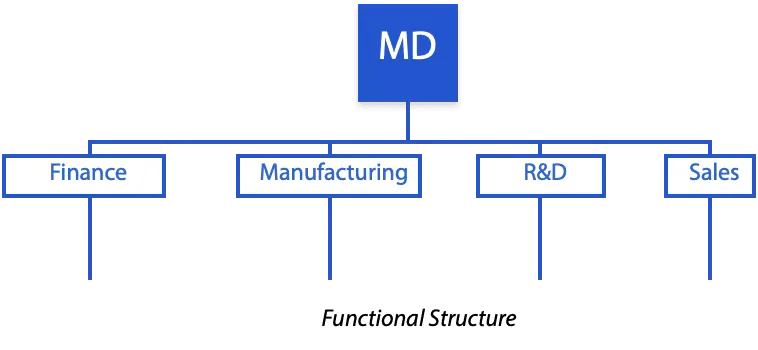
4.2 The main functions within organisations are:
Ordering and purchasing - provision of raw material and non-current assets. Negotiating with suppliers and placing orders
Manufacturing/production - this is what customers pay for. The manufacture of goods either standard goods or made to customer order (bespoke).
Service operations (direct service provision) - a business that specialises in providing services as opposed to manufacturing and selling goods. For example: lawyers, accountants, architects, consulting engineers. These businesses usually need to have qualified staff members available to perform the services that it offers to consumers. Note that services cannot be stored (in contrast to manufactured items) so client demands cannot be met by supplying from inventory.
Sales and marketing (finding customers, selling to them). See ‘Marketing’ in a later chapter.
Distribution. This can be achieved by using the business’s own transport. However, nowadays this function is often outsourced to a specialist logistics company, such as UPS or DHL.
Administration - the background tasks that keep the organisation running. For example, the office functions, dealing with correspondence, record-keeping.
Research and development - the development new products and services and the development of new manufacturing processes.
Human resources - recruitment, training, retention and, sometimes, removal of employees
Accounting and finance - including payment of suppliers and employees, invoicing customers and collecting payment, cash management, and financial statement preparation. The credit control department assesses the credit-worthiness of new customers, sets a credit limit and will chase slow-payers.
Cash and working capital management. Often this is part of the accounting department, but it is important to realise the importance of cash management: businesses fail, not because they make losses (owners could keep pumping in new funds), but because they run out of cash and cannot pay suppliers, staff salaries, interest, bank loan repayments or the tax authorities. A cash flow forecast (or cash budget) is a key document, showing the expected inflows and outflows of cash each month and the balance at the end of the month. This should provide long-range warnings so that the company might be able to raise new finance or defer some expenditure. The management of working capital can also help:
Encourage customers to pay faster
Delay payments to suppliers (potentially dangerous if overdone)
Reduce inventory so that less cash is tied up in stocks.
Treasury management. Typically, treasury departments are found only in large companies. Their function is to consider:
Is there enough long term capital? Do additional shares need to be issued? Do we need to approach banks for loan capital? What dividend can we afford to pay?
How can we manage and minimise risks arising from foreign exchange exposure? For example the company has exported to the USA and expects a US$ receipt. But is the US$ weakens, the amount received in the home currency will reduce.
How can we manage interest rate risk? For example, should the company borrow at a fixed rate or a variable rate of interest.
How can the company’s or group’s tax liabilities be minimised? You will note that companies like Apple, Google and Facebook have been criticised for their tax-mitigation methods.
Note that once organisations grow there is usually a separation between its owners (eg shareholders), those who direct it (eg the board of directors). There will also be a separation between the direction of the company (by the board of directors) and the hierarchy of managers who implement to board’s decisions.
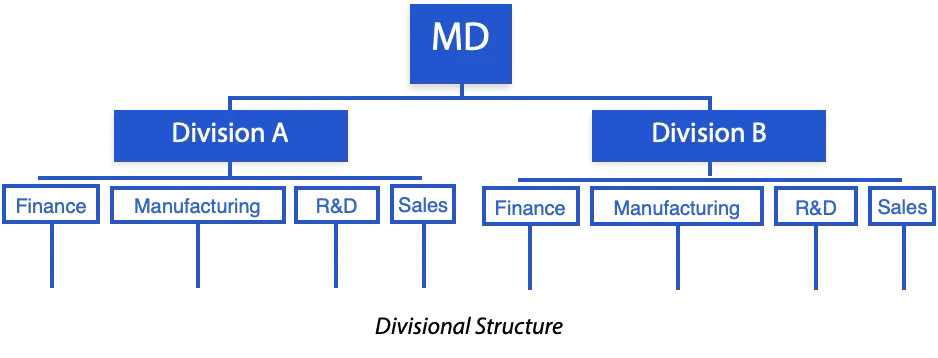
If the business continues to grow it may find it worthwhile to divisionalise. This means splitting the company up, perhaps on the basis of product or geography. For example you might have a North American division and a European division. You might have a division which makes and sells paint and you might have a division which makes and sells pharmaceuticals. The rationale for splitting a company up into divisions is to achieve specialisation. If you are selling paint and pharmaceuticals it is likely that the manufacturing is very different, the markets and competition will be very different, as will the regulation of the business. There is probably not much point in keeping it all together as one unit, and the business is better off being divided up into different divisions which can specialise in their own products and markets.
A matrix organisation is more complex. A good way to think of a matrix organisation is to think of a project team. A project team for project A, for example, will have a project leader or manager for project A. The members of the team report to that manager. But the members of the team also have functional responsibilities. For example, there will be a project accountant and someone who looks after the quality control aspects of the project perhaps someone who deals with the personnel involved in the project.
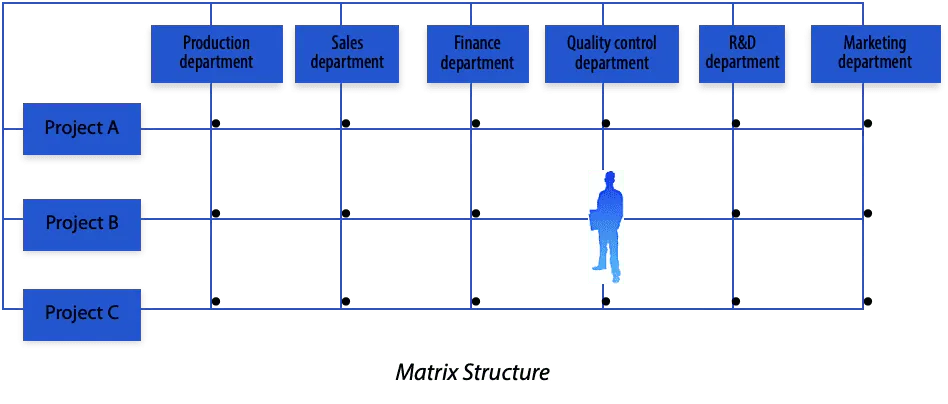
These people, as well as reporting to the project manager, also have to report to their functional heads. Therefore each person can have two bosses. Classical management theory suggested that this was unfair. But in fact depicting the organisation as a matrix doesn’t cause there to be extra pressure on the people who work for the project. It is perhaps simply a more honest representation of the pressures that the project members are under.
It should encourage more cooperation between managers. For example, if Project B were running behind time, the Project B manager and the Quality Control manager might be able to negotiate a way in which the quality control processes could be (safely) speeded up. The new approach can then be given to the quality control staff to implement.
A boundaryless organisation can be virtual, hollow or modular:
Virtual: create a company outside the organisation to respond to exceptional, often temporary market opportunities.
Hollow: all non-core operations are outsourced eg accounting, human resources, legal services and manufacturing could be outsourced, leaving the company to concentrate on its core competence eg design of new products.
Modular: order parts from different internal and external providers and assemble into a product.
5 Levels
Organisations are often regarded as having three levels, known as the ‘Anthony hierarchy’:
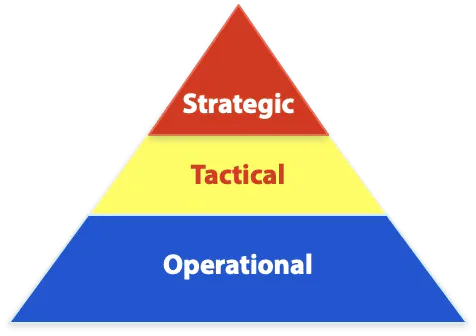
The top level is the strategic level. This is basically the very top managers and the board of directors. They should be looking after the strategy of the organisation, and whenever you hear the word “strategy,” you should be thinking of something like a five-year plan for the whole organisation. What will the organisation be doing in five years? In what countries will it be operating? Will it still be manufacturing or will it have switched to predominantly service provision?
Right at the bottom of the organisation is the operational level. This is the level where the day-to-day activities are carried out. The time horizons are very short, often things are dealt within a day, and planning is often not much longer than a week or two. These people are predominantly dealing with or recording transactions which are either happening or have already occurred: processing invoices, sending out orders, dealing with customer queries, these are all at the operational level.
In between there is the tactical level, think of the tactical level as being the level of a manager of a department. Typically this person will have a time horizon of about a year because this person will often be concerned with meeting the year’s budget. Of course they have to deal from time-to-time with day-to-day activities, but their particular priority will be to make sure that they organise their department to meet this year’s budgets and expectations.
6 Tall/narrow, wide/flat
Organisations are often described as being tall-narrow or wide-flat.
In the tall narrow organisation each manager or supervisor looks after relatively few people.
Here the diagram has been drawn so that each supervisor directly looks after two people. That will be described as having a span of control of two.
In the wide flat organisation the span of control is much wider. In this diagram we’ve shown a span of control of seven, meaning that each supervisor or manager has seven people reporting directly to him or her.
You will see in a tall narrow structure there are many layers and because each manager looks after only a few people, there can be very close supervision. Indeed it might not be mere supervision: it might be closer to re-performance or interference.
The tall narrow structure is sometimes described as very bureaucratic, very formal, strict job descriptions, great importance placed on exactly what one’s grade is, and the sort of pay and benefits and conditions that would go with that grade. The wide flat organisation is much more egalitarian; there is much less distance between top and bottom in the organisation and communication between top and bottom will be much faster. Because it is more egalitarian, there tends to be less emphasis on strict job descriptions and a greater emphasis on how can we get the job done, a greater emphasis on all being a part of a team, rather than being a part of a hierarchy.
In the 1990s there tended to be deliberate moves from tall narrow to wide flat by many organisations. They called this ‘delayering’ or ‘flattening’ the shape of the organisation. There were two motives for doing this.
First of all in the ‘90s there began to be very great cost pressure from Far Eastern manufacturers where manufacturing was relatively cheap. In response to this, Western businesses had to be somewhat ruthless. They had to ask, “Is any value being added by these people in the middle, or are they just managers, managing supervisors, managing assistant supervisors?” It was decided that often these people were not adding value and that they could safely be removed from the organisation.
Secondly in the 1990s, things began to move quickly. Technology changed very rapidly; there were huge changes in world markets, and operations based in China or India or Malaysia became very skilled and very adept at designing and launching new competing products. Western organisations therefore had to change and respond quickly and the tall narrow organisation was very slow to change. Many layers had to agree to the change, and many people were protecting their own particular grade. Therefore to get faster and more flexible responses to change, the wide flat organisation was often adopted.
Note that the term ‘scalar chain’ refers to the chain of command from the top of the company down to the bottom.
7 Centralisation/decentralisation
The shape of the organisation is independent of where power lies within the organisation. You could have two organisations of exactly the same shape and structure, yet in one a particular grade of employee could be given an expenditure authority of only 100 Euros but in another, the same grade of person could be given an expenditure authority of 10,000 Euros. Decentralisation or centralisation describes how far down the organisation power is passed. Generally it is agreed that some decentralisation is good but too much decentralisation can be counterproductive.
7.1 Claimed advantages are as follows.
If nothing is decentralised, all decisions have to remain at the top of the organisation, with the managing director or the board of directors. Those people would be overworked, they will be mixing up trivial decisions with important decisions, and really their skills should be reserved for making important decisions.
Secondly, if requests have to be passed up through an organisation for a decision to be made and then the answers are passed down, decisions are likely to be much slower. So decentralisation adds speed.
Third, it might be better to decentralise power to areas of expertise. For example the best person to make a decision about where to place advertising is somebody in the sales and marketing department, not the managing director who may have come from an accounting or engineering background. Similarly, perhaps the best person to deal with competitive pressures in South America is the head of the South American organisation, not somebody based in London or Paris. The person in South America has local or geographic expertise.
Fourth, motivation: good employees like to make decisions and like running their own departments or divisions. If you don’t decentralise and allow them to have power, the good people will leave.
Finally, training and assessment. If you never allow any junior people to make decisions, how will you know who the good ones are and who should be promoted in the future?
The big potential disadvantage is poor co-ordination, sometimes described as dysfunctional decision-making. That’s where one division could make a decision which although good for it may harm the organisation as a whole. It might be, for example, that a manufacturing division stops making a component which is vital somewhere else in the organisation. Poor co-ordination means it’s all messed up. Therefore there has to be some degree of co-ordination between the various departments and divisions in an organisation, and this may require the head office or the board of directors occasionally to interfere with the decentralisation and to impose decisions.
8 Recent trends
There have been some recent trends in organisational structure, including:
Downsizing (shrinking the business) has been necessary to keep costs down and, perhaps, to gain efficiency through outsourcing (see below)
Delayering, we have discussed recently, moving towards wider, flatter organisations, both to save costs and to achieve flexibility.
Outsourcing means getting an outside firm to perform some of your operations. These operations will generally be your support operations. Therefore, it is relatively common to outsource your IT and perhaps your receivables ledger. Most businesses don’t make money from the receivables ledger or from their IT and these are necessary evils. They may make their money from clever engineering or thinking up clever adverts if they are an advertising agency. The thought behind outsourcing is that firms should concentrate on what they are good at, their core activities, and try to outsource everything else, because those functions are liable to be management distractions. Management should concentrate on where it adds value: where the organisation can makes its money.
Offshoring is moving part of your business abroad usually to make use of cheaper labour rates found there. The processes could be outsourced to abroad or the company could set up its own operations there.
Shared services refers to the consolidation of business operations that are used by several parts of the same business. For example, IT and accounting could be located in one city and country to service the needs of an international organisation.
9 Formal and informal organisations
The formal organisation is what management has deliberately designed, it’s what management knows about, and also it’s often written down in some manner. Therefore management knows about the organisation chart and knows who is manager of the department, who is supervisor, and who works in it. Management will have caused procedures manuals to have been written to set out the proper ways of doing things. Staff appraisals, showing which staff may be better and which ones have certain weaknesses will also be carefully recorded.
However, an enormous amount of the organisation is informal.
This diagram is supposed to depict that, because what it shows is an iceberg. Only a relatively small part of an iceberg is seen or is known about. By far the greater part of it is invisible, but dangerous. If management is unaware of the informal organisation then they are liable not to be able to manage very well. So, for example, if you have two people who dislike each other but nevertheless, according to the organisation chart, are supposed to co-operate, then that department will not work well. Similarly, despite lower management issuing newsletters and e-mails to all their staff , rumour and gossip gets around organisations very quickly. It’s often inaccurate, but that doesn’t mean it’s not going to be believed.
Group norms is another important example. A group norm is an arrangement people come to, often slowly, about how they should behave. For example it might be the group norm that nobody ever works past 5 o’clock on a Friday. They have come to this arrangement somewhat informally but anyone new joining the organisation will generally fall in line so that they fit in and are acceptedly colleagues. Once certain group norms have been adopted by a number of people, it can be very difficult for management to shift those norms to something else as all of those people resist together.
Mutual cover-up. If you make a mistake, it should be reported to your manager, but you have a friend in the other department and you and your friend agree to conceal that mistake. After all, your friend never knows when he will need the favour again one day.
Management nowadays is generally familiar with the existence of informal organisations, but will find it difficult is to understand the nature and details of the informal organisation. What are people’s personal ambitions? What alliances have been made? What personal problems or relationships have been formed? What ways have people decided to act that could be wildly different from what’s laid down in the procedures manuals?
Examiner feedback: the latest FBT/BT report reminds candidates that operational supervisors motivate their teams, while departmental or project managers normally coordinate the wider resources—people, machinery and budgets.
Read organisational scenarios for structure clues. Functional means specialist departments; divisional means product, geography or customer units; matrix means dual reporting; tall or flat describes layers and span of control; centralisation or decentralisation describes where authority lies.
The nature and structure of organisations
5 questionsAnswer the questions one at a time. Your progress is saved so you can leave and come back.
Open chapter practice