
Chapter 13
The nature of groups

1 Types of committee
Standing committee: a permanent committee dealing with recurring matters.
Ad hoc or special committee: formed temporarily for a specific issue or project.
Executive committee: has delegated authority to make and implement decisions.
Sub-committee: examines part of a larger committee’s work and reports back.
Joint committee: includes representatives of different groups, departments or organisations.
1.1 Advantages and disadvantages of committees
Advantages include pooled knowledge, broader representation, better coordination, checks on individual decisions and greater acceptance of agreed actions. Disadvantages include slow and costly decisions, excessive compromise, domination by a few members, unclear accountability and discussion without action.
1.2 Building team effectiveness
Useful techniques include clear objectives and roles, an appropriate balance of technical skills and team roles, agreed ground rules, regular briefings, training and coaching, constructive conflict resolution, team-building or problem-solving exercises, feedback and review of performance.
2 Consequences of ineffectiveness at work
Individuals may be ineffective through lateness or absence, low productivity, missed deadlines, errors, poor-quality work, weak communication, resistance to change or failure to follow procedures. Teams may suffer from unclear goals and roles, an imbalance of skills, poor coordination, unresolved conflict, domination, free-riding or weak decisions.
The organisational effects can include delay, rework and higher costs; dissatisfied or lost customers; reputational damage; control, safety or compliance failures; lower morale and higher staff turnover; and reduced profit or failure to achieve strategic objectives.
3 Groups
Knowledge of groups is an important aspect of management theory.
This is a very good definition because it includes both formal and informal groups. Handy said any group will have:
Handy defined a group as :
“Any collection of people who perceive themselves to be a group.”
A sense of purpose or aim
An identity; in other words, there is a feeling of who is within the group and who isn’t within the group.
Group norms, that is, accepted ways of behaving and if you don’t fall in line with group norms, you are likely to be excluded from the group.
Communication between the members of the group.
Groups can be formal or informal.
The formal group is simply one which is formed by management.
Informal groups are not formed by management action and indeed management may not even be aware of their existence. However we are social beings and we like being part of a group and therefore understanding groups is important to management. You may remember groups were mentioned when we talked about the human relations school of management first identified by Elton Mayo. In his study at the Hawthorne plant of the Western Electric Company the existence of informal groups was discovered.
4 Team Roles
A team is an example of a formal group: the team would have been deliberately created by management.
One of the great advantages of the team is that people with different skills are brought together so that the team is stronger than any one person individually could be. So if you’re forming a team to look at the implementation of a new IT system, you probably have someone with IT skills, someone with accounting skills, someone with production skills, and so on. Each of these people will bring knowledge and also can represent their own particular interests.
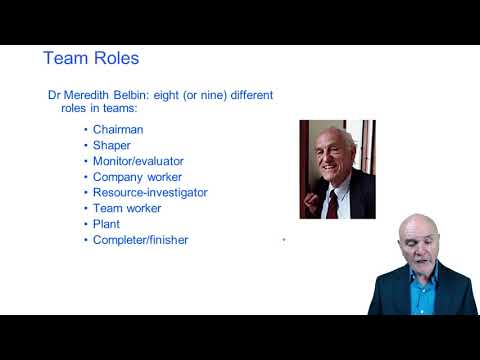
However, as well as bringing different technical skills it has been recognised that people bring different psychological profiles, and this has been examined by Dr. Meredith Belbin who categorised eight or perhaps nine team roles, and produced questionnaires that would allow people to assess what their particular characteristic or characteristics were.
Chairman (sometimes called, the “coordinator.”) This person clarifies goals, promotes decision-making and is a good delegator.
Shaper. Is someone who is someone driven, thrives under pressure, wants to overcome obstacles, tends to want to get their own way.
Monitor/evaluator. Sees all options, judges things accurately and fairly objectively.
Company worker (sometimes called an “implementer”). Turns ideas into practical actions. They’re not particularly the theoretical person, more the “roll your sleeves up and get on with it” sort of person.
Resource-investigator. Explores opportunities, examines contacts.
Team worker. Listens, builds, tries to play down potential friction, calms the water.
Plant rather unusual unorthodox person - creative, imaginative, and is deliberately put into the team - planted in other words - with the hope that they will solve difficult problems and bring some slightly offbeat ideas into consideration.
Completer/finisher. This person is painstaking, conscientious, careful, looks for errors and is keen on finishing within the deadline.
Specialist. A single-minded person who provides particular knowledge and the skills which may be in rare supply otherwise.
Belbin says that you want people with all of these characteristics within a team. This doesn’t mean you have to have eight or nine people because many people are strong in more than one of these characteristics. You also have to sometimes be careful not to have more than one person of a particular sort. For example if you have two shapers – they were the people who quite liked their own way - there is likely to be some conflict.
5 Tuckman – Stages of team development
Another area of groups which will easily lend itself to questions in the examination is Tuckman’s stages of team development. He said every team or indeed group will go through these stages.
First, there is the forming stage; a rather slow tentative stage - should we form a group? What might it be for? In informal groups, a gradual coming together of people with like interests.
Then he there would be a storming stage, a stage where different people might compete for different roles within the group; perhaps two people with shaper-type characteristics fighting over who is actually going to become the main spokesperson for the group.
Then there would be norming - establishment of how the group is going to behave, acceptable methods of behaviour.
At long last the group begins to perform; we get some output from it. People know each other, they know what the group is for, they know who is the leader of the group, they know who is the spokesperson of the group, they know who the completer/finisher is, they know how often they are going to meet, whether formal records are going to be kept and so on, and they can perform.
Finally there is a dorming stage. This is where a group meets out of habit rather than out of any real need. At the dorming stage, effectively the sleeping stage, not much is achieved and really the group at this point should be disbanded.
Are there any lessons to be learned from these stages of team development? Well, the main one is that no useful output is really achieved until the group reaches its performing stage. Therefore anything management can do to accelerate the passage from forming, through storming and norming until we get to performing, is good.
So when a formal group is created, management can form it, they will say who is in it, what it’s for. They will say who the leader of the group or the team is going to be; that’s the storming out of the way. They might tell the group that you will meet once a week, that we want you to report once a month. And very quickly the group can get down to actually performing so that the organisation gets useful output.
Additionally, Tuckman said was that every time the composition of the group changes - one member leaves, another one joins - you go through these stages again. There is a slight loss of performance. And once again management could take action to try to introduce a new person to the group in such a way that the group is disturbed relatively little, and the performing continues almost unabated.
6 Teams and committees
For an effective committee, look for a clear purpose and defined responsibilities, plus an appropriate mix of members. ‘Open-ended’ discussion is a warning sign because it makes the meeting harder to control.
Finally on groups, a couple of descriptions of two types of formal group.
First of all a team and we use the word “team” automatically whether it’s an IT implementation team, a project team, a football team. Teams are deliberately formed, they have very specific objectives, almost always they bring together mixed skills, and they will have a definite leader or captain.
Committees are also formal groups deliberately formed, and certainly with specific areas to deal with. However, rather than actually carrying out specific tasks they tend to be more concerned with decision-making, bringing together people from different departments, discussing matters and coming to a conclusion. There will be a chairperson or chairman, or nowadays even just called “chair.” This person tends to coordinate the committee rather than giving it orders. They will be drawn from different departments and they will have mixed skills so the information is shared, and finally any decisions made are normally recorded formally, on minutes, by the committee secretary, who is also responsible for distributing the minutes and agenda.
7 Effective and ineffective teams
Characteristic | Effective team | Ineffective team |
Goals | Understood and agreed | Disagreement and a lack of understanding |
Contributions from members | Every member participates eagerly | Some members dominate the team whilst others say little |
Listening | Members listen to others and respond to the points made | Members might appear to listen but then simply reiterate their own views. No real interaction |
Conflict handling | Disagreement is tolerated and might even be welcomed as a creative step | Disagreements are ignored or suppressed. |
Decision-making | Consensus is usually achieved ie a united view on which all are prepared to agree | The leader might decide, over-ruling objections, or votes taken after which minorities still feel ill-at-ease. |
Assignment of responsibility | People are given clear action points that they are expected to achieve | No responsibilities are allocated and often points decided upon get done by no-one. |
Self-evaluation | Self-examination and self-criticism are common so that adjustments are made to the group’s method of operating to keep it effective | Self-evaluation is avoided and methodologies are static. |
The team leader is key to the creation of an effective team because the leader can:
Ensure everyone understands the team’s goals and purposes
Set the agenda for the meeting
Ensure team-members know their roles and the roles of others
Ensure all contribute
Stop domination by only a few
Encourage consensus
Protect minority views
Record and follow-up clear action points
Occasionally team-building exercises might be used to, for example, demonstrate the importance of good communication within the group.
8 Dorming and mourning
Mourning stage, when the team disbands and members adjust to its ending.
Dorming is different: the team still exists but has become complacent and ineffective.
The nature of groups and teams
6 questionsAnswer the questions one at a time. Your progress is saved so you can leave and come back.
Open chapter practice