
How people learn

1 Kolb’s four stages
The standard names of Kolb’s four stages are concrete experience, reflective observation, abstract conceptualisation and active experimentation. These correspond to having an experience, reflecting on it, forming a theory and testing that theory.The learning process

There are two approaches to learning theory.
First, the behaviourist approach. In this approach we are assumed to learn essentially through reward and punishment. It’s based on stimulus. So if we do something right and we get rewarded, we are likely to do that again. If we do something else and in some way get punished, we are likely to try to avoid that. And so as time passes and we learn, and we will tend to do more of the right things. This doesn’t mean of course that we understand what we are doing. Only that we respond appropriately in certain circumstances.
The cognitive approach tries to look rather more at the mental process we might go through to gain understanding. It argues that the mind takes sensory information and tries to impose some sort of logic on that, some sort of rational approach. Very much more in this approach we understand or attempt to understand what’s happening and why we are doing it.
Probably the cognitive approach will ultimately be more flexible. If we are presented with a new situation, we might be able to think our way through it. But if we have learnt simply on the behaviourist approach and we don’t know why we are doing something, then a new situation is likely to confuse us.
2 Honey and Mumford
There are two sets of learning theories that you need to understand for this examination.
The first is by Honey and Mumford who examined different learning styles. They categorised different learning styles as theorists, reflectors, activists, and pragmatists.
A theorist likes to understand the theory before moving on to practice or practical application. The theorist is likely to read an instruction book first before trying to work the new computer.
Reflectors observe what’s going on and carefully consider it. They like to work at their own pace and tend to be a relatively non-participative and cautious learner.
Activists are almost the reverse of theorists. If they had a new computer they would switch it on and try and work it before ever thinking of looking at the user guide. They are excited by pressure, by new projects. However, they do tend to rush into things without adequate preparation.
Pragmatists are inspired to learn if they see a practical outcome. They willingly learn something if they see it will help them make their job better or easier. They wouldn’t at all be interested in learning for learning’s sake and they probably would find it quite difficult if a theoretical approach was taken to instructing them.
What’s the point of these four categories? Well, if you were trying to train a group of 20 people, remember, they won’t all learn in the same way. Some will be theorists, some will be pragmatists. Perhaps the best you can do is go for a variety of activities and approaches so that each type of learner is given something they can respond to.
3 Kolb – experiential learning
The second learning theory in the syllabus is Kolb’s experiential learning: the idea that we go through a number of cycles, gradually learning by our experience.
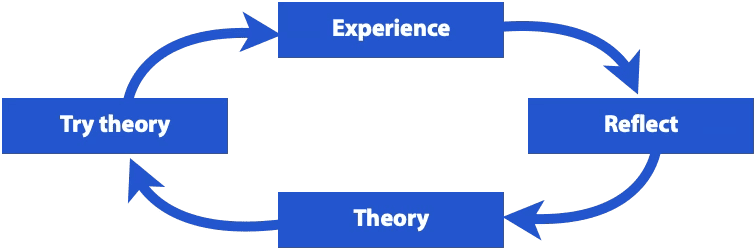
Let’s take as an example a situation where we have made a presentation to a potential new client for a valuable new contract, but we don’t win it. That’s the experience, so we go away and think why we didn’t win it. It could be that our prices were too high; it could be that our presenters didn’t do a very good job. Anyhow, from this reflection we develop a theory about how to increase our chance of winning, and next time we make a presentation, we try out our ideas. If we fail to win the next job, we need a bit more reflection but if we win the next job then we probably conclude that we have moved in the right direction, that we have learned better how to pitch for new work.
4 Developing and training
Now we need to look at some matters relating to development and training. First, some definitions.
Training. Training is very specific. It is needed for your current role. So you would talk about training in use of a spreadsheet or a database or the accounting system.
Development is much less specific; it’s needed at some time in the future. Very often the word “development” is linked to management to give the term ‘management development’. Say that we know that as a manager’s career progresses, the manager will probably be required to make presentations, to write reports, and to interview potential new employees. The manager might not need to carry out these activities within the next month or so or even the next year. But we know that probably at some time in the future a manager should be equipped with these skills. Development provides the manager with the skills for the future.
Education is knowledge acquired gradually through learning and instruction. It might or might not be work-related.
Classify learning by its purpose, not by the label of the course: training develops skills for the current job; development prepares for future roles; education builds broader knowledge.
Irrespective of what type of learning is required, it certainly needs to be properly planned. Training is expensive: the cost of trainers, the cost of employees’ time and the cost of the damaging effects of missing or ineffective skills and abilities. The planning process usually follows steps like these:
Training needs analysis: what are employees’ current skills and competences and what skills and competences do they or will they need. Identify gaps.
Agree a budget.
Decide how the training will be provided: formal courses (in-house or elsewhere, by company staff or outside training), coaching, mentoring, shadowing a colleague, self-study or computer-based training programs.
Provide the training.
Measure the results to assess the success of the training and to identify if employees have now reached the required standard.
Effective training should:
Motivate employees
Increase productivity and efficiency
Increase employee initiatives
Reduce the incidence of errors and shoddy work. This reduces business risk and increases profit
Improve customer relations and customer loyalty
Helps the organisation to comply with laws and regulations
Allow more delegation to employees and therefore more flexibility in assigning work.
How people learn
8 questionsAnswer the questions one at a time. Your progress is saved so you can leave and come back.
Open chapter practice