
Theories of motivation

1 Motivation

Motivation has been described as the urge to run towards a target rather than merely ambling towards it. Understanding motivation is important for managers. You want your staff to be keen to run towards targets, to never be satisfied, to always seek improvement. If you don’t understand what motivates individuals or how they can be motivated then it can be difficult to get them to work enthusiastically in a way that will fulfil the organisation’s objectives.
2 Maslow’s Hierarchy of Needs
One of the most famous theories of motivation is Maslow’s Hierarchy of Needs which was put forward in 1943. This is a content theory of motivation. Maslow stated that we all have a variety of needs and we’re motivated to try to meet those needs. However, he said the needs form a hierarchy.
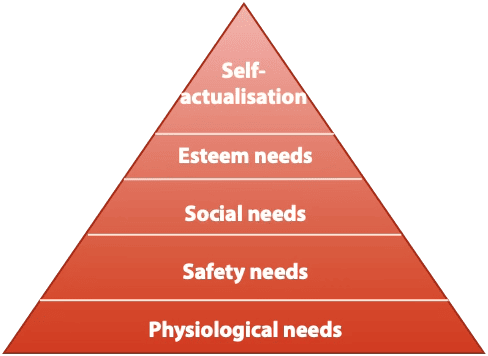
First if you have absolutely nothing, your world will be dominated by physiological needs. Those are physical needs: somewhere to live, food, warmth.
Once those needs have been satisfied then you turn your attention towards safety needs. Not only do you want somewhere to live but you want somewhere relatively safe to live.
In terms of jobs and organisations one might argue that once one earns enough to satisfy physiological needs then one might turn towards satisfying safety needs - physical safety in the workplace, medical coverage, job security.
Once the safety and physiological needs have been met, we then turn our attention to social needs, the need to get on with people, to feel wanted, to have friends.
After that there is esteem, the need to be respected, to be recognised, to be looked up to, to be praised, to feel that you’ve done something well.
Finally the self-actualisation needs. This is a need we might have to think that what we’re doing, the way we’re living is worthwhile, that it’s not all simply a waste of time.
Maslow said we all have these needs. Some of them can be met at work perhaps. Some people don’t need to meet them at work if they were born extremely rich as there is no problem with their physiological needs or safety needs and there will probably be no problem either with their social, esteem or even self-actualisation needs.
There are many critics of this theory. For example that not all people go through the needs or place their needs in the same hierarchy, and it could well be that many people have higher social needs than are suggested in this diagram. Sometimes we might be able to meet these needs through work. Sometimes work may give us no opportunity to meet these needs.
Perhaps the main lesson to be learned from this theory is that there is more to motivating people than money. People may prefer stable employment to a pay rise, for example. They might prefer a small promotion with little increase in salary. They may respond very well to being praised and they may respond very well if they feel what they’re doing is worthwhile.
3 Hierarchy of needs - limitations
Here are some of the potential limitations of Maslow’s theory.
First of all is the order in which we want to fulfil needs correct? Is that the only order?
Secondly, we are all individuals, we may have different needs, they may be in different orders, and the importance of needs may well change throughout our lives.
The theory might not properly explain altruistic behaviour; that is behaving in a way which doesn’t fulfil our needs but which is more directed and fulfilling other people’s needs first.
Finally the theory is dominated by Western cultural values. Maslow developed his theory in America and it could well be that that culture is more interested in material well-being than some other cultures where, perhaps, social needs are more important. We certainly have to be careful when applying Maslow’s hierarchy of needs internationally. It’s well known that people from different cultures may have different priorities.
4 Herzberg
Herzberg postulated his theory hygiene theory of motivation.
He was using the word “hygiene” as an analogy with hospitals. If the hospital is going to make you well it must be hygienic; in other words, clean. If it’s not hygienic you’ll get worse. But hygiene itself doesn’t make you well: hygiene is just a starting point.
First he argued that an organisation must get its hygiene factors correct. If a hygiene factor is missing then people become dissatisfied. Examples of hygiene factors would be enough money to live on, reasonable relations with colleagues and your superiors, reasonable physical conditions in which you’re working, a feeling that you’re being fairly treated. If any of these is missing you are likely to be so upset that none of the other motivating factors that the organisation tries will work.
Once the hygiene factors are in place then you can have the motivating factors such as recognition, praise, a feeling that you are advancing and getting better skills, a feeling that what you’re doing is worthwhile interesting work.
It should be noted that the Herzberg hygiene factor theory is not completely different to Maslow’s hierarchy of needs. Many of the lower order needs (physiological needs and safety needs) are very similar to what Herzberg would call hygiene factors. The higher order needs (social needs, esteem needs, self-actualisation needs) are very similar to Herzberg’s motivating factors.
The Herzberg theory is sometimes known as a two-factor theory (hygiene factors + motivation factors).
5 McGregor – Theory X and Theory Y
McGregor’s name is associated with Theory X and Theory Y. This can be regarded as a theory of motivation, but it can also be regarded as a theory of management, in particular a contingent theory of management.
You might remember the Ashridge model of management style: tells, sells, consults, joins with, a range of style going from very autocratic and dictatorial to one which was increasingly democratic and participative. Theory X and Theory Y simply represent the two extremes.
The Theory X manager assumes that people really don’t want to work, that they have to be watched very carefully, that they are lazy, that they only go to work with some reluctance because they have to earn money to live.
The Theory Y manager believes that the workforce thinks that work is as natural as play, that they get enormous social rewards from going to work, that they get enormous interest from going to work, that they like being given problems to solve, and they like recognition.
So how do we motivate people?
McGregor’s was called Theory X and Theory Y to be entirely neutral, not Theory Wrong and Theory Right. Basically he was saying that if you are put in charge of people who don’t like to work and who go there reluctantly, then perhaps the way you have to get the best work out of these people is to be very strict with them, to watch them carefully, to control them closely.
If however you are a manager of people who have good qualifications, who are used to being asked their opinion, who have high technical skills, then by far the best way to motivate them is a much more participative approach.
So motivation is effectively a matter of contingency. It depends whom you are trying to motivate. Different people are motivated by different managerial approaches.
For Theory X/Y questions, match the wording to the assumption: needing direction and control signals X; self-direction, satisfaction and creativity signal Y. Do not reverse the two labels.
6 Intrinsic and extrinsic rewards
Motivational influences can be termed “intrinsic” and “extrinsic rewards.”
Intrinsic rewards come from within - a feeling of achievement, challenge, personal advancement, self-fulfilment.
Extrinsic rewards come from outside. Typically they would be pay, praise, recognition.
7 Increasing motivation
So how on a practical basis could we go about increasing motivation?
The first approach which is normally suggested is participation. Elton Mayo’s investigations in the 1930s suggested that taking an interest in people, asking their opinion, allowing them to contribute towards decisions, seems to motivate.
The second approach is job design, of which there are three main types. Probably the first two here aren’t going to be very motivating in fact.
Job enlargement means more of almost exactly the same. It is certainly what will be called a horizontal change; there is no more challenge or responsibility in the job. So if you are working in a car factory and your job was putting on the front wheels, job enlargement would let you put on the back wheels as well.
Job rotation is also a horizontal change, no real increase in challenge. Here if you were working in a car factory and your job was putting on the wheels then perhaps next week you could put in the headlights, the week after that you could fit the exhaust pipe and so on. But they are all essentially fairly basic manual jobs and at best perhaps job rotation alleviates some of the boredom.
Job enrichment is a vertical change. It’s giving people more responsibility and more challenge in their job. Here we use our car factory analogy again. If your job was putting on wheels it could perhaps be enriched if you are also given responsibility for some sort of quality control. Perhaps as a car went past you’d be asked to identify blemishes in the paintwork and to report those. Here there is an undoubted increased responsibility and interest and this is assumed to increase people’s motivation somewhat.
8 Pay as a motivator
Finally on motivation we look at the extent to which pay, wages, and salaries can be regarded as a motivator.
When Herzberg originally formulated his hygiene theory pay was regarded as a hygiene factor. You had to give people sufficient pay that they could live reasonably from week to week. Later on he revised his theory and pay came in both sides. Basic pay had to be sufficient to live on, then offering people bonuses or increased pay of some sort could be strongly motivating.
If it’s going to motivating it’s really essential that pay is related in some way to effort or to achievement, but there are certain difficulties here. First of all businesses often don’t have complete freedom relating to what to pay people. They have to bear in mind what they can afford, what the going rate is. You can’t keep giving people increases over and above inflation otherwise they’ll simply be priced out of their market.
Also, many large companies have strict pay bands and if you are a certain grade you’ll be paid within that band irrespective of how good you are. And finally, performance-related pay can be difficult to assess unless that person’s performance can be directly measured and assessed. However, in many organisations performance depends on what other people do as well as what you do, and it can become very difficult to be sure that you’re giving group rewards or performance-related pay in fair ways.
Theories of motivation
5 questionsAnswer the questions one at a time. Your progress is saved so you can leave and come back.
Open chapter practice