The Statement of Financial Position and Income Statement (part c) - ACCA (FA) lectures
YouTube video
50 Comments
D
dipskhuzaim·
❤️
B
Boss·
Ok understood sales-cost of good sold to find gross profit
Z
Zohrab·
Thank you for lecure
H
Hadeel Mansour Alhumaidi·
Got it now, the gross profit is
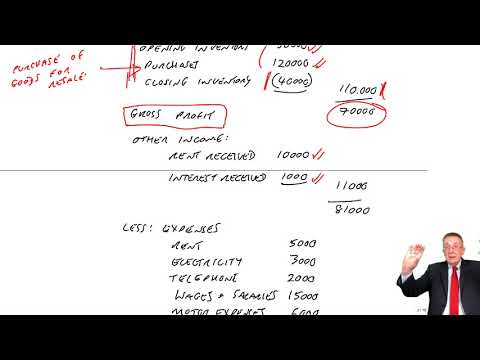
Revenue of the sold purchases - the closing inventory= 110,000 - 40,000 = 70,000
W
Williamson·
Nah brother, gross profit= revenue-cost of sales=180,000-110,000=70,000.
A
abdullahkashmiri·
u replied too late lol
H
Hadeel Mansour Alhumaidi·
I dont get it how the 70,000 coming from??
J
John MoffatTutor·
The revenue (180,000) less the cost of sales (110,000) gives the gross profit (70,000) !!
M
Mirza Yasir·
There is a term Gross Profit (Sales - Cost of Sales)
Is there any term for Gross Profit + Other Income, it will be still called Gross Profit or something else?
M
Mubiana·
why do we classify rent received under other income when in fact letting out property isnt our main business is it because its injected in the business. why cant it fall under capital employed since its separate from the business and brought in by the owner whats the connection there ?
J
John MoffatTutor·
We show it as other income precisely because it is not our main source of income.
It is not separate from the business - it is a source of income for the business. The business belongs to the owner (this is not a limited company as is stressed in the lecture - we deal with limited companies in a later chapter) but we are calculating the profit of the business. All income of business less all expenses of the business result in profit for the business, and the profit increases the capital which is owing to the owner as is shown in the Statement of Financial Position.
J
Jakhongir·
Thank you for the lecture it was great but could you please explain me how cost of sales here related to sales revenue: $180 000
J
John MoffatTutor·
You are correct (and is what I show in the lecture) except for the fact that the closing inventory is 40,000 and not 4,000.
H
Halima·
Really thanking much for the well detailed teaching .
J
John MoffatTutor·
Thank you for your comment :-)
S
sandra·
Is that the exact format for the statement of profit or loss
J
John MoffatTutor·
For a sole trader, there is no 'exact' format, but what is in the lecture is the normal format. For limited companies there are strict rules and the format of the SOPL for limited companies is explained in a later lecture.
A
Akbar·
I have a little problem. Can you explain fully definition of bank overdraft
J
John MoffatTutor·
It is where the bank allows your normal current account to go negative.
For example, suppose that at the moment I have $100 in the bank. I then go and spend $150 from my bank account. So my balance is now minus $50 (we say that I am $50 overdrawn).
I can only do this if the bank has given me permission to go negative/overdrawn - they will usually set a maximum amount allowed, depending on how good a customer I am.
They will charge interest on the overdrawn amount because they are effectively lending me money. It is only for short-term borrowing from the bank.
B
blue87·
Thank you
J
John MoffatTutor·
You are welcome :-)
Y
Yao·
Hi. If a share holder in a limited liability company (or a sole proprietor) decides to give the company money (to help with revenue expenditure) and money is repaid to the shared holder / sole proprietor at a later date, will that also considered to payment of dividend or drawing (in the case of a sole proprieter )?
J
John MoffatTutor·
No. It is a loan to the company which is then repaid.
J
Judith·
Can investments be classified as a liability?
J
John MoffatTutor·
If the business has made an investment then it is an asset.
S
Slake Derreck·
Hello,
I know you mention that if an owner takes money from they business its drawings but what if they also work for the business in a management position. Are they still taking drawings when they pay themselves say a monthly.
The other question is if someone who owns a stake in a company(for example 30%) and works can take a salary and also draw money from the business.
Look forward to hearing from you.
Thanks
J
John MoffatTutor·
If it is a sole trader (i.e. not a limited company) then anything the owner takes is drawings, even if they do work for the business.
If it is a limited company then anyone working for the company is paid a salary and there is no such things as drawings. If they also own shares in the company then they will get paid a dividend. This is all explained in the later lectures on limited companies.
I
IBRAHIM·
Hi, sir what is the effect of return inward and return outward on statement of profit orloss
J
John MoffatTutor·
They are both explained in a later lecture :-)
J
John MoffatTutor·
Thanks for your comment :-)
S
sepideh·
Thanks for your great teaching
J
John MoffatTutor·
Thank you for your comment :-)
A
Andrew·
Flawless teaching ! Very grateful !
J
John MoffatTutor·
Thank you for your comment :-)
S
Shobinya·
Sir,
I have always struggled with these basic knowledge of accounting as subject but never took an active decision to learn them. As I am preparing for my March Financial Reporting exam, I planned to get my basics knowledge concrete. I find it more empowering to know actually what is going on in accounts. Makes me feel more confident. Thank you sir.
K
kasie666·
saaaammmmmeeeeeee lol
A
Asif·
Sir, you are the best finance and accounts teacher I have been blessed with. I am really grateful to God you as a teacher are there.
J
John MoffatTutor·
Thank you for your comment :-)
K
kandiero·
Rent Received & Interest received is it not part of the trading account?
R
Ruqayyah·
Can you help for this question?
Usefulness of indirect method for statement of cash flow for stakeholders?
J
John MoffatTutor·
It helps them understand the relationship between the various financial statements.
S
Suraj Nagesh·
Hi sir, so in terms of accounting the word "Purchases" means any good bought for resale.
In terms of accounting what would a purchase of non current asset be labeled ?
Thanks and kind regards.
S
Suraj Nagesh·
Okay, please disregard the above.
I went through the next lecture and understood what you call the purchase of a non current asset.
A Capital expenditure.
:)
A
Asif·
You are the best finance and accounts teacher I have been blessed with. I am really grateful to God you as a teacher are there.
J
John MoffatTutor·
Thank you for your comment :-)
K
kyrb88·
When you are crediting and deducting from the right column, I don't understand why you wouldn't put the deduction as a minus. Such as;
Is this just an unspoken rule, that you would look at the header and automatically know, and/or is it up to the person who creates the FS P&L as you said it can vary depending on the company.
Thank you
K
kyrb88·
Apologies, summary should be:
Sales Rev – 180,000
Cost of Sales (110,000)
70,000
Gross Profit – 11,000
81,000
Expenses – (31,000)
Net Profit - 50,000
J
John MoffatTutor·
Firstly, the layout in this lecture is for a sole trader - not for a limited companies (limited companies are covered in a later chapter and the layout of their financial statements is a little different and is dictated by law).
Second, you cannot be asked to prepare a set of financial statements in the Paper FA exam, but you could be presented with statements (or extracts from them) for either a sole trader a limited company in the exam, and so you should know how they are likely to be shown in the exam.


Revenue of the sold purchases - the closing inventory= 110,000 - 40,000 = 70,000
Is there any term for Gross Profit + Other Income, it will be still called Gross Profit or something else?
It is not separate from the business - it is a source of income for the business. The business belongs to the owner (this is not a limited company as is stressed in the lecture - we deal with limited companies in a later chapter) but we are calculating the profit of the business. All income of business less all expenses of the business result in profit for the business, and the profit increases the capital which is owing to the owner as is shown in the Statement of Financial Position.
For example, suppose that at the moment I have $100 in the bank. I then go and spend $150 from my bank account. So my balance is now minus $50 (we say that I am $50 overdrawn).
I can only do this if the bank has given me permission to go negative/overdrawn - they will usually set a maximum amount allowed, depending on how good a customer I am.
They will charge interest on the overdrawn amount because they are effectively lending me money. It is only for short-term borrowing from the bank.
I know you mention that if an owner takes money from they business its drawings but what if they also work for the business in a management position. Are they still taking drawings when they pay themselves say a monthly.
The other question is if someone who owns a stake in a company(for example 30%) and works can take a salary and also draw money from the business.
Look forward to hearing from you.
Thanks
If it is a limited company then anyone working for the company is paid a salary and there is no such things as drawings. If they also own shares in the company then they will get paid a dividend. This is all explained in the later lectures on limited companies.
I have always struggled with these basic knowledge of accounting as subject but never took an active decision to learn them. As I am preparing for my March Financial Reporting exam, I planned to get my basics knowledge concrete. I find it more empowering to know actually what is going on in accounts. Makes me feel more confident. Thank you sir.
Usefulness of indirect method for statement of cash flow for stakeholders?
In terms of accounting what would a purchase of non current asset be labeled ?
Thanks and kind regards.
I went through the next lecture and understood what you call the purchase of a non current asset.
A Capital expenditure.
:)
Sales Rev - (110,000)
70,000
Gross Profit - 11,000
81,000
Expenses - (31,000)
50,000
Is this just an unspoken rule, that you would look at the header and automatically know, and/or is it up to the person who creates the FS P&L as you said it can vary depending on the company.
Thank you
Sales Rev – 180,000
Cost of Sales (110,000)
70,000
Gross Profit – 11,000
81,000
Expenses – (31,000)
Net Profit - 50,000
Second, you cannot be asked to prepare a set of financial statements in the Paper FA exam, but you could be presented with statements (or extracts from them) for either a sole trader a limited company in the exam, and so you should know how they are likely to be shown in the exam.