

A full mock exam is one of the most useful things you can do before an ACCA exam—but only if you use it properly. A mock is not there to reassure you, frighten you or predict your exact result. It is a rehearsal that shows you where marks are being lost while there is still time to do something about it.
At OpenTuition, we would much rather see you score 42% in a properly attempted mock, diagnose the reasons and repair them than score 65% with your notes open, extra time and several interruptions. The first result gives you a route to improvement. The second may give you false confidence.
The purpose of a mock is not the mark—it is the next decision. Attempt it honestly, mark it carefully, identify why marks were lost and turn that diagnosis into your final revision plan.
Reviewed 16 July 2026 for current computer-based ACCA exams. Always check the current syllabus and exam format for your exact paper and variant.
1. What a mock exam can—and cannot—tell you
A good mock tests several things at the same time:
whether you can recall and apply technical knowledge without notes;
whether you read the requirement accurately;
whether you can use the CBE tools efficiently;
whether your answer is clear enough for a marker to reward;
whether you can keep moving when one requirement becomes difficult; and
whether your time plan survives the pressure of a complete exam.
One mock score cannot guarantee a pass or predict the questions you will receive. Self-marking also involves judgement, particularly for written answers and professional skills. Treat the percentage as evidence, not a verdict.
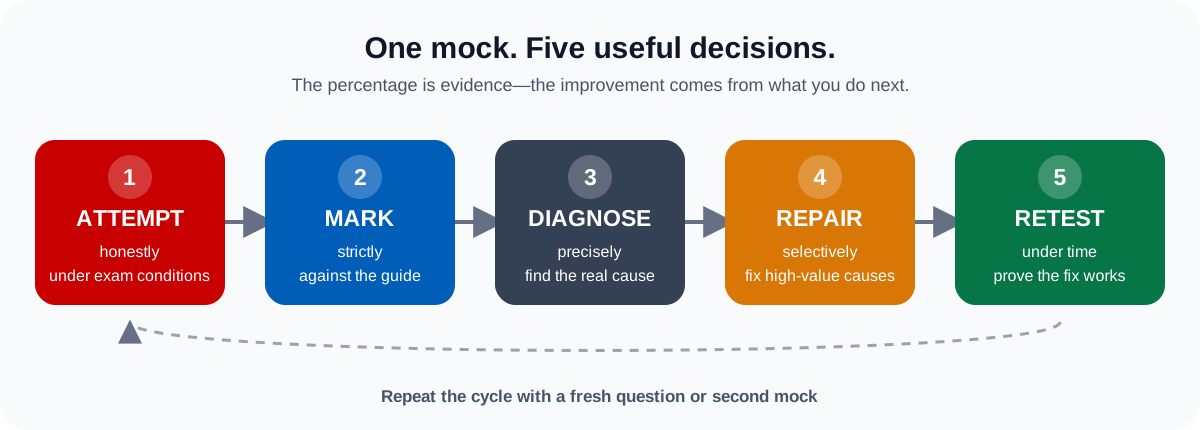
A mock creates improvement only when the result leads to diagnosis, repair and another timed test.
2. Use the right mock at the right time
Use current material for your exam, sitting and variant. ACCA's Practice Platform contains specimen, practice and past-exam content in the CBE environment. The specimen shows the current assessment style. Practice exams are updated for relevant syllabus or format changes; older past exams can still be useful, but ACCA warns that they may not reflect later changes.
Do not save all question practice for the final fortnight. Use shorter timed requirements throughout your studies, then use full mocks to test whether the separate skills work together.
Stage | What to attempt | What you are testing |
|---|---|---|
Early revision | A representative question set or selected requirements | Your starting weaknesses and familiarity with the exam format |
About two to three weeks before | First complete timed mock | Knowledge, technique, CBE control and time management together |
After targeted repair | Second complete timed mock | Whether the corrections work under pressure |
Final days | Selected weak requirements—not endless full exams | Confidence, recall and disciplined execution |
ACCA recommends completing two full practice exams under exam conditions as part of revision. If time is short, one honest full mock with a thorough debrief is more valuable than several rushed attempts that you never analyse.
3. Make it a real exam rehearsal
Use the ACCA Practice Platform whenever possible. Knowing the subject is not enough if you lose time arranging exhibits, entering spreadsheet workings, scrolling between screens or deciding where to type your answer.
For a valid rehearsal:
check the current duration, structure and instructions for your exact exam;
sit the mock in one uninterrupted session;
use the same CBE environment and permitted tools you expect in the exam;
remove notes, model answers, messages and other help;
keep only the items permitted in the real exam;
start and stop at the official time; and
save your complete answer and any timing notes for the debrief.
Do not pause the clock to look something up. If you become stuck, record what happened and continue. That uncomfortable moment is useful evidence about what you need to repair.
4. Set a time plan before you press Start
There is no single time formula that safely fits every ACCA exam. Use the current duration and mark structure for your paper. Allow a modest amount of the available time for navigation, reading, planning and final checks, then set a stopping time for each question or requirement from its marks.
Write down the clock time at which you must leave each major question. A plan such as “spend about 45 minutes” is easier to ignore than “move on at 11:15”.
During the mock, obey those stopping times. The purpose is to practise producing the best answer possible within the allocation—not to perfect the first question while the last one remains blank.
5. Use a simple routine during the mock
Read the requirement. Identify the verb, subject, perspective, required output and marks before becoming absorbed in the scenario.
Set the stopping time. Decide when you will move on, including planning and typing.
Answer for marks. Use clear headings, labelled workings and scenario facts. Make distinct points rather than one long paragraph.
Protect the rest of the exam. If a figure will not reconcile or an idea will not come, preserve useful work, state a reasonable assumption where appropriate and continue.
Review intelligently. Return to flagged or incomplete items only after giving every compulsory part a proper attempt.
For objective-test questions, read exactly what must be selected, complete manageable items efficiently and avoid sacrificing several later marks to rescue one difficult item. For constructed responses, show the method, apply the scenario and answer the actual verb. At Strategic Professional, professional skills are demonstrated through the quality of the technical answer; merely naming a skill does not earn it.
6. Mark the answer—not your intentions
Take a short break, then mark while the experience is still fresh. Use the official marking guide and sample answer where available. Do not award a mark because you “knew what you meant” or because your answer discusses the same general topic.
Award marks only for work that is visible and relevant.
For calculations, recognise valid method and follow-through only where the guide allows it.
For written answers, look for separate developed points rather than matching the sample answer word for word.
For professional skills, apply the stated criteria to the answer you actually produced.
Record the approximate time spent on each major question, not only its score.
A sample answer is usually fuller than anything a student could produce in the exam. Its purpose is to teach and illustrate possible points. Do not conclude that your shorter answer must be wrong—but do not give yourself marks for points that never reached the screen.
7. Find the real cause of every important lost mark
“Revise costing” or “practise audit” is too vague. For each important loss, identify its cause and the action that would prevent it next time.
Cause | What it often looks like | Best repair |
|---|---|---|
Knowledge | You could not recall a rule, method, pro forma or standard | Return to the relevant OpenTuition lecture and notes, then retrieve it from memory |
Requirement | You answered the topic but missed the verb, perspective or restriction | Practise requirement analysis before reading the full scenario |
Application | Your answer was generic or did not explain why the scenario fact mattered | Build each point from fact to principle, consequence and conclusion |
Time | Later parts were rushed or blank | Set and obey clock-time stopping points in the next timed set |
CBE control | Navigation, exhibits or spreadsheet work consumed too much time | Repeat the same task in the Practice Platform until the tool becomes routine |
Presentation | Valid work was difficult to follow or insufficiently developed | Use headings, short paragraphs, labels and one clear purpose per point |
Some errors have more than one cause. A blank final requirement may appear to be a knowledge problem, but the real cause could be spending too long on an earlier calculation. Diagnose the chain, not only the final symptom.
8. Turn the result into a 48-hour repair plan
Do not let the marked script disappear into a folder. Within 48 hours:
Choose the three highest-value weaknesses. Prioritise repeated problems and those that cost many accessible marks.
Repair the underlying skill. Review the exact lecture or note, reconstruct the method without looking and attempt a short fresh question.
Rewrite the weakest requirement. Do it closed-book and within the original time allocation.
Record one behavioural rule. Examples: “move at the stopping time”, “read the verb first” or “label every spreadsheet working”.
Retest after a gap. Use a different requirement or second mock so you test learning rather than memory of the answer.
Your error log should be short enough to use. A useful entry contains the question, cause, correct approach and next action. Copying the entire model answer creates more reading, not better performance.
9. Interpret your mock score sensibly
A score at or above 50% is encouraging only if the mock was current, attempted under proper conditions and marked strictly. It is not permission to stop practising. Look for sections that were weak, marks gained by uncertain guesses and time problems hidden by a strong opening question.
A score below 50% is not a prediction of failure. It tells you that the present combination of knowledge, technique and timing is not yet producing enough marks. That is exactly why the mock was attempted before the real exam.
Look for improvement between comparable attempts:
Did you attempt more of the exam?
Did you obey the time plan?
Did repeated errors reduce?
Did written points become more applied and easier to mark?
Did the CBE tools stop distracting you?
10. Adapt the method to your ACCA exam
Exam family | What the mock should particularly test | OpenTuition guidance |
|---|---|---|
On-demand CBEs | Careful reading, breadth, efficient workings, flagging and returning without over-investing in one item | |
Applied Skills session CBEs | Balancing objective-test and constructed-response marks, spreadsheet workings and strict question timing | |
Strategic Professional | Requirement analysis, scenario application, professional skills, depth of judgement and control of long cases |
For SBL, prepare and use the applicable pre-seen material exactly as instructed for the relevant practice exam. For tax, law and reporting variants, make sure the mock matches your variant and examinable period.
11. Your mock-exam checklist
Before | During | After |
|---|---|---|
Confirm the current exam and variant | Read the exact requirement | Mark strictly against the guide |
Use the CBE Practice Platform | Set and obey stopping times | Classify why marks were lost |
Create realistic conditions | Attempt every compulsory part | Choose three priority repairs |
Remove notes and interruptions | Show clear workings and application | Rewrite the weakest requirement |
Prepare a timing record | Do not pause or seek help | Retest the skill after a gap |
12. Resources to use
The OpenTuition mock rule: attempt honestly, mark strictly, diagnose precisely, repair selectively and retest under time. A mock is valuable only when it changes what you do next.