


Applied Skills session CBEs test more than technical knowledge. You must move confidently between objective tests, scenarios, exhibits, calculations and written answers while keeping every minute tied to available marks.
This guide is for Performance Management (PM), Taxation (TX), Financial Reporting (FR), Audit and Assurance (AA) and Financial Management (FM) session CBEs. Check your exact TX or other variant and delivery availability in myACCA.
Key rule: your answer workspace is the product being marked. Put clear workings, explanations and conclusions there. Notes in the scratchpad or on paper are for you only and cannot earn marks.
Current Applied Skills session CBE format
These exams are three hours and worth 100 marks. Every question is compulsory. PM, TX, FR and FM contain three sections; AA contains two.
| Exam | Objective-test content | Constructed-response content |
|---|---|---|
| PM, FR and FM | Section A: 15 × 2-mark OTs (30) Section B: three 10-mark OT cases (30) | Section C: two 20-mark questions (40) |
| TX | Section A: 15 × 2-mark OTs (30) Section B: three 10-mark OT cases (30) | Section C: one 10-mark and two 15-mark questions (40) |
| AA | Section A: three 10-mark OT cases (30) | Section B: three scenarios, normally one 30-mark and two 20-mark questions (70) |
Recent official specimen resources use a three-hour attempt. The older OpenTuition Pages guide referred to a 3-hour-20-minute live format with seeded content; that is no longer the format students should plan around.
Allocate time by marks
Three hours for 100 marks gives 1.8 minutes per mark. Use this to set section and requirement deadlines before the exam becomes stressful.
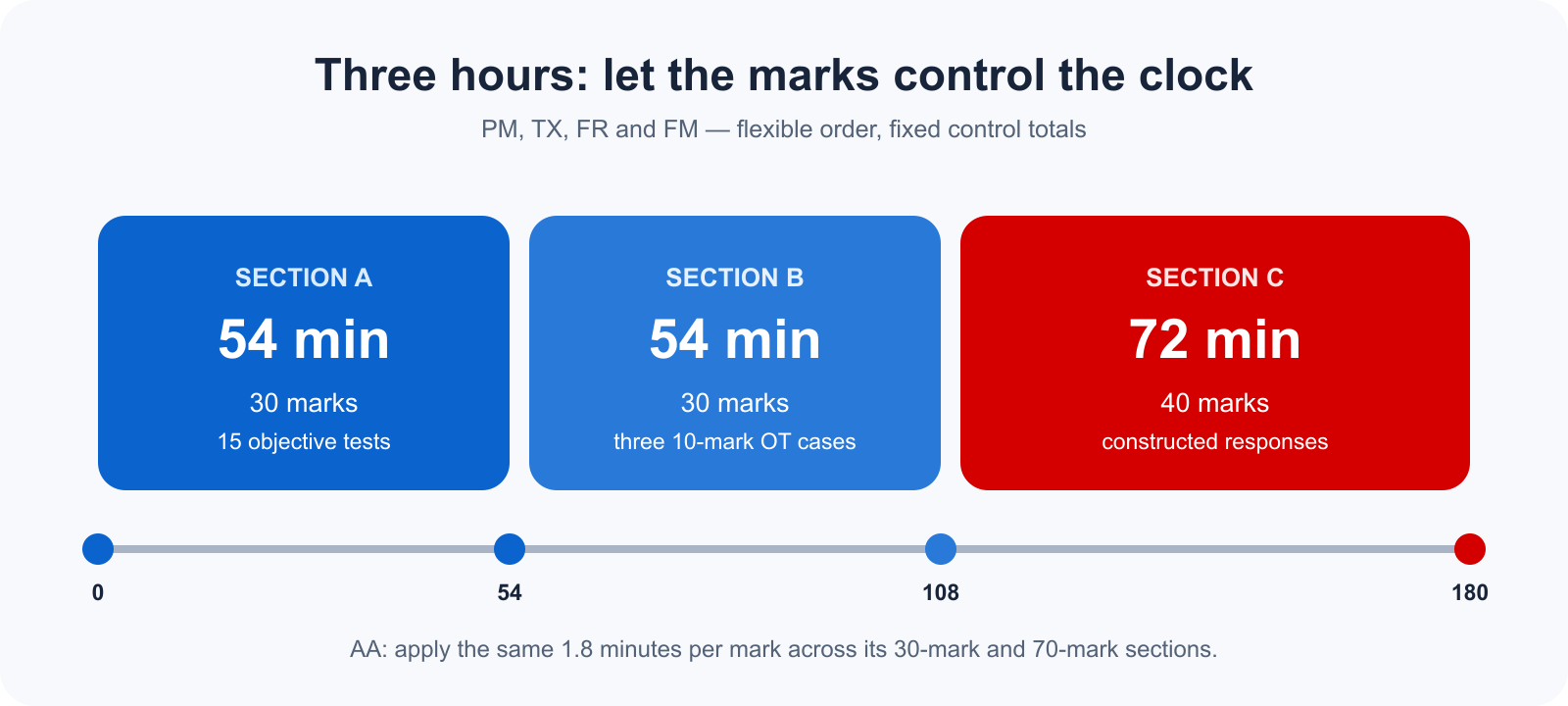
Figure 1: The 54–54–72 minute control plan for a 30/30/40-mark exam. AA students should apply 1.8 minutes per mark across its two sections.
This is a control plan, not a compulsory order. You may start with a constructed-response question if that has worked in practice. What matters is that you:
- set a finish time for each section or question;
- do not repeatedly check low-mark OTs at the expense of constructed responses;
- move on when the marks no longer justify more time;
- attempt every requirement, because a short relevant answer can still collect marks.
Read the requirement before the exhibits
A long scenario feels much shorter when you know what you are looking for. Before reading in detail, identify:
- the requirement verb: calculate, explain, discuss, assess, identify, recommend or prepare;
- the subject matter and period;
- the number of separate parts;
- the marks for each part;
- the required answer format, such as a calculation, report extract or explanation.
Then read the exhibits actively. Highlight or note facts that answer the requirement. Do not copy facts into the answer without explaining their significance.
Objective-test technique
Session CBEs may use multiple choice, multiple response, fill-in-the-blank, drag and drop, drop-down, hotspot and hot-area questions. The same core principles apply:
- read the stem and any negative wording carefully;
- calculate before looking at numerical options where practical;
- check dates, units, signs and rounding;
- confirm the required number of responses or active areas;
- make a reasoned selection, flag genuine uncertainty and move on;
- use the navigator to find incomplete responses before leaving the section.
In an OT case, allocate time to the case as a whole—about 18 minutes for ten marks. The five items share scenario information but should be answerable independently. Do easier items first if one calculation is blocking you.
A repeatable method for constructed responses
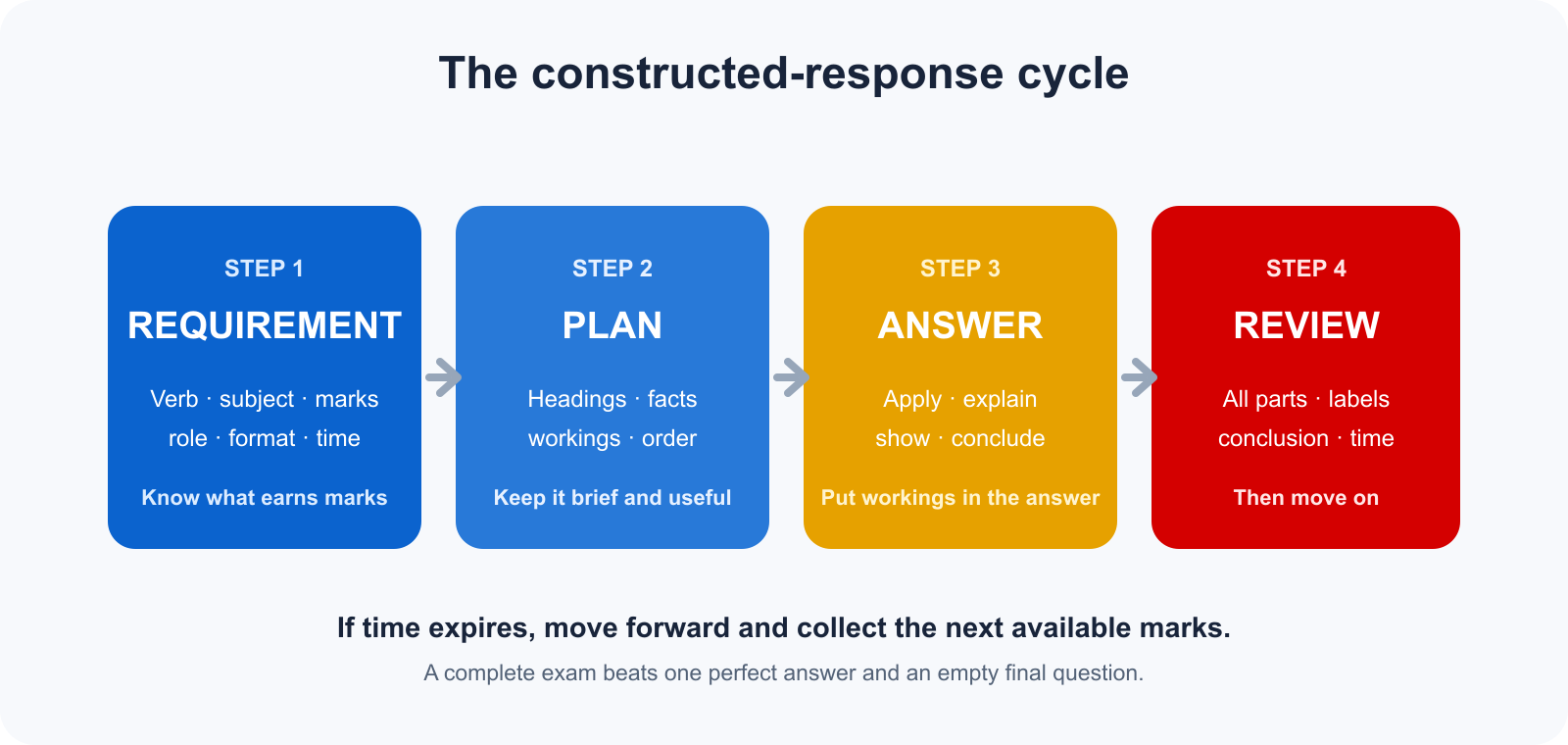
Figure 2: A disciplined constructed-response cycle. Planning is short but visible in the structure of the final answer.
1. Requirement and time
Break the requirement into its separate verbs and subjects. Convert marks to time. A 20-mark question has about 36 minutes; a 10-mark part has about 18 minutes. If a requirement contains several subparts, divide the time again.
2. Plan headings and points
Create headings that mirror the requirement. Under each heading, note the calculations, scenario facts or technical points needed. A one- or two-minute plan prevents repetition and knowledge dumping.
3. Write for marks
- Make one developed point at a time.
- State the rule or issue, apply it to the scenario and explain the consequence.
- Show calculations and workings in the spreadsheet or response area.
- Label workings and cross-reference them to conclusions.
- Use complete, concise sentences for narrative answers.
4. Review and move
Check that every requirement has an answer, figures are labelled, and a requested conclusion or recommendation is present. Then move on at the planned time. A polished first answer cannot compensate for an unattempted final question.
Use the CBE workspace as a professional tool
Word processor
Use headings, short paragraphs and appropriate tables or bullets. Formatting should make the logic visible, but elaborate presentation earns no marks by itself. Do not spend time repeatedly resizing text or perfecting spacing.
Spreadsheet
Set calculations out in a logical sequence. Label rows and columns, show assumptions and use formulas sensibly. A marker must be able to follow the method. Do not hide all reasoning inside one complex formula or present only a final number.
Scratchpad and rough paper
Use them for quick plans or temporary arithmetic only. The marker does not see them. If a working, assumption or explanation deserves credit, copy or reproduce it in the answer workspace before leaving the question.
Exhibits and screen layout
Practise opening, closing and resizing exhibits, using the splitter and navigating between requirements. Avoid leaving so many windows open that the relevant data becomes hard to find. A simple routine—requirement, relevant exhibit, answer—reduces screen clutter.
Subject-specific technique
PM: calculate, interpret and advise
PM is not a collection of formulas. After a calculation, explain what the result means for performance, behaviour or decision-making. Link variances and measures to the scenario. A correct number with no interpretation may address only part of the requirement.
TX: exact rules, clear workings and the correct variant
Use materials for the booked variant and syllabus period. Tax rules, rates and dates change. Lay out computations by tax and period, label reliefs and exemptions, and answer advisory requirements in plain language. Do not perform calculations that the requirement does not need.
FR: treatment, calculation and presentation
Explain why an accounting treatment applies, not only the journal or final figure. In financial-statement questions, use the spreadsheet structure carefully, show adjustments and keep narrative discussion specific to the entity and ratio movements.
AA: specific risks, controls and procedures
Generic lists score poorly. For an audit risk, identify the scenario fact, explain the possible misstatement and link it to the affected balance or disclosure. For a procedure, state what the auditor should do, the source or evidence involved and the purpose. “Check the invoice” is rarely specific enough.
FM: calculate and conclude
Show the route through investment, financing, working-capital or risk calculations, then interpret the result. If asked to recommend, give a conclusion consistent with your figures and discuss relevant non-financial or practical factors.
A preparation plan that develops exam skill
- Learn actively: combine the current OpenTuition notes and lectures with short topic questions.
- Move to exam-standard questions: attempt OTs, OT cases and constructed responses from a current revision kit.
- Practise in the ACCA Practice Platform: become comfortable with exhibits, word processing, spreadsheets and self-marking.
- Mix and time: stop choosing questions only by topic. Practise the order and time limits you intend to use.
- Complete full mocks: attempt at least two under realistic conditions and leave time to repair weaknesses between them.
Debrief every substantial answer
Do not ask only whether your final number matches the solution. Ask:
- Did I answer every verb and part?
- Did I use the scenario rather than reproduce generic notes?
- Were my workings visible and labelled?
- Did I reach the requested conclusion?
- Did I finish within the time allowed?
- Was the error technical, interpretive, presentational or caused by time?
Model answers are teaching documents and are often longer than a candidate could write. Use them to identify missing ideas and better application, not as scripts to memorise.
What to do when you fall behind in the exam
- Stop polishing the current answer.
- Check the remaining marks and time.
- Recalculate a strict finish time for each remaining question.
- Attempt the easiest identifiable points first under clear headings.
- Return only if all compulsory requirements have some answer.
Never abandon a large constructed response because you cannot complete one calculation. State an assumption if needed, continue with the method, and answer the narrative or interpretive parts using the information available.
The final week
- Complete the last timed mock early enough to debrief it.
- Repeat weak requirements in the CBE workspace.
- Review current examinable documents, key rules and your error log.
- Do not replace sleep with passive rereading.
- Complete system checks and confirm identification, location, timing and permitted items.
Frequently asked questions
Should I start with Section C?
You may, if timed practice proves it helps. Set a hard section deadline and do not let one difficult constructed response damage the objective-test sections.
Will scratchpad workings be marked?
No. Put mark-worthy workings and explanations in the response workspace.
How many full mocks should I complete?
At least two is a strong minimum for most students, with enough time to debrief and repair weaknesses. Many students need more. Quality of review matters as much as quantity.
Are older past questions useful?
They can be useful for technique after checking the current syllabus, technical rules and format. Recent Practice Platform material and a current revision kit should be the core of final preparation.
Official sources and next steps
- ACCA exam support resources by exam and variant
- ACCA guide to Applied Skills session CBE specimen exams
- ACCA PM exam format and support
- ACCA AA exam format and support
- OpenTuition free ACCA notes, lectures, tests and tutor forums
This guide was reviewed on 15 July 2026. Always use the syllabus, examinable documents and Practice Platform resources for your exact exam and session.