

ACCA Strategic Business Leader (SBL) is not a conventional knowledge paper. It is a workplace simulation in which you act as a senior adviser, diagnose an organisation's problems and communicate decisions to directors and other stakeholders.
You still need the syllabus. However, the pass is earned by selecting the right knowledge for the task, using the case evidence, developing the commercial consequences and presenting advice in the format and tone requested. A model remembered but not applied is rarely useful.
This is the SBL exam-pass study guide. It explains how to prepare the pre-seen, analyse exhibits, build developed points, demonstrate all five professional skills and control the three compulsory tasks. For the separate resource-by-resource workflow, see How to Study for ACCA SBL Using OpenTuition.
Reviewed 15 July 2026 for the SBL syllabus applicable from September 2026 to June 2027. ACCA confirms there are no syllabus additions, deletions or amendments for this exam year.
1. Understand what SBL is really examining
SBL asks whether you can behave like an effective business leader or adviser while working with incomplete, sometimes inconsistent information. A strong answer follows a visible decision chain: understand the task, select relevant evidence, use technical knowledge as a lens, explain the organisational consequence and give clear professional advice.
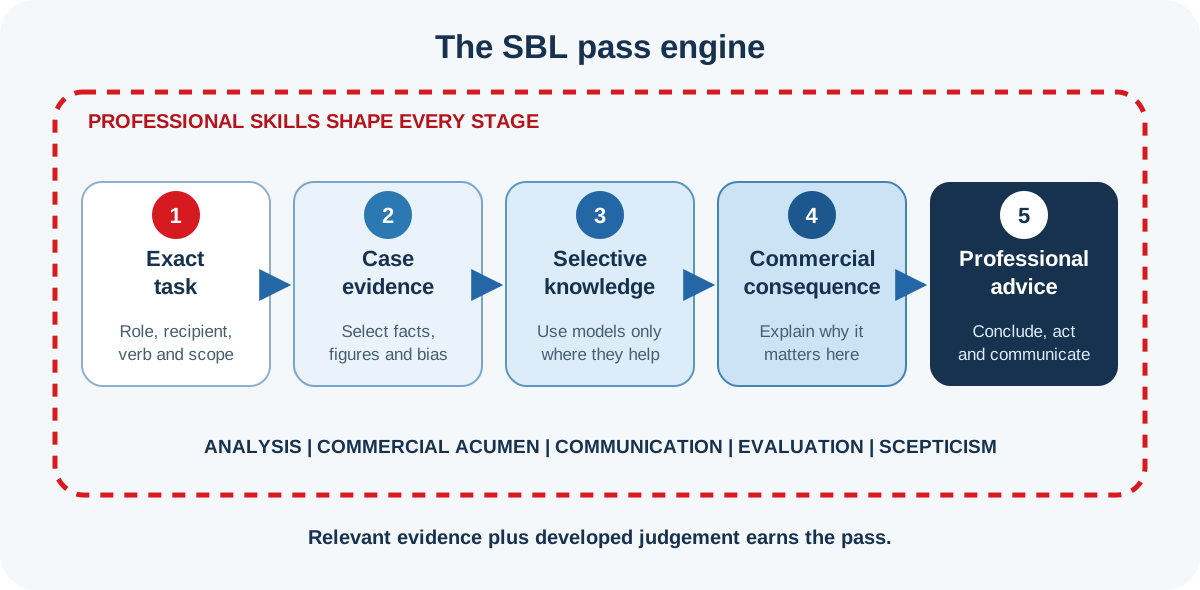
An original OpenTuition model of how SBL turns knowledge into workplace advice.
Begin with the decision required, not with a favourite model. Ask: what must the recipient decide, which evidence matters, what does it mean for this organisation, and what should happen next?
SBL pass rule: theory gives you a way to think. Case evidence and developed judgement turn that thinking into marks.
2. Know the exam structure and control the clock
SBL is a 3 hour 15 minute closed-book computer-based exam. It is one integrated case study containing three compulsory tasks. Task marks vary between sittings and tasks may place you in different professional roles.
Exam component | What it means for your approach |
|---|---|
80 technical marks | Every technical point must answer the task and be applied to the organisation. |
20 professional skills marks | Analysis, commercial acumen, communication, evaluation and scepticism are each tested once for 4 marks. |
Three compulsory tasks | Prepare for the full syllabus and attempt every task. There is no optional safe area. |
195 minutes including RPRT | Reading, Planning and Reflection Time is included and may be used flexibly. |
Pre-seen released two weeks before | Know the organisation and industry context before exam day, but do not question-spot. |
The latest examiner's report recommends using roughly the first 30 minutes to read and analyse the exam exhibits. The remaining 165 minutes can then be allocated by total marks, including professional skills marks. That is about 1.65 writing minutes per mark. A 20-mark requirement therefore receives about 33 minutes after the initial reading period.
Write the finish time beside every requirement and obey it. If a point is not developing the task, stop. A complete, relevant attempt across all three tasks is safer than an excellent first task followed by rushed or missing work.
3. See the syllabus as eight connected leadership capabilities
The syllabus is broad because senior advice rarely belongs to only one business function. Study the eight technical areas as an integrated system rather than a shelf of disconnected models.
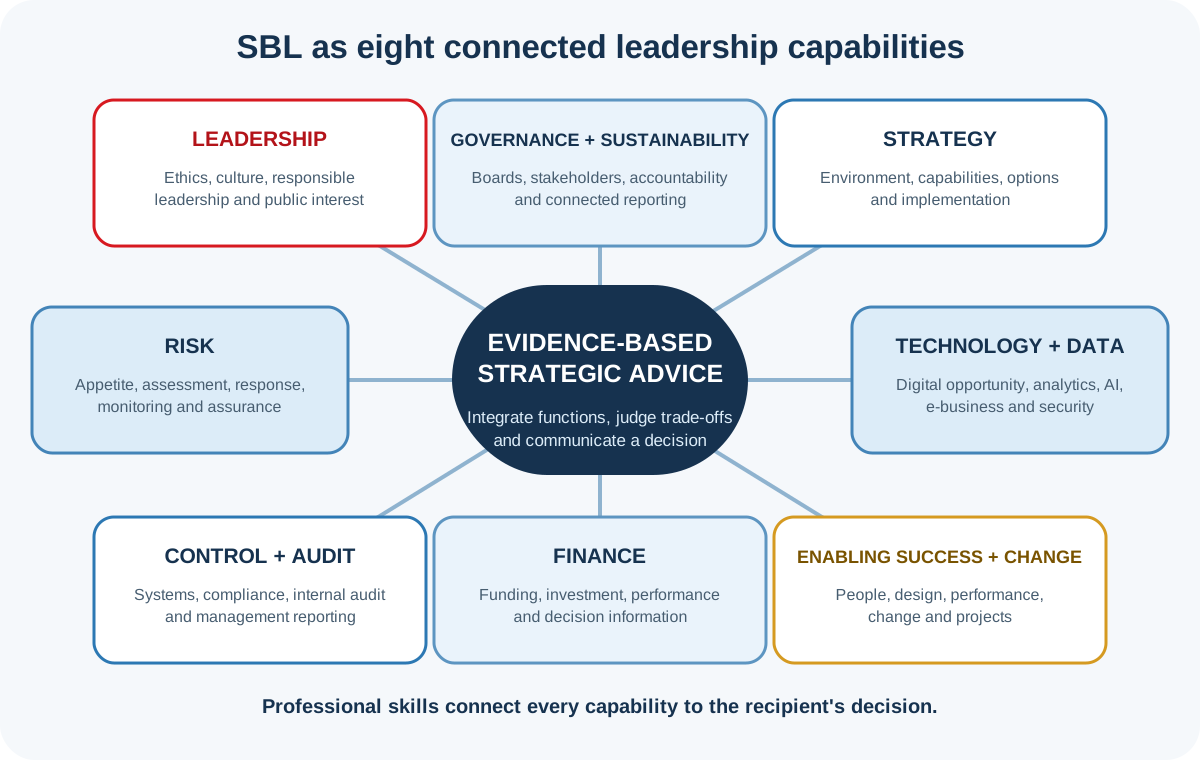
Any task may connect several capabilities, so practise moving between them.
Leadership: responsible leadership, culture, ethics, professionalism and the public interest.
Governance and sustainability: agency, stakeholders, boards, governance arrangements, integrated reporting and sustainability responsibilities.
Strategy: external environment, resources and capabilities, competitive position, strategic options and implementation.
Risk: identification, assessment, appetite, culture, response, monitoring and assurance.
Technology and data analytics: cloud and mobile technology, big data, AI, e-business and information security.
Organisational control and audit: control systems, internal audit, compliance and management reporting.
Finance in planning and decision-making: finance transformation, investment, funding, performance analysis and cost information.
Enabling success and change: organisation design, talent, disruptive technology, performance excellence, strategic change and projects.
Professional skills sit across every area. In one requirement you might need governance knowledge, risk analysis and finance evidence, all expressed as commercially realistic advice to the board.
4. Learn models as lenses, not scripts
Models can organise thought, but they do not replace thought. The examiner's report repeatedly criticises candidates who force a familiar framework onto a task or reproduce generic theory without addressing the decision.
Weak use of a model | Mark-earning use |
|---|---|
Explain every element of PESTEL. | Select the two or three external factors that materially affect the decision and explain how. |
Label a stakeholder as a "key player". | Justify its power and interest in this specific decision, then recommend practical engagement. |
List the stages in a change model. | Use relevant stages to recommend actions that solve the organisation's actual implementation problems. |
State the components of an internal control framework. | Connect the control weakness, consequence and proportionate control response. |
Give a memorised advantage and disadvantage. | Explain the trade-off using the organisation's finances, capabilities, stakeholders and objectives. |
For each model, learn its purpose, the decision it helps with, its limitations and two contrasting examples of application. If common sense answers the task more directly than naming a model, use common sense supported by the case.
5. Use OpenTuition as an active SBL study system
Read the matching chapter in the free SBL notes.
Watch the relevant SBL lecture, pausing before the tutor reaches each conclusion.
Close the materials and reconstruct the model, its purpose and its limitations from memory.
Apply it to a short business scenario without looking at a model answer.
Attempt an exam-standard task in the ACCA Practice Platform.
Compare your answer with the marking guide and examiner commentary, then rewrite the weakest requirement.
Use the SBL flashcards for retrieval and the SBL revision lectures to consolidate technique. Keep an error log with six causes: knowledge gap, missed requirement, weak evidence, undeveloped implication, inappropriate professional style, or time control.
6. Use the pre-seen for familiarity, not prediction
The pre-seen is released through Exam Planner two weeks before the exam. It describes the fictitious organisation and its industry. Its purpose is to remove basic orientation work from exam day so that you can understand the new exhibits faster.
Create a concise context map covering:
the organisation's purpose, ownership, size and stage of development;
its products or services, customers, revenue logic and major costs;
its strategy, resources, capabilities and current performance;
its governance, leaders, culture, values and key stakeholders;
industry structure, terminology, regulation, technology and major trends; and
visible tensions, vulnerabilities or inconsistencies that may help you interpret later evidence.
Do not turn this into predicted questions or pre-written answers. The tasks are driven primarily by new exam-day exhibits. Do not undertake extensive external research, and do not copy pre-seen passages into answers. You cannot take your annotated copy into the closed-book exam, although the pre-seen itself will be available on screen.
A sensible two-week pre-seen routine
Days 14-11: read twice, define unfamiliar industry terms and build the one-page context map.
Days 10-7: examine the business model, stakeholders, governance, performance and strategic position through different syllabus lenses.
Days 6-3: continue full-task practice with published exams and mocks. Do not let the live pre-seen replace question practice.
Days 2-1: reread for familiarity, test yourself on the context, and rest. Avoid predictions circulated by other students.
7. Read every task before reading its exhibits
The requirement is your filter. Before analysing detailed evidence, identify six controls:
Role: Who are you in this task?
Recipient: Who will use the answer and what do they need?
Verb: Are you assessing, evaluating, advising, recommending or explaining?
Scope: Which decision, period, stakeholder or issue is included?
Output: Report, briefing note, memo, email, slides with notes, or another format?
Professional skill: Which 4-mark skill must be especially visible?
Then read the exhibits with that filter. One exhibit may support more than one task, and more than one exhibit may be needed for a developed point. Note the source, possible bias, date, reliability and connection to other evidence.
8. Turn exhibit evidence into professional advice
Use the REACT method to keep each point relevant and developed.
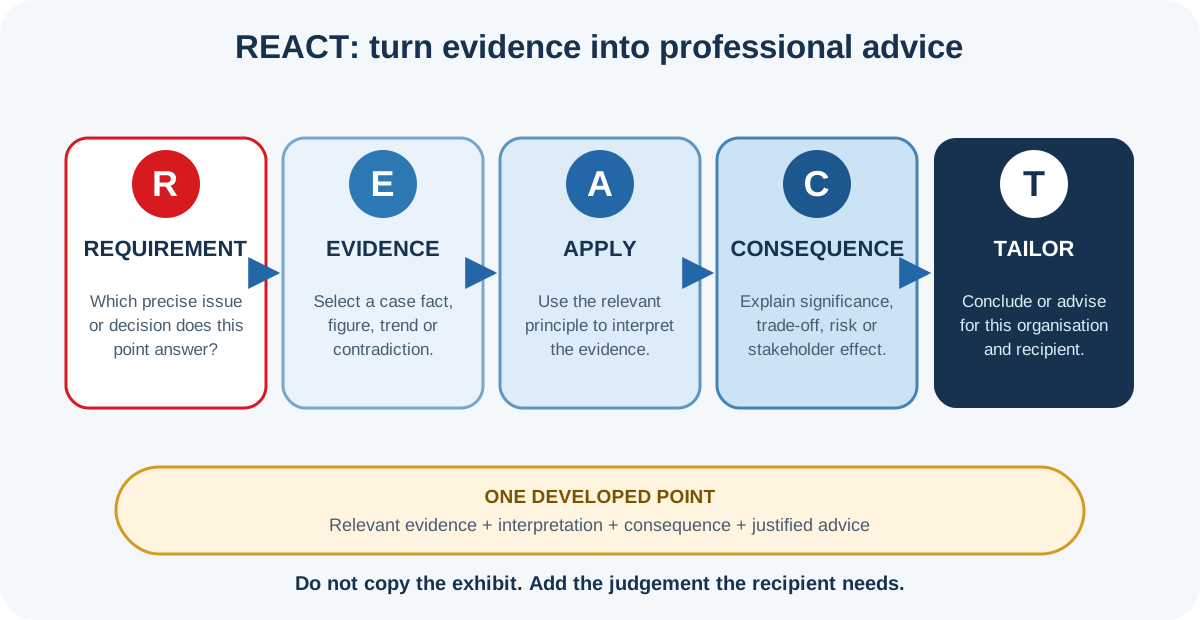
REACT prevents both model dumping and unsupported recommendations.
Requirement: state the precise issue or decision your point addresses.
Evidence: select a specific fact, figure, trend, quotation or contradiction from the case.
Apply: use the relevant business principle or professional judgement to interpret it.
Consequence: explain why it matters - financially, operationally, strategically, ethically or to a stakeholder.
Tailor: conclude, prioritise or recommend an action that fits the organisation and recipient.
Generally, a well-developed point may earn up to two technical marks. A label or copied fact is only the start. Development comes from significance, organisational consequence, comparison, case evidence or a justified action.
9. Demonstrate all five professional skills deliberately
The professional skill named in a requirement is not a decorative extra. It describes how your technical answer must be developed.
Skill | What the marker should be able to see |
|---|---|
Analysis | Relevant evidence has been investigated, connected and used to explain causes, relationships or implications. |
Commercial acumen | Advice recognises the organisation's business model, resources, stakeholders, constraints and practical operating reality. |
Communication | The requested format, recipient, tone, structure and level of detail are appropriate and persuasive. |
Evaluation | Arguments have been weighed, significance has been judged, trade-offs are clear and conclusions are justified. |
Scepticism | Claims and evidence have been probed, bias and inconsistency considered, and conclusions expressed with professional caution. |
Scepticism does not mean turning every point into a question. Tell the recipient why an assertion may be unreliable and what that means for the decision. Commercial acumen does not mean writing "this will improve profits" after every point. Show the realistic mechanism, constraint and business effect.
10. Make the requested format useful, not theatrical
Formats carry professional meaning. A board report should support a decision. A briefing note should be concise and actionable. Presentation slides should contain focused messages, with supporting explanation in the notes.
Use a clear title and headings that mirror the requirement.
Address the recipient and purpose where this adds value.
Keep paragraphs short, with one developed idea per paragraph.
Use tables only when they improve comparison; thin one-line entries usually restrict development.
For slides, put the decision-level message on the slide and the evidence, explanation and implication in the notes.
Do not spend precious minutes on elaborate introductions, contents pages or decorative formatting.
Use a candid but respectful tone. Calling a director "incompetent" is not professional scepticism; explain the capability gap and required action.
11. Make recommendations specific and implementable
Weak recommendations merely rename a model: diversify, communicate, introduce controls, use cloud computing, train staff. Strong recommendations answer five practical questions:
What exactly should be done?
Why does the case evidence make it necessary?
Who should own or oversee it?
How should it be implemented, monitored or safeguarded?
What trade-off, risk, cost or stakeholder reaction must be managed?
If asked how to mitigate integration risk, recommend actions that reduce those specific integration risks. Do not spend the answer redescribing the risks. If asked how to manage stakeholders in an acquisition, evaluate power and interest in that acquisition - not in routine operations - and justify the engagement response.
12. Use financial and data evidence without losing the decision
SBL may provide accounts, ratios, forecasts, investment information or operational data. Calculate only what helps answer the task. For each useful number:
identify the movement or relationship;
compare it with a meaningful benchmark;
connect it to operational or strategic evidence;
explain its limitation or uncertainty; and
state the implication for the decision.
Do not mistake a percentage change for analysis. Falling revenue, for example, is not automatically a loss, and interest does not reduce operating profit. Protect basic accounting accuracy while keeping the answer focused on business meaning.
Apply the same discipline to non-financial and digital evidence. Ask whether data is complete, timely, unbiased and comparable; whether technology fits the process and people; and whether cyber, ethical, control and implementation risks have been addressed.
13. Integrate ethics, governance and sustainability
Ethics is not confined to a labelled ethics task. Leadership decisions affect stakeholders, culture, reputation and the public interest. When ethical pressure appears:
identify the decision, incentive and people affected;
connect the facts to integrity, objectivity, competence, confidentiality or professional behaviour;
explain the business and public-interest consequences;
recommend proportionate escalation, evidence gathering, safeguards and governance action; and
consider whether the organisation's culture and controls created the problem.
For governance and sustainability recommendations, go beyond creating a committee or issuing a report. Explain mandate, membership, accountability, information flows, assurance, measures and how the arrangement improves decisions and stakeholder confidence.
14. Convert examiner feedback into a revision checklist
Answer the exact task. Do not answer a related question because it feels more familiar.
Use exhibits as evidence, not as text to copy. Comment, connect and develop.
Apply every technical point. Generic syllabus knowledge attracts limited credit.
Develop the significance. Explain why the fact matters to the organisation or decision.
Respect scope. The stated transaction, stakeholder, period and requested action control the answer.
Make professional skills visible. Read the technical and professional requirements together.
Use practical recommendations. A model name is not an action plan.
Control time. Avoid lengthy plans, repetition and polishing one task beyond its mark allocation.
15. A ten-week SBL study plan
Week | Main focus | Required output |
|---|---|---|
1 | Leadership, ethics, culture and the SBL answer method | Write six REACT paragraphs from a short case. |
2 | Governance, stakeholders, sustainability and reporting | Complete a board-focused evaluation and recommendation task. |
3 | External analysis, resources, competitive position and strategy | Assess strategic options using selective evidence, not a model dump. |
4 | Risk, control, internal audit and assurance | Link risks to controls, owners, monitoring and consequences. |
5 | Technology, data analytics, cyber risk and e-business | Prepare commercially realistic digital recommendations. |
Week | Main focus | Required output |
|---|---|---|
6 | Finance, performance, investment and decision-making | Turn financial and non-financial evidence into board advice. |
7 | Organisation design, talent, change and projects | Write an implementation plan with ownership and trade-offs. |
8 | Five professional skills and professional formats | Rewrite one answer in report, briefing-note and slide formats. |
9 | Integrated timed tasks and exhibit navigation | Complete all three task types using the Practice Platform. |
10 | Full CBE mocks, debrief and targeted repair | Complete at least two full timed exams and reattempt weak tasks. |
If you have longer, extend each technical phase but keep producing applied answers. Do not postpone full tasks until every model feels perfect. Exam technique is a capability that must be trained.
16. Know when you are exam-ready
You are ready when you can:
understand a task's role, recipient, verb, scope, output and professional skill quickly;
use the pre-seen as context without relying on predictions;
find and connect relevant evidence across several exhibits;
produce developed points instead of copied facts or generic theory;
demonstrate all five professional skills through technical answers;
write useful reports, briefing notes and slides with notes in the CBE workspace;
complete all three tasks within 195 minutes; and
achieve a safe pass across several full mocks, not just one familiar scenario.
Complete the Ethics and Professional Skills Module before SBL if possible. After every mock, classify lost marks by cause and rewrite the weakest requirement while the diagnosis is fresh.
17. SBL resources to use
The SBL pass formula: answer the exact task, select the decisive evidence, apply only useful knowledge, develop the commercial consequence and communicate practical advice - within a disciplined time limit.