
Strategic Management Accounting

1 2026/27 Syllabus scope note
Use a strategic model as a structure for scenario analysis, not as material to reproduce. Under each relevant heading, identify the scenario evidence, explain the performance-management implication and justify a suitable measure or conclusion. Do not repeat information already supplied in an exhibit.
Porter's Five Forces and the Boston Consulting Group portfolio matrix are retained in this chapter as background reading, but they are no longer specifically listed in the APM syllabus for September 2026 to June 2027. They should not be prioritised over the current syllabus requirements. Do not confuse Five Forces with Porter's generic strategies, which may still support evaluation of an organisation's chosen competitive approach when relevant to a scenario.Introduction
This chapter contains a general review of the different levels at which planning, decision making and control take place within an organisation so as to manage both its long-term and short term performance.
Additionally, more detailed consideration is given to the nature and purpose of strategic planning.

2 Hierarchy of management
Planning, performance management, decision making and control can be classified into three levels:
Strategies and objectives (for example budgets) measurement and controls will be exist at all three levels and should form a coherent plan. For example, if the company wants to increase its sales by 50% in the next three years by expanding abroad (a strategic level target), this will have to be communicated to the various operating units and each will be given their own objectives for each year (the tactical level). If all operating units achieve their targets then so should the company. In turn, the tactical-level objectives will have to be communicated to operating departments: sales, production, marketing etc. so that operating unit performs as required. All the time, measurement of progress has to be in place at all levels and performance actively managed where necessary. In this way strategic objectives are cascaded down the organisation via the formulation of subsidiary performance objectives.
2.1 Strategic planning:
This is the process of developing the long-term (for example 5 to 10 years) plans for the company.
For example:
what new products to launch?
what new markets to develop?
This sort of planning, together with the decision making involved, will be done at Board level. It tends to be more outline rather than detailed planning.
2.2 Management control / Tactical planning:
This is the more detailed, short-term planning (for example, the one year budgets) in order to ensure resources are obtained and used effectively in order to achieve the long-term plans of the company
For example: how many staff will the company need next year?
Control will be exercised against budget using, for example, variance analysis.
2.3 Operational control:
This is the day-to-day management of the business in order to ensure that specific tasks are carried out effectively and efficiently.
For example: ensuring that the budgeted production is achieved each day.
The information used will be very detailed and will be quantitative, but will often be expressed in terms of (for example) units or hours instead of purely in monetary terms.
3 Strategic planning
As previously stated, strategic planning is the developing of a long-term plan for the company. The various stages involved are illustrated in the diagram below (P3 revision):
3.1 Strategic planning model
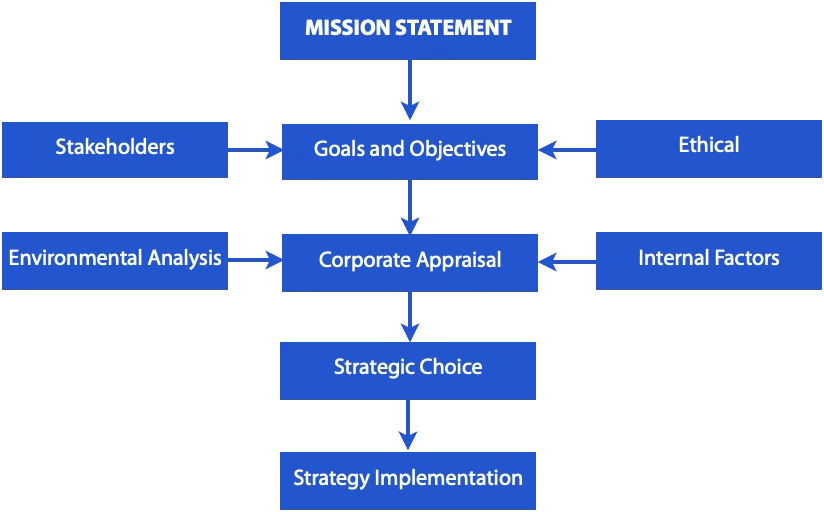
Each of the stages involved is explained in the following paragraphs.
3.2 Mission statement
As described above: the mission tries to encapsulate the purpose and values of the organisation.
3.3 Stakeholders
As described above: strategy should be determined by what stakeholders want or tolerate.
3.4 Ethics
Strategic decisions cannot be separated from a consideration of the ethical consequences of those decisions. For example, if management decides to close down an operation, employees there will lose their jobs and there is an ethical issue there’. Similarly, starting to drill for oil in an area of natural beauty will also have an ethical dimension.
With regard to ethics, in APM you are simply expected to be aware that strategies can have ethical repercussions and you should be able to discuss those at a relatively simple level. In particular unethical behaviour can have serious financial consequences such as reputational damage, fines, compensation payments and loss of trading licences.
Increasingly, sustainability is becoming an important ethical issue which customers pay attention to. Sustainability means meeting our own current needs without compromising the ability of future generations to meet their own needs. Sustainability is not just environmentalism and most definitions of sustainability also include concerns for social equity and economic development.
3.5 Corporate Appraisal
Corporate appraisal is a critical assessment of the strengths and weaknesses, opportunities and threats in relation to the internal and external (environmental) factors affecting an organisation. The purpose is to establish the condition of the organisation prior to preparing a long-term, strategic plan.
The term ‘Position Audit’ is sometimes used as an alternative to ‘Corporate Appraisal’ and sometimes used to refer to an organisation’s internal factors.
Corporate appraisal requires organisation to look at:
External (environmental) factors. These can be categorized as opportunities or threats
Internal factors (resources and competences). These can be categorized as strengths or weaknesses.
3.6 External factors can be assessed using PESTEL or a Porter’s five forces analysis:
PESTEL
Political
Economic
Social
Technological
Environmental/ecological
Legal
Although organisations usually can’t do much to change PESTEL factors, they might be able to avoid threats (for example do not try to develop markets which technology is likely to make redundant) or make use of opportunities (for example, expand into a country that has become economically and politically attractive).
Porter’s five forces (industry level): looks at industry attractiveness.
Threat of new entrants
Threat of substitutes
Bargaining power of buyers
Bargaining power of suppliers
Rivalry between existing competitors
Oganisations can assess which industries are most attractive and may also be able to change the effect of the five forces. So, if competition (rivalry) is fierce perhaps the organisation should consider a takeover or merger; if there is intense bargaining power from suppliers, performance might be improved by backwards integration by setting up or taking over a supplier.
3.7 Internal factors – resource analysis (M words)
Money
Men and women
Manufacturing/machinery
Material
Methods (knowhow)
Management
Management information systems (IT)
Marque/make (brand)
Markets and marketing
3.8 Internal factors - produce life cycle
This helps an organisation to decide on which products should be continued and promoted, and which products should perhaps be phased out or abandoned as this is influenced by where products are positioned on its ‘product life cycle’.
Remember this is not very good at forecasting when a new phase might start.
It can be useful to think about what aspects of performance should be concentrated on at each phase of the life cycle to try to maximise performance:
Introduction: It is vital that the product has a successful launch. Successful advertising and promotion to generate good early sales is essential. If the product does not have a successful launch it can be very difficult to rescue it later. Essential performance measures could be advertising effectiveness and sales volumes achieving their budget levels. Profits are note really expected at this stage.
Growth: The product is going to be successful. Copycats will enter the market. Continuing good performance depends on trying to stay in the lead. The company should be keeping a careful watch on competitors’ activities: prices, promotions, sales volumes.
Maturity: The market has stopped growing and there will be considerable competition. Prices will be forced down and good performance (profits) depends on large efficient operations, often global, with low unit costs.
Decline: Decline can be slow and profitable and performance depends on hanging onto a niche market. Alternatively, the company could decide to exit from the industry.
3.9 Boston consulting group (BCG) matrix.
A potentially useful approach to considering each existing product is to position them on a Boston Matrix (or Boston Grid).
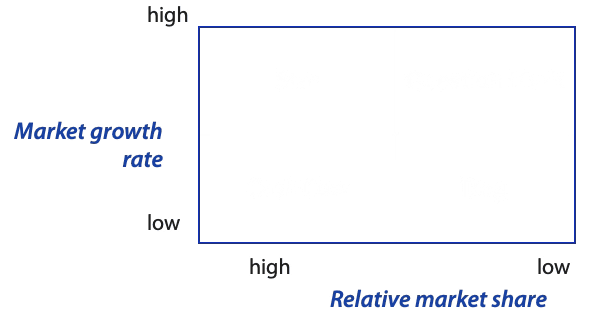
Having positioned the products on the grid, it can then be used to consider future strategies for each of them.
Question mark: Because there is a high growth rate, this product is relatively new with (perhaps) a big future. It’s a product the company should be interested in selling. However, BCG places a lot of emphasis on ‘big is beautiful’ and says that there is no hope of profitable survival if the market share is low. Therefore decide whether to withdraw or to work to increase market share. This will be cash negative and profits are unlikely to be made as the company fights for an increased market share. Suitable performance will be successful market growth. Profit targets would not be very relevant.
Star: Not as good as it sounds. Usually cash neutral as the company fights to keep market dominance. Sustained market share is what’s wanted here.
Cash cow: now the payback for all that earlier effort. Conserve cash, go for profits and set appropriate targets. You should not expect a major assault on this product because it is perceived as an old product on its way out. Stretch its life out as long as you can.
Dog: Divest either by closure or sale. No growth and a small market share – going nowhere
3.10 SWOT analysis
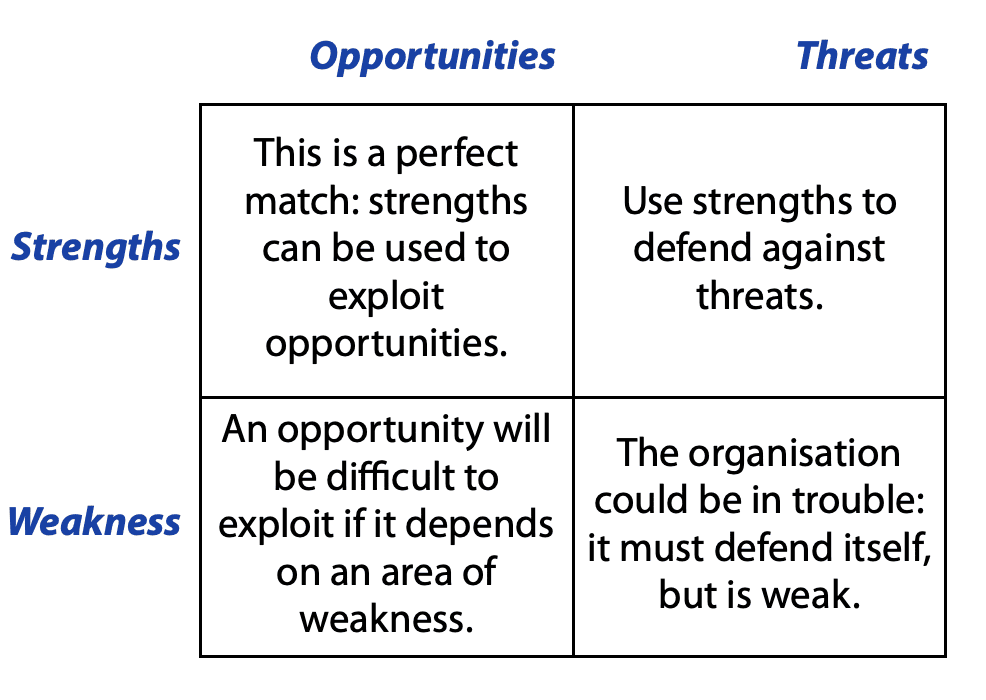
Having analysed the internal and external factors, they can be arranged as a SWOT analysis
(S = strengths, W = weaknesses, O = opportunities, T = threats).
It can be useful to arrange these factors in a grid as follows so that appropriate responses can be generated - again with the hope of optimising performance:
3.11 Gap analysis
A gap analysis compares what an organisation is likely to do it is continues more or less as it is doing, and what its owners (or other stakeholders) want to organisation to achieve.
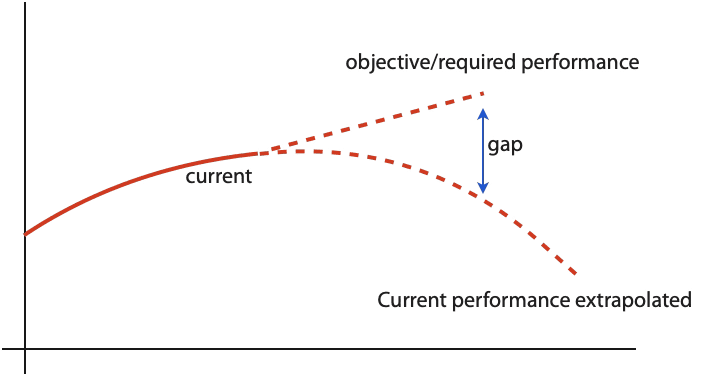
It is often very useful to think of the organisation as having a gap in the profits expected and required so that the organisation must close a profit gap. Ansoff ’s product-market matrix sets out how this might be achieved.
3.12 Generic strategies
Porter argued that there are three generic strategies that will enable a company to gain sustained competitive advantage.
These are:
Cost leadership
Differentiation
Focus
Cost leadership means selling ordinary products into a competitive market at a competitive price. Profits can be increased by reducing the cost of manufacture, not by raising the price of the product. Good performance depends on low costs and the company must focus on measures such as efficiency, cost of material, automation and so on. Cost leadership is usually easier to achieve if the company is very large so that it can benefit from economies of scale.
Differentiation means selling a product that is special in some way so that it commands a higher selling price than rival products. The product might be better styled, be of better quality, be tailored to the buyer’s precise needs and so on. Low costs are not so vital because the profit margin depends on high selling prices. Good performance relies on innovation, flexibility, quality etc.
A focus strategy can be superimposed on the first two strategies. Focus means concentrating on only a small segment of the market. Perhaps the company is small and cannot produce a full product range, so it focuses its efforts on one segment or niche. The company has to get to know its chosen segment very well and must be able to accurately target those customers. Both cost leaders and differentiators can choose to also adopt a focus strategy.
3.13 Ansoff’s matrix
Ansoff ’s matrix is commonly used by businesses that have growth as their main objective, and is used to focus management’s attention on the four main alternative strategic options available for growth, particularly profit growth:
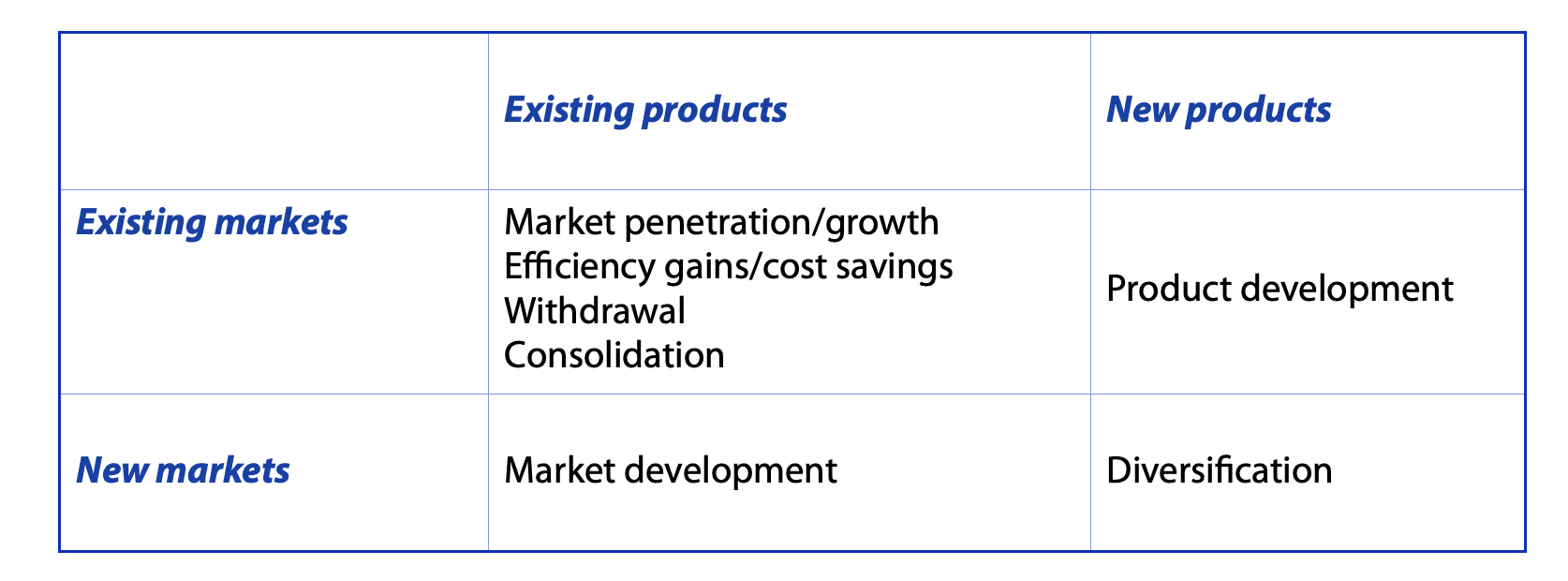
Ansoff’s matrix is very useful: in a simple diagram all classifications of growth options are set out.
In general, staying with existing markets and products is a low-risk, low-return strategy. Exploring new markets or new products will be higher risk and return. Venturing into diversification might be sometimes seen as a sign of desperation: what is driving an organisation to risk so much on the success of a radically different business?
4 Strategic choice
Having carried out a corporate appraisal and having identified potential strategies, it is then necessary to appraise them and formulate a strategic plan. The types of techniques that may be employed in appraising the strategies are discussed in the chapter on decision making.
5 Strategy implementation
The strategic plan will generally be formulated at Board level. Once it has been prepared, it will normally be the managers of the company who will be expected to implement it. This then becomes the second tier of decision making identified at the start of this chapter – Management control / Tactical planning.
6 Special considerations for multinational companies
A multinational company is one which undertakes a substantial proportion of its business in countries other than the one in which it is based.
The strategic planning process in these companies and the strategic choices made must take account of certain special features, and you must be able to briefly describe these for the examination.
Process specialisation
e.g. place labour intensive operations in countries with low wage rates
Product specialisation
e.g. consumers in different countries have different requirements and ‘tastes’
International trade issues
e.g. the economics of a business may be particularly sensitive to exchange rate fluctuations. There could be import restrictions. There might be transportation problems.
Political sensitivities
e.g. particular countries may have particular political risks.
Administrative issues
e.g. the transfer of profits may result in tax being payable twice. Ownership of foreign companies might be subject to special rules.
7 Benchmarking
An organisation’s objectives, capabilities, performance and strategic plans should be assessed in relative terms since its success depends on beating competitors or on improvement of previous performance. Benchmarking means comparing performances and there are a number of bases that can be used:
Historical: compare to own performance in previous periods.
Industry/sector: compare to the performance seen in other similar industries.
Best-in-class: compare to the performance seen in the best competitor.
Additionally, the factors that are benchmarked can be:
Functional benchmarking: comparing specific functions with the same functions in other companies (which do not have to be in the same industry)
Product benchmarking: comparing specific products with those produced by competitors (sometimes involving reverse engineering)
Financial benchmarking: comparing financial performance with that of competitors
Strategic benchmarking: comparing with how other companies compete.
The typical stages involved are:
The identification of problem areas
The identification of other industries with similar processes, and from them the industry leaders
The detailed surveying of the other company’s business practices.
The implementation of new, improved business practices.
The monitoring of improvements.
There can be considerable difficulties in obtaining from competitors data needed for benchmarking. For example, no competitor is likely to volunteer how long it takes to make a product or what internal quality standards it sets. Even not-for profit organisations can be reluctant to supply benchmarking data as they are sensitive about their performance. Sometimes governments step in to ensure that comparative data is made available. For example, in the UK the government insists that schools and hospitals publish performance data. School head teachers and hospital administrators often disapprove, stating that the published data does not take into account many important factors, such as the nature of the population making use of the school or hospital.