
The Nature of Performance Management

1 Introduction

Professional skills marks
Twenty of the 100 marks are professional skills marks. They are earned through relevant technical work: clear communication, balanced analysis and evaluation, reasoned scepticism and practical commercial judgement. Do not write a separate professional skills section.
Exam technique: develop each paragraph as Point - scenario evidence - implication - judgement or action. Use headings that follow the requirement and allocate time in proportion to the marks: approximately half the examination to Section A and one quarter to each Section B question.
Recurring examiner feedback: definitions and descriptions earn little credit unless the requirement asks for them. Answer the exact verb and object, apply facts from the scenario and justify why each point matters. Do not recommend improvements when the requirement has not asked for recommendations.
This chapter looks at what is meant by “performance management”. It is essential to understand that term if you are going to succeed in this paper as questions are directed at describing, improving and reporting on performance management systems.
2 Performance management
It is presumably obvious that organisations will want to improve their performance. However, it is not at all obvious how good performance should be defined. This will differ between organisations and departments within those organisations, and will often vary over time within a single organisation or department.
For example:
Type of organisation | Possible signs of good performance |
|---|---|
Profit seeking/commercial | Rising share price, increasing profits, dividends and EPS. |
A city council’s waste management services | Regular rubbish collection, clean streets, few complaints, no smell. |
A school | Good exam results, good pupil attendance, low rates of bullying, success at sport. |
A charity for the supply of medicines and medical care | Number of patients helped, number of patients cured, number of people vaccinated. |
You might disagree with some of the signs of good performance listed. For example, not everyone might think that good sports performance is relevant to schools; others feel strongly that it is. Some people might believe that vaccination is wrong. Additionally, some indicators can be contradictory. For example, the relationship between increasing profits, increasing dividends and increasing share value is complex.
Furthermore, identifying desirable performance such as an increasing share price does not say anything about what behaviours are needed to produce that. For example, it could be dependent on more advertising, cost cutting, moving-up market, withdrawing certain products and from certain markets, spending on research and development to invent new unique and popular products. If increased share price depends on innovation then successful innovation becomes essential performance.
So, to where do managers look to see what might be regarded as markers of performance? The answer is that they must look to the organisation’s mission and its stakeholders.
Once desirable performances have been defined, the next step is to manage it so that individuals, cost centres, divisions and subsidiaries all work towards achieving those behaviours and targets. This requires three steps:
Design ways in which to measure the desired behaviours and achievements
Measure them
Provide suitable feedback
There can be many measures in a large company, but the most important are called key performance indicators (KPIs). These are just what the name implies: measurements, or indicators, of performance where the organisation must do well if it is to succeed. Achievement of the KPIs should be high on everyone’s agenda.
3 The mission statement, goals and objectives
3.1 The mission statement
In section 2, above, we asked how good performance could be identified or defined and the mission or mission statement is very important here.
The mission statement is an expression of the overall purpose and scope of the organisation, which is in line with the values and expectations of the stakeholders.
It answers the question: What sort of business are we, or do we want to be?
A mission statement will generally contain four elements:
• | a purpose | What, and for whom, the company exists for. |
• | a strategy | The range of businesses in which the firm seeks to compete and some indication of how it intends to compete. |
• | policies and behaviour standards | Guidelines which help staff decide what to do on a day-to-day basis to carry out the strategy. |
• | values | The beliefs and moral principles which lie behind the firm’s culture. |
So a mission and mission statement is a public statement about what the organisation is for, how it intends to achieve those aims and also statements about its ethics and values.
Achieving the mission can therefore be taken as a strong indication of what is meant by of good performance.
Examples of three ‘real-life’ mission statements are reproduced below:
Mission Statement
The mission of The Walt Disney Company is to be one of the world’s leading producers and providers of entertainment and information. Using our portfolio of brands to differentiate our content, services and consumer products, we seek to develop the most creative, innovative and profitable entertainment experiences and related products in the world.
McDonald’s vision is to be the world’s best quick service restaurant experience. Being the best means providing outstanding quality, service, cleanliness, and value, so that we make every customer in every restaurant smile.
The mission of the Office of the United Nations High Commissioner for Human Rights (OHCHR) is to protect and promote all human rights for all.
So, performance in The Walt Disney Company includes:
Creativity
Innovation
Differentiated content
Profit
McDonalds lists:
Quality
Service
Cleanliness
Value
Customer satisfaction (smiles!)
No doubt profit is also important to McDonalds, but some companies are reluctant to refer to that in their mission statements.
The mission of the Office of the United Nations High Commissioner for Human Rights (OHCHR) is to protect and promote all human rights for all is somewhat fuzzy. It would be better if it were more precise in defining human rights and how it might resolve conflicting views.
Although the purpose of the Mission Statement is to communicate to stakeholders the nature of the organisation, and to focus strategy, in practice they are often full of meaningless phrases!
3.2 Goals and objectives
Missions can be very grand and not very specific. It’s all very well for a company to say that it has ‘quality’ as one of its mission, but what does quality mean? What frequency and type of defect must be eliminated and which will be tolerated? By when must a quality level be attained? Something more specific is needed.
Goals and objectives are often put together with no distinction made between them. However, strictly speaking, goals are statements of general intentions (not that much different to a mission), whereas objectives are more specific.
An example of a goal is to improve profits
An example of an objective is to achieve a Return on Capital Employed of 25% within two years.
3.3 Good’ objectives should be SMART:
Specific: sales, rejects, cost per unit are all specific. Better and improve are not
Measurable: usually that the specific aspects of performance have to be quantified
Agreed/accepted/achievable: imposing an unrealistic or impossible target will be ineffective
Relevant: relevant to the person responsible (ie they can affect it); relevant to the organisation’s mission. If objectives are seen as irrelevant, arbitrary and merely an exercise in management power they will fall into disrepute.
Time-bound: objectives should be attained within a specified time frame.
An example of ‘real-life’ objectives is printed below:
Financial objectives over the next 3 years:
To increase the operating profit before taxes by 15%
Return on equity of at least 20%
Cost-income ratio below 45%
Net credit losses below 0.5%
3.4 Critical success factors
An organisation can easily end up with many objectives and there is a danger that the more easily attained objectives is what people concentrate on. However, there are some objectives which are more important or fundamental to success than others. These are the organisation’s critical success factors.
Here are two definitions:
Johnson, Scholes & Whittington:
'Those product features that are particularly valued by a group of customers, and, therefore, where the organisation must excel to outperform the competition‘
Or:
Where an organisation must perform well if it is to succeed.
The second definition is simpler, but the first is more useful because is places emphasis on the idea that success is caused by customers: it is vital (critical) to meet customers’ expectations.
Controlling and planning critical success factors
Sometimes it is essential that current targets are met - and particularly important if these targets relate to critical success factors. The target has become a KPI.
For example, if a company’s success relies on its reputation for high quality then it must maintain that reputation by ensuring methodologies are put in place to measure that quality so that remedial action can be taken quickly if needed. That would be an example of a controlling CSF and its associated KPI.
Sometimes, however, a company might have decided that its future depends on change. Perhaps its products have become dated and to survive the company must have a successful program of innovation. Innovation requires careful (and risky) planning but it might be essential. CSF and KPIs (eg two new, innovative products within 12 months) must be established and incorporated into the planning process.
Both controlling activities and planning activities are necessary and a careful balance is needed between them. Enough resources must be dedicated to the future whilst not jeopardising current profitable operations.
Examples of critical factors could be:
Profitability
Market position
Reputation
Market share
Productivity
Product leadership
Personnel development
Employee attitudes
Public responsibility
They depend on:
Structure of the industry
Competitive strategy
Industry position
Geographical location
Environmental factors
Temporary factors
Functional managerial position
Classification:
Internal eg inventory control; delivery times
External eg exchange rates
Monitoring eg actual vs budget
Building eg targets to launch new products or updates
Johnson and Scholes suggested a six step process for developing CSFs:
Identify the success factors that are critical for profitability.
Identify what is necessary (the ‘critical competencies’) in order to achieve a superior performance in the critical success factors.
Develop the level of critical competence so that a competitive advantage is obtained.
Identify appropriate key performance indicators for each critical competence.
Give emphasis to developing critical competencies that competitors will find it difficult to match.
Monitor the firm’s and competitors’ achievement.
3.5 Stakeholders
A stakeholder is anyone, or any organisation, affected by an organisation.
Stakeholders include: shareholders, employees, suppliers, customers, the local populace, government. Stakeholders have different requirements and these will affect what is meant by performance. Consideration of stakeholders is important because:
Generally, the organisation is being run for the benefit of at least some stakeholders. For example, a profit-seeking organisation is run primarily for the benefit of shareholders; a hospital is run primarily for the benefit of patients.
Other stakeholders can influence the success of the organisation. For example, if employees go on strike then this will put the organisation’s profits at risk or might prevent further admissions of patients to a hospital
Therefore, when devising strategies, managers must bear in mind:
What the principal stakeholders want
What the stakeholders will tolerate.
Mendelow’s matrix can help managers to decide on how best to handle stakeholders:
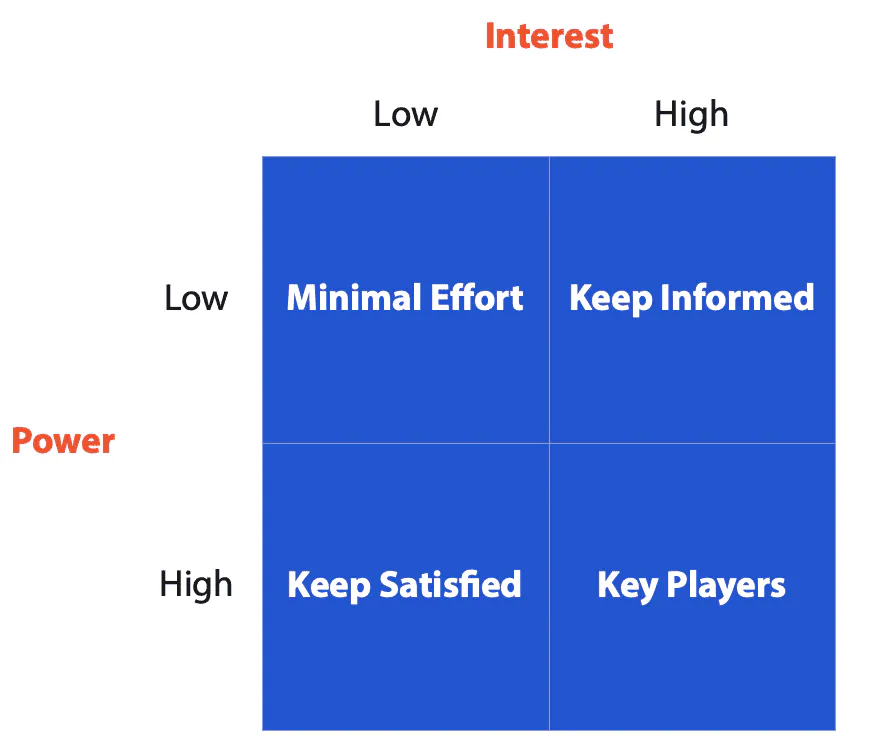
Power = the amount of power a stakeholder can exercise
Interest = how likely a stakeholder is to take action
The four categories of stakeholder are:
Key players: these people have the power and will take action. Therefore management needs to keep them happy.
Keep satisfied: they have power but are reluctant to exercise that power provided they are kept satisfied. If really unhappy, they might turn into key players.
Keep informed: no power, but lots of noise. Management will aim to keep them informed as a matter of politeness.
Minimal effort: this group is at the back of the queue when management is making decisions.