ATX*** P6 June 2014 Exam was.. Instant Poll and comments ***
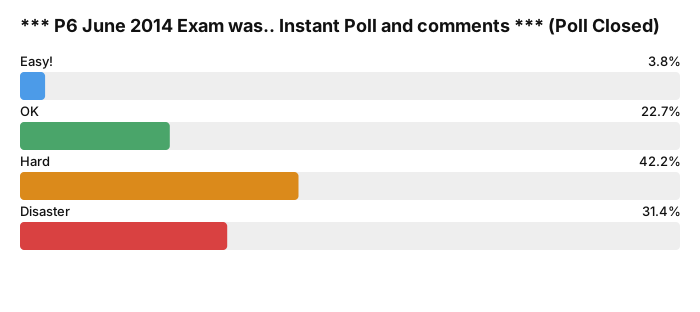
its wasnt one of the best P6 exams was it?
That's exactly how I felt carl29
did not understand question 1 at all. glad i attempted this last. rest of paper was passable. q1 was an unincorporated company... didnt really get the difference in the two disposal options suggested. both were selling the assets?? or not? :)
Question 1 very very difficult, on the whole very hard. Expecting to resit in December :-(
for question 3, part a) it asked for implications for the employees regarding the childcare. I wrote about the child care exempt benefits, like it is 55 pounds for basic rate tax payer. Is it correct??
I spent ages working out question 2 based on 5 associates and getting the profits under the marginal rate. Had a great answer then re-read the question to see they were all 23% companies.
Absolute waste of time!
Threw me for the last 2 questions!
Will deff be re-sitting.
part 1 the biggest problem was getting your head round the scenario. Then there was a timing difference due to the cessation of trade.
1st Jan 2015 OR 30th April 2015. The 30th April taxable in 15/16 and 1st Jan 14/15, there was also additional income due to the 4 months (29k)
Also they asked you to calculate trading profit from 1st May 2013 which was slightly odd as you could work in the margin and just calculate the difference in closing tax cost.
Disposing of assets, entrepreneur relief was claimable. You needed to add assumptions such as it was a trading company etc etc, I didn't do this part well.
Again the IHT question requried some thought, BPR was available (you had to state conditions or assumptions) if he died while business was still owned. If business was sold and then father died afterwards then it become a PET with taper relief etc
Question 2 I found tricky, but do-able. The loss relief was tricky.
I used carry forward loss relief of 68k for offsetting 41k leaving 27k carry forward.
Then offsetting the loss against current year income and gains.
The diposal of the sub qualified for SSE as over 10% ownership for more than 12 months in the 2 years before disposal.
on to part B - i think and there was a question about the timing of diposal. Proceeds being 80k for 1st Oct diposal and 100k for April i think disposal date. The key point here is that SSE will still be available within 2 years of the original diposal but not over a year or 2 years, something along those lines.
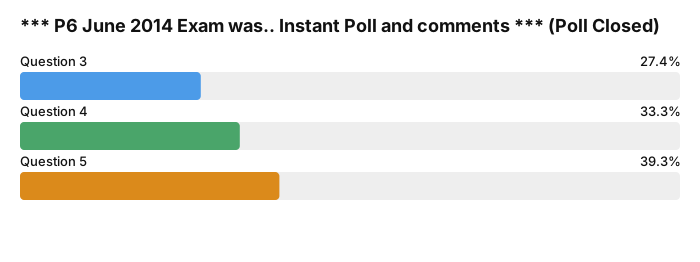
I chose question 4 and 5 and thought they were tricky but do-able.
childcare allowance for lower rate is £55 per week or higher rate £28 per week. There may have also been a child care benefit charge if anyone earned over £50k, i didn't chose this question but know that the £50k is something new to the sylabus.
I think for me one of the hard things I find about tax is that you have to carry on, even when you know that you have not done the question correctly. The rules can be so tricky and tiny changes in scenario can mean a different situation arises (dates of death/gift being a good example of this)
How did people find question 1 and 2 overall?
Yeah that's what I meant Carl.
Worked out all taxes to make sure they didn't pay at marginal rates, to see they all paid CT at 23% anyway.
where was the SSE in question 2??. As I remember the holding disposed was just 5%.
Ahhh budddy, read the question. Examiner only asked for explanation and calculation of the use of losses and carry forward loss.
So you should have first worked out which groups existed and then calculated any gains/losses on disposals then any trading adjustments such as Binni being only 10 month accounting period and being acquired 31st December so only 78,000/10*3 = 23,400 profit being able to be group relieved.
I didn't do so well on this question BUT the good thing is there are a lot of marks just for ploughing through and coming up with an answer.
In Q2 i believe the SSE applied to the initial disposal of the shares when they had 17% (12% was disposed of? If i remember correctly) so there was no gain there.
Then in part 2 or whatever it was, where you could dispose now or in the next accounting year, i put it wanted you to calculate how much you could dispose of now and save some tax and then dispose of the rest next year. Think i calculated like a 4k saving...
Question 1 got me as i couldnt map out the timings and how they affected the question but i think the issue is about cessation of business and continuing the business. The timings also affected the rate which Ziti (I think was the name) was classed as. Higher rate tax or lower rate tax person.
IHT was not my strong point again due to the dates and the fact that his dad Riti was not dead so we had to guess what happens. The date were also soo bad that it was like keep him alive until july when the 7 years are up and you can claim the PET is tax free.
but main thing i did mention was taper relief.
Quick one for Q1, was the 6k expenditure for new equipment fully allowed due to AIA? and also the question said no equipment was greater than 6k in cost or sales, does that mean all equipment was classed as cheap chattels?
Anyways Q2 was a mess, i could describe the different groups and so on but i could not visualize it once i got writing the profit share and distributions. The profits are the profits for the company and not the parents share off which is P2. but i had it in my mind to reduce and how everything based on the parent. This is what caught me for a good 15 minute before i moved on.
Only thing i would say is that the holding in company Viere??? was original 17% before selling 12% during the year. Im not sure how SSE works when you split your trades but the two dates were exactly stretching two periods. one period when in the last 2 years it owned >10% and one when it owned less than 2 years.
Oh my one other contribution was that for Binni i also flexed the tax limits further to refect the fact it had only been trading for 10 months not 12 so upper and lower limits shrank to 250k.
After that i did q4 and q5 which i thought was reasonble but i question how much i write in them as answers as my answers do not look like they justify 5 marks each.
You're never going to believe this - my watch slowed (finally stopped just before the end) during the exam!! And the exam hall is massive so from the back I couldn't read the clock!!
I asked the time, he said "25 past", but I assumed that was 11:25, not 12:25!!! As it didn't feel like I'd been in the exam that long!!
Argh, I was thinking I'd timed it really well, leaving a 1hr for the last two questions, when really there was only 15mins left!!'
Soooo frustrating, I'm the sort of person that brings two calculators into the exam - I've never worried about needing two watches!!!!
I may have scrambled together 10 marks tops for questions 4 & 5 (if I'm lucky). I can only hope that I did well enough for q 1&2 to get a pass.
Sounds like it was a tough exam for all, and from the comments I seem to have faired OK on q 1&2,
I'm expecting to re-sit, but if I pass it'll be a miracle/ happy bonus.
Ggggrrrrr!!! Soo annoyed!!
In the group CT question, did anyone spot that V was a consortium?
Also, L was only 85% owned by R, and R was 80% owned by Opus). Does that mean that it's outside of the loss group as the ownership between O and L is 80% x 85% = 68% <75%. ?
Therefore there would be a loss group of O,A,R,B but another loss group of R and L.
OR
I don't know my loss group rules and it all counted as one big group??????
Please put me out of my misery! I'm away all weekend and don't have my notes to hand!!!
V was a consortium, 17% for 6 months and 5% for 6 months, does this mean 12% across the year or we can only loss relieve 5%? Ive not seen that before, i went for 12%.
Also yeah i got that R and L was a capital gains group but L was not able to have any losses relieved vs its profit leaving it at 75k profit in the year (its gains could be offset vs the losses carried forward in the capital gains group?).
Also how many associates are in the group? I said 6 but ive seen 5 mentioned earlier on. Ive looked in my notes and i still think 6 but now im not sure.
The question said there were loads of overseas associates which effectively would reduce the limits to virtually nil, so use 23% tax rate throughout.
Im not so sure. Ive seen a past question similar where the term "loads" didnt really matter, we calculated the limits based on the associates given to us. The question asked for "any extra info needed" i think we needed to ask about the extra associates.
Q 1 was difficult and also 2 was bit complicated due to mess up in associates. I feel both theory and revision needs. I failed in the latter therefore didn't have time. I relied on kaplan but feel this time I should move to BPP. ANY IDEA?
Im not sure Kaplan would be to blame for a fail. I think the examiner was a little harsh this time, the December exam was a nicer paper. Q1 was something out of the ordinary and I feel Q2 was a harder group relief question than we have been used to. Also this was the first exam ive seen in a while where very few marks were attributable to capital gains reliefs.
Hi
Does anyone know any update on the the 10 year limit on exam?
All in all it was a strange exam.
In Q1, I think I did okay enough but I'm not sure. I got different IT liabilities for the two different types of disposals but the same CGT liability for both which is worrying me because that's weird. But I structured it well enough so hopefully I'll get some marks there. In the first disposal scenario the basis period was the cessation period and the year before the cessation period and I relieved the 6000 equipment bought against AIA and I'm not sure whether I should have done that or not.
b) of the question wasn't too bad. Before 2015, BPR applied, afterwards, it didn't but taper relief came into play.
Q2. I completely missed out on the SSE exemption even though I knew the rules full well! I did manage to latch on to the consortium bit but then I missed out on the 17% for the 6 months and 5% for the next 6 months. For the newly acquired subsidiary my profit was 31200 or 32100 or something. I think it was acquired on Dec 1.
Since I missed out on the SSE, part b sucked. Didn't attempt it. Didn't even spend time on it which was a good thing cause as it turned out I was really short on time.
Part c) was easy enough. Ethics blah blah and some procedure.
Attempted Q3 and Q5.
Q3 a) It qualified for the scheme but the genius that I am I laid down the conditions, stated that the conditions were being satisfied and then said it was not qualifying for the scheme. shoot me.
The rest of the Q3 wasn't too bad.
Q5. Can anyone tell me if there was some trick to the roll over on the machine or was it straight forward? Cause I have a feeling that there was something to it that I missed.
last part was the beneficial interest thing. It's a taxable benefit for the employee but what about the company? I deducted it from interest income :D
Before I went through the posts, I had lost 12.5 marks. but now with the SSE thing that I missed and the 17% and then 5%, I think I may have lost some more.
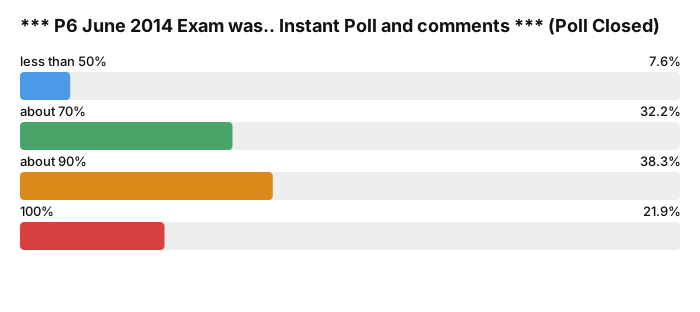
Just hope I get 50. I've already failed this once at 49 :/
The rollover on the Cara machine, the way I saw it was
13k gain rolled over,
Cost was 94k
Proceeds were 80k
rollover meant base cost was 94 - 13 = 81k
thus a loss of £1,000,
Company was a close company, loan is subject to 25% charge, which is repayable by HMRC once the director repays the loan. BIK is chargable to the company for the loan at 13.8% NI and the individual has to pay tax on the interest free part at the official rate of interest as the loan is not at market value.
Thats what I put.
Totally missed the consortium bit, quite liked the rent a room bit, that was my favourite part as property is my strong point.
8th August will be results release date
mufakir - Good luck brother, i failed at 49 last time too. I think in Q5 it was a depreciating asset for rollover relief. Im not sure where all the 6 marks came from, but maybe that is worth a couple to talk about that. So i think the gain crystallises on purchase and becomes chargeable on disposal.
Hi, anyone here taking p6 MYS variant?
How do u answer for the
Q1
(a) donation of goods and van
- is it both not deductible and should added back?anything else to talk about?
(b) tax issue if independent contractor / employee
- talk about withholding tax for independent contractor? wat else?
- Wat to talk about employee? More than 60days? Not exempted? wat else?
(c) argument for single / separate business
- how do you argue
(d) impact of single/separate business
- how to you explain the impact?
Q2
(a) export
- wat incentive?
(b) manufacturer incur cost for automation
- wat incentive?
(c) promoted product, RM100million capital expenditure
- investion tax allowance?
(d) tourism,promoted activity , RM10million annual profit, profitable after 3 months
- pioneer status?
Q4
(a) compute capital allowance and balancing adjustment
- is it control transfer? So no balancing charge?
- Wat else to talk about? 9marks!
(b) stamp duty
- explain wat?
(c) impact on disposal of asset on tax estimate/revised estimate
- wat impact on tat?
Q5
(a) tax payable for both benefit package
- second package can save tax?
(b) Cash available
- first package more cash available?
(c) Merits
- first package more cash
- second package save tax
- wat else can talk about?
(d) Tax treatment for
- scholarship from company (exempted?)
- rental income (settlement? S65(1) below 21 years old, unmarried)
- part time income when vacancy (taxable?)
so missed out close company. another 2.5 gone :D
Q1 - Tough to get into. Longer period spreads it over two tax years for IT.
Different types of disposal - first is just the building so no ER, second is whole business so ER available. Equipment covered by capital allowances in both cases and balancing charge in income tax.
b) IHT not too bad if identified when taper relief changes.
Q2 - Looks like everyone approached this differently! All companies full rate, can't relieve one in full by group relief unless defer other loss b/f. So I took the tax planning point to be restrict the WDA to reduce CY loss to just what can be used. As a c/f loss can only be used internally and that co wouldn't be profitable in the future. One co was only 10 months - noticed someone said only acquired on 31 Dec, missed that bit!
SSE available on the sale of shares if they sell on first date but not on the second. Slight after tax benefit on the second date but not a lot for a possible increase of share price.
Q4 - PPR relief restriction on the tennant.
UK domicile for IHT so that spouse legacy not restricted.
Residue of estate calc straight forward.
Q5 - Cara machine was rolled over gain on a depreciating asset. Therefore the gain rolled over crystalizes rather than reduces new asset base cost. New asset is just a balancing charge as pool balance was nil.
Dividend v bonus not too bad.
VAT flat rate scheme - I explained system but said it wasn't available due to some exempt supplies, think that was wrong!
Tough paper overall!
q2 and V i dont think was classed as a consortium as the question said some one else not related to the the holding company already owned 75% share holding. If some one else owns 75% that would effectively mean they have full rights to the passing losses downwards as they would be in a loss group
as for associates, i messed up and missed the fact that they said the overseas businesses mean it was contently a higher rate tax payer.
For q5, the investment was in a depreciating asset so i calmed hold over relief instead of roll over relief so it meant crystallizing gain if you replaced, obsolete or 10 year after purchase. since it was being "replaced" the 13k crystallized to pay. the other comment i picked up on was that the WDA for all assets was set to nil. not sure if this is correct but i assumed all benefits relating to the asset had been taken before and so the loss was in fact a gain as the there was no cost to be asset. i then took it as lower of cost vs net reliseable value and took that amount as being the gain to calculate on.
how was it a depreciating asset btw?
because it was a machine? and machines depreciate?
Topic lockedNew replies are closed.