Skip to contentSkip to search
Kaplan Publishing: Black Friday countdown

SBR*** P2 March 2016 Exam was.. Instant Poll and comments ***

Oopentuition_teamAdmin10y ago

Please vote in our Instant Polls about the P2 March 2016 Exam.
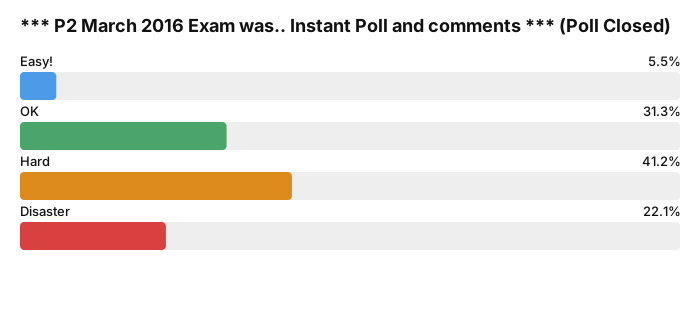
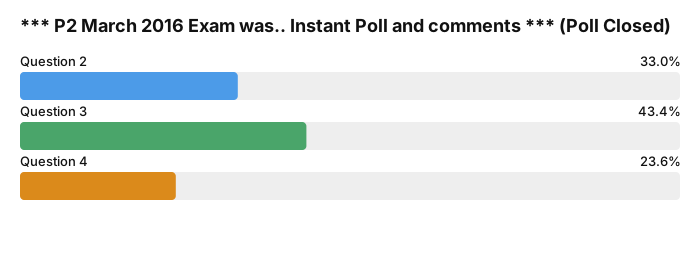
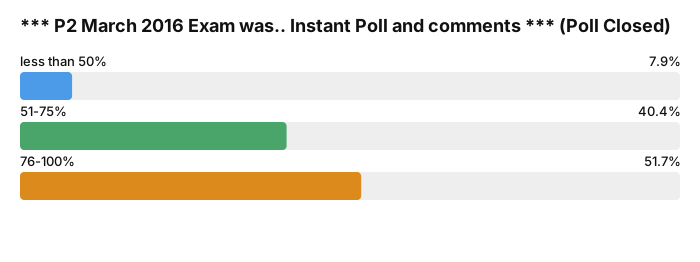
*** P2 March 2016 Exam was.. Instant Poll and comments *** poll results *** P2 March 2016 Exam was.. Instant Poll and comments *** poll results *** P2 March 2016 Exam was.. Instant Poll and comments *** poll results Post your comments about P2 exam below

HH10y ago#31
The Acq of sub 1 was 2 years prior. The acq of sub sub was 6 months from the year end when Sub 1 Purchased 70% of sub 2.. The increase in the Parents holding of Sub 1, needed to be included in the consideration of acq of the sub sub. So the consideration for sub sub involved the 25% holding 6 months from the year-end, and the 42% indirect consideration from Sub 1's purchase of sub 2. The difference then needed to be taken off Sub 1' NCI figure.
Former userFormer user10y ago#32
yes it is step acquisition and not D shape
Former userFormer user10y ago#33
Yes it was a step acquisition as "acca63" said.
Former userFormer user10y ago#34
Yes you are right, step acquisition it is
Former userFormer user10y ago#35
Yes it was a step acquisition!
HH10y ago#36
It was a D-Shape group. If you can recall, both the Parent and Sub 1 (Lambley) had investments in H. A step acq involves 2 purchases from the same entity. This didnt happen in the exam question. Bideford bought 25%. And then Lambley bought 70%. Because Lambley bought 70%, it meant that H company became a Sub Sub of Bideford. But it's not a step acq. Definitely a D-Group.
Former userFormer user10y ago#37
I hope I did enough to earn me a pass this time around.the paper was fair but as usual time pressured.Consolidation is always messing up time management in the exam
RRaymond10y ago#38
I am writing P2 for the first time in June, your comments really made me to brace myself up for what's ahead. Hope it goes well for you all :)
OOlga10y ago#39
Oh noo! I also did a step acquisition ((( I so shocked I didn't see it on the script! it's was pure down to bad lighting, darkish colour paper and nerves! So unfair coz that's what def gona make me fail now
Mmartin10y ago#40
@hassandiamond said: It was a D-Shape group. If you can recall, both the Parent and Sub 1 (Lambley) had investments in H. A step acq involves 2 purchases from the same entity. This didnt happen in the exam question. Bideford bought 25%. And then Lambley bought 70%. Because Lambley bought 70%, it meant that H company became a Sub Sub of Bideford. But it's not a step acq. Definitely a D-Group.
Can u clarify. D or step. Surely there was 2 purchases by L in H???
AArjun10y ago#41
It's D shape. There is no step acq in SFP. 2 purchases would still make sub from associate. Equity method if less than 50% and consol when gained control.
HH10y ago#42
Correct me if i'm wrong because during exam stress, your mind can play tricks.This is how i read it. 2 years prior, Bideford bought 60%(SUB) in L and 25% (ASS) in H. Then 6 months from the year-end, L bought 70% in H. At that point, Bidefords 25% holding in H had increased but not by additional purchase of shares, but just cos in the 18 month gap, they would have made profits and the investment would have gone up. The additional amount which it had gone up by needed to be added in W5 group reserves because Bideford was only recording the investment at cost. As for the group structure, the acquisition of H occurred when L bought 70% in H because that meant that Bidefords total holding (direct and indirect) was now 67% (42 and 25).
Aanam10y ago#43
it was surely a step acquisition because investment of B in H has changed from 25% (Associate) to 67% (sub-subsidiary)
AArjun10y ago#44
67% effective holding hence Hassan is correct. There is no step acq in SFP. An associate consolidated when control, hence becomes sub, achieved. Difference in reserve between acquisition and at the reporting date is reflected between NCI and group reserve. Therefore complex group (D Shape), can not confirm enough.
HH10y ago#45
Technically it's not called a step-acquisition, because B didn't purchase the shares directly. It gained control, due to L's purchase. But i think the treatment is the same, and as long as the %'s are the same then we are probably saying the same thing! :) It's definitely a D-shape group though, because both B and L had control over H.
Mmartin10y ago#46
@hassandiamond said: Technically it's not called a step-acquisition, because B didn't purchase the shares directly. It gained control, due to L's purchase. But i think the treatment is the same, and as long as the %'s are the same then we are probably saying the same thing! :) It's definitely a D-shape group though, because both B and L had control over H.
Hassan. Do you use the fv 25% per q in assoc at date of 70% purchase to get gooodwill??
TTereza10y ago#47
You seem to gave done really well. well done. I can see my mistakes now...
HH10y ago#48
@mfe100 said: Hassan. Do you use the fv 25% per q in assoc at date of 70% purchase to get gooodwill??
Yup! The difference between the 2 associate figures needed to be added to Ret Earnings because Bideford was still recording it at cost. If possible, can you guys remember what you did with the Inventory and provision? I think i worked out an inv write down of 3m and then with the provision, because it was an "onerous contract" you record a provision for the lower of the total payments in the contract or the cost to terminate. I think it was 3.5 off retained earnings and then added to Liabilities on the face of the SFP.
DDetermined10y ago#49
What I did for Goodwill in Hampston was use 3 amounts for the FV of Consideration, the original amount Bidgeford paid for the 25% plus the increase in the fair value of that 25% holding which was from 200 to 225 so 25 is the increase in FV. Plus the 70% of what Lambley paid for H because it was L that paid for H. So 200+25+(70% of what L paid for H) . I think it was 70%. Then I put the increase in the FV of H as in the 25 to the retained earnings of B as it was a gain on disposal of an investment. It wasn't Really a disposal but H was no longer an investment for B, it was now a sub sub at the year end.
DDetermined10y ago#50
I just see it as it is all Fair Value figures at the date of acquisition. So you have to bring in fair values for goodwill consideration and the net assets. Same as the equity tables, bring everything in at fair value. I screwed up on the fair value figures at acquisition for Lambley, it's normally given so I just couldn't remember how to figure it out myself. It's over now, cannot change anything. So what will be will be in April. It's a really tough paper to pass I think.
Mmartin10y ago#51
@hassandiamond said: Yup! The difference between the 2 associate figures needed to be added to Ret Earnings because Bideford was still recording it at cost. If possible, can you guys remember what you did with the Inventory and provision? I think i worked out an inv write down of 3m and then with the provision, because it was an "onerous contract" you record a provision for the lower of the total payments in the contract or the cost to terminate. I think it was 3.5 off retained earnings and then added to Liabilities on the face of the SFP.
Exactly what I did on that Q
HH10y ago#52
@determinedciara said: What I did for Goodwill in Hampston was use 3 amounts for the FV of Consideration, the original amount Bidgeford paid for the 25% plus the increase in the fair value of that 25% holding which was from 200 to 225 so 25 is the increase in FV. Plus the 70% of what Lambley paid for H because it was L that paid for H. So 200+25+(70% of what L paid for H) . I think it was 70%. Then I put the increase in the FV of H as in the 25 to the retained earnings of B as it was a gain on disposal of an investment. It wasn't Really a disposal but H was no longer an investment for B, it was now a sub sub at the year end.
B owned 60% in L but im sure thats what you put in the exam. You did Exactly what i did, and is also consistent with past exam answers. It needed to be added to Ret Engs, because the qn said Bideford had kept Investments at cost (ie the 200) Also, the difference between what L paid for H and the figure you entered in the goodwill consideration (ie 40 % of L's investment in H) needed to be deducted from the NCI figure of Lamley to avoid double counting (Indirect holding adjustment). There was also a sneaky bit about how B had included 5m of legalcosts associated with the purchase. That had to be removed and deducted from Ret engs. This examiner must hate seeing people pass!
OOlga10y ago#53
when ever it's step acq or D shape acq its is easy and straight forward to calculate unless you in the stressing environment and lots of pressure and you are genuinely misread then ... June
OOlga10y ago#54
What you describe its pure D shape ( I wish it wasn't)
Former userFormer user10y ago#55
Hassan's answer is right.
Aanam10y ago#56
it was not a direct purchase but the substance of that transaction needed to be considered rather than just a legal form......according to which the accounting boundary of 50% holding and control has been crossed... if i am not wrong it should be a step acquisition
HH10y ago#57
@anam121 said: it was not a direct purchase but the substance of that transaction needed to be considered rather than just a legal form......according to which the accounting boundary of 50% holding and control has been crossed... if i am not wrong it should be a step acquisition
Terminology is not important. As long as we both did the same thing, and we are both correct, then i don't care if it's called a Shotgun Acquisition LOL
Mmartin10y ago#58
RE q3 B store in liquidation for sale. My read on this was that the asset did not meet all criteria to transfer to ahfs. it was not available for sale in its current condition due to the ongoing liquidation sale.?????
HH10y ago#59
As it was 8 marker, i saw it as a 50/50 split between Construction costs (IAS16 and IAS 23) and then the IFRS 5. I wrote that all the costs associated in getting the store ready for use should have been capitalised. As for HFS, I cant fully remember, but i think i listed the criteria for HFS, and i think i stated it would classify. I didn't think Liquidation effected the classification as i didn't see it as "Work to be done to get the asset ready for sale". I reckon i could be wrong there. I did say, that as the decision was made 3 months after the Year-end, it was a non-adjusting even under ias10. Though i really wasnt sure if that was right either. How did you see the 3 deposit payments with the leases? I said with Op lease, it should be added to the total lease payments and recognized in the PNL on a straight line basis. For the 1st Finance one, i said it would reduce the effective rate of finance. The 2nd finance one, i said as it was interest free and to be returned at the end of the lease, i said it should include finance costs which equal the amount of interest that would have been occured under normal circumstances. Again though, it felt wrong when i was writing it. I dont recall learning this stuff during my studies!
Ffrancois98810y ago#60
I am so surprised how you remember all these details, For some reason, i got a negative goodwill which i was surprised in the exam room, but hey under pressure, you do weird things...
Topic lockedNew replies are closed.