
Skip to content

ACCA Forums

APMJune 10 Exams POLL Paper P5 was Post your comments here

OopentuitionAdmin16y ago
Please share here with community your comments about P5 exam!
?Take our P5 exam survey


Vote in our instant poll!
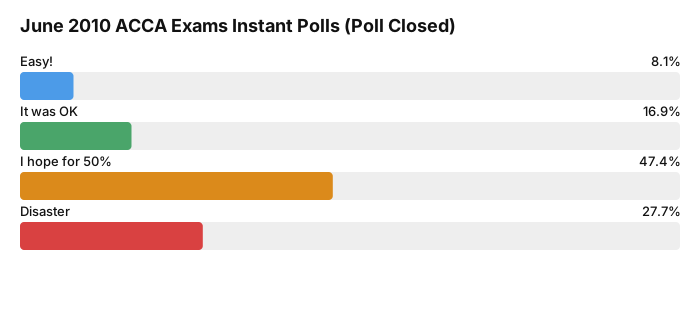
June 10 Exams POLL Paper P5 was Post your comments here poll results
Former userFormer user16y ago#31
last question was 12 marks am sure with no part c)

other than that fully agree

just harsh marked myself and got 47...not happy :(

I am angered as i failed the june 09 exam which had tons of very specific theory where this was a very waffle paper with no substance time demand was insane.
As usual, glad to see back of Shane tbh as his exams have no consistency of difficulty i.e. june 09 was hard (for me) dec 09 looked a lot simpler and this was just a very half assed paper,

budget was a gift of 7 marks - as was the probability unless I missed something
ended out with 900K emv for one of them?

but it's hard to do gage how they will mark theory i.e. i wrote some random stuff for why government would open a riding school i said to allow it to people of a lower socio economic background (can't afford high fee's) demand for it for reason's like a world competition (olympics eg)
Former userFormer user16y ago#32
One guy next to me was still writing without being spotted at 1.23!!! just proves the time pressure i stopped at 1.15!!
Former userFormer user16y ago#33
@zigot14 said:
Discursive questions were very open and confusing - not sure what they really wanted. It feels like the examiners formulated the answers first, and they came up with the question to suit it. Trouble is, we can't read his mind well enough to intepret the question!

Also, did anyone notice the mistake in Q2? The heading of the probability table given. It should be "no. of students" instead of "student fees".

Princeacid: to calculate the EV, u need to list down all 9 possible outcomes by pairing the outcomes up. Then calculate the adjusted profit for each outcome individually, add them up together to get ur net profit.
Get combined probability by multiplying probabiliyt of outcome 1 with probability of outcome 2. Multiply the results again to obtain the EV. Finally, sum them up together.
Lengthy, took me 5minutes to figured out what they really wanted.

Are you sure they meant number of students?
I assumed these were really fees, and was absolutely confused. Spent a lot of time on calculations, and ultimately nothing...:( Left this part of the question.
Former userFormer user16y ago#34
@ellichrisott said:
last question was 12 marks am sure with no part c)

other than that fully agree

just harsh marked myself and got 47...not happy :(

I am angered as i failed the june 09 exam which had tons of very specific theory where this was a very waffle paper with no substance time demand was insane.
As usual, glad to see back of Shane tbh as his exams have no consistency of difficulty i.e. june 09 was hard (for me) dec 09 looked a lot simpler and this was just a very half assed paper,

budget was a gift of 7 marks - as was the probability unless I missed something
ended out with 900K emv for one of them?

but it's hard to do gage how they will mark theory i.e. i wrote some random stuff for why government would open a riding school i said to allow it to people of a lower socio economic background (can't afford high fee's) demand for it for reason's like a world competition (olympics eg)

I've also marked myself and got 47 as a best case scenario :))
As the most probable outcome, I expect 40-41...
Oh damn! My first fail, have never failed before at ACCA exams :(
(Maybe P7 is also, of course, but I am more confident with that exam - surprisigly! Expected P5 would be much easier than P7).
Former userFormer user16y ago#35
hi guys, what was the average cost for chargeable consultation, both for full time and contractors in question 1, was there a trick in that question?
Former userFormer user16y ago#36
oooooooooooooh god its my last paper since dec09, i think z exam is too lengthy, if i didnt pass it i dont know what to do? i covered 90% of z exam in bad writing i dont know if z marker could distinguish my handwriting? god be with me
Former userFormer user16y ago#37
@sifelani said:
hi guys, what was the average cost for chargeable consultation, both for full time and contractors in question 1, was there a trick in that question?

I just left this part out - only 7 marks and would take almost 20 mins I would estimate. I also left out the expected values calculation. Still hope to pass as I did good theory answers
Former userFormer user16y ago#38
....and linking that heterogeniety, simultaneity, perishabilty and intangibility to the scenario, would one get marks for just defining these without any really meaningful link???????
Former userFormer user16y ago#39
@enigma1981 said:
I just left this part out - only 7 marks and would take almost 20 mins I would estimate. I also left out the expected values calculation. Still hope to pass as I did good theory answers

Hey,

I did the same as you. I revisited these parts about three times each and each time was more confusing....ouch.

I hope for a pass still as i think i did fairly ok on the discursive questions.
Ttrinistudent00116y ago#40
I had some trouble with Q1 (b)....to me something was missing. How did you all handle that bit? The exam overall was lengthy.....but I think I managed ok. Just will wait till August to see how I did, I guess.
Former userFormer user16y ago#41
i just noticed that question 2 was exactly the same as question 1 in 2003 sitting question called NW Entertainment company. asked to do budgeted net profit, probablities and comment on the use of expected values.even some numbers in the question are same
Former userFormer user16y ago#42
Question
1 The NW Entertainments Company (NWEC) is a privately owned organisation which operates an amusement park in
a rural area within the North West region of a country which has a good climate all year round. The amusement park
comprises a large fairground with high-quality rides and numerous attractions designed to appeal to people of all ages.
The park is open for 365 days in the year.
Each day spent by a guest at the park is classed as a ‘Visitor Day’. During the year ended 30 November 2003 a total
of 2,090,400 visitor days were paid for and were made up as follows:
Visitor category % of total visitor days
Adults 40
14–18 years of age and Senior Citizens 20
Under 14 years of age 40
Two types of admission pass are available for purchase, these are:
The ‘One-day Visitor’s pass’ and the ‘Two-day Visitor’s pass’, which entitles the holder of the pass to admission to the
amusement park on any two days within the year commencing 1 December.
The pricing structure was as follows:
(i) The cost of a One-day pass for an adult was £40. Visitors aged 14–18 years and Senior Citizens receive a 25%
discount against the cost of adult passes. Visitors aged below 14 years receive a 50% discount against the cost
of adult passes.
(ii) The purchase of a Two-day Visitor’s pass gave the purchaser a 25% saving against the cost of two One-day
Visitor’s passes.
(iii) 25% of the total visitor days were paid for by the purchase of One-day passes. The remainder were paid for by
the purchase of Two-day passes.
Total operating costs of the park during the year amounted to £37,600,000.
NWEC receives income from traders who provide catering and other facilities to visitors to the amusement park. There
are 30 such traders from whom payments are received. The amount of the payment made by each trader is dependent
upon the size of the premises that they occupy in the amusement park as shown in the following summary:
Size of premises No of Annual Payment
Traders per Trader
£
Large 8 54,000
Medium 12 36,000
Small 10 18,000
The income from each trader is received under 3 year contracts which became effective on 1 December 2003. The
income is fixed for the duration of each contract.
All operating costs of the park incurred during the year ending 30 November 2004 are expected to increase by 4%.
This has led to a decision by management to increase the selling price of all categories of admission passes by 4%
with effect from 1 December 2003. Management expect the number of visitor days, visitor mix and the mix of
admission passes purchased to be the same as in the previous year.
NWEC also own a 400 bedroom hotel with leisure facilities, which is located 20 kilometres from the amusement park.
During the year ended 30 November 2003, the charge per room on an all-inclusive basis was £100 per room, per
night. The total operating costs of the hotel amounted to £7,950,000. Average occupancy during the year was 240
rooms per night. The hotel is open for 365 days in the year.
It is anticipated that the operating costs of the hotel will increase by 4% in the year ending 30 November 2004.
Management have decided to increase the charge per room, per night by 4% with effect from 1 December 2003 and
expect average occupancy will remain at the same level during the year ending 30 November 2004.
The revenue of the hotel is independent of the number of visitors to the amusement park.
2
3 [P.T.O.
Required:
(a) Prepare a statement showing the budgeted net profit or loss for the year to 30 November 2004. (7 marks)
(b) The management accountant of NWEC has prepared the two-way data table shown in Appendix 1. Discuss
how the directors could make use of such a table. (4 marks)
(c) (i) Another organisation has announced its intention to open an amusement park and hotel. The management
of NWEC are uncertain of the impact that this will have on the number of visitors to its park and hotel during
the year to 30 November 2004. Current estimates of the number of visitors to the amusement park and the
average percentage occupancy of the hotel are as follows:
Amusement Park Hotel
Admission Receipts Probability Occupancy % Probability
Increase/(decrease)
Increase by 10% 0·20 75% 0·10
No change 0·60 60% 0·60
Decrease by 15% 0·20 45% 0·30
Using Appendix 1 on page 4, prepare a summary which shows the range of possible net profit or loss
outcomes, and the combined probability of each outcome. The table should also show the expected
value of net profit or loss for the year. (6 marks)
(ii) Comment briefly on the use of expected values by management. (3 marks)
(d) Discuss SIX performance measurement criteria that management could utilise in order to assess the quality
of service provided by the hotel. Indicate what would be measured and state the mechanisms which would
enable measurement of the chosen criteria. (6 marks)
(e) Name and comment on the actions that could be taken by management in the short-term, in an attempt to
ensure that the profitability of NWEC is not affected by the opening of an amusement park by another
organisation. (6 marks)
(f) Explain the term ‘strategic management accounting’ and discuss the benefits that might accrue to NWEC as
a result of its introduction by management. (8 marks)
(40 marks)
Former userFormer user16y ago#43
and solution
Part 3 Examination – Paper 3.3
Performance Management December 2003 Answers
1 (a) NWEC Ltd
Budgeted Profit and Loss Statement for year to 30 November 2004
Amusement Park – admission receipts:
One-day pass £ £
Adults: 8,696,064
14–18 years, senior citizens 3,261,024
Under 14 years 4,348,032
Two-day pass
Adults: 19,566,144
14–18 years, senior citizens 7,337,304
Under 14 years 9,783,072
––––––––––
52,991,640
Other revenue Income from traders 1,044,000
–––––––––––
Total revenue – park 54,035,640
Operating costs 39,104,000
–––––––––––
Budgeted profit of park 14,931,640
Hotel income 9,110,400
Hotel operating costs 8,268,000
––––––––––
Budgeted profit of hotel 842,400
–––––––––––
Total budgeted profit 15,774,040
–––––––––––
Workings:
No. of Visitor days for year to 30 November 2004 = 2,090,400
One-day passes = 2,090,400 x 25% = 522,600
Two-day passes (2,090,400 x 75%)/2 = 783,900
Admission fees applicable from 1 December 2003.
(increased by 4% per annum).
Category of visitor:
One-day pass (£) Two-day pass (£)
Adults 41·60 62·40
14–18 years; senior citizens 31·20 46·80
Under 14’s 20·80 31·20
(b) A two-way data table shows the results of combinations of different values of two key variables. In this case, the table enables
the management of NWEC to view the net profit or loss for each of a range of combinations of levels of admission to the park
and hotel occupancy. A spreadsheet data table tabulates the results of sensitivity analysis – i.e. the outcome values when one
or two values are changed. The use of a data table enables the management of NWEC to quickly assess the impact on
profitability of changes in the number of visitor days to its amusement park and/or in the level of hotel occupancy. This table
indicates to management that for a net loss of £510,670 to occur within the year to 30 November 2004, not only would the
number of visitor days sold have to decrease by 25% but also hotel occupancy would have to fall to 40% (by 331/3% of the
previous year’s level). The best possible outcome is a profit of £28,649,968 which would arise if visitor days to the park
increased by 20% and the hotel occupancy rate also increased to 75% from 60%. Most decisions are quite complex,
involving a range of different input values. The management of NWEC can perform ‘what-if’ analysis, which will improve the
quality of decision-making within the organisation.
16
(c) (i) The range of possible outcomes using the probability estimates given in the question and the values contained within
Appendix 1 are shown in the following table together with the expected value of net profit.
% Change in Probability Hotel Probability Combined Net Profit Expected Value
Visitor days Occupancy Probability of net profit
£ £
+10% 0·20 75% 0·10 0·020 23,350,804 467,016
60% 0·60 0·120 21,073,204 2,528,784
45% 0·30 0·060 18,795,604 1,127,736
0% 0·60 75% 0·10 0·060 18,051,640 1,083,098
60% 0·60 0·360 15,774,040 5,678,654
45% 0·30 0·180 13,496,440 2,429,359
–15% 0·20 75% 0·10 0·020 10,102,894 202,058
60% 0·60 0·120 7,825,294 939,035
45% 0·30 0·060 5,547,694 332,862
–––––– –––––––––––
1·000 14,788,602
–––––– –––––––––––
(ii) The use of expected values takes into account the relative likelihood of each of the possible outcomes occurring. The
expected value of £14,788,602 is not one of the potential outcomes in the table, but is the weighted average of those
outcomes. The use of expected values by the management of NWEC implies that they have a risk-neutral attitude. A risk
neutral decision-maker will ignore the variability in the range of potential outcomes and will be concerned only with the
expected value of outcomes.
(d) The management of NWEC could choose from the following list of criteria relating to service quality. As required by the
question, a measure and mechanism for measurement is also provided.
– Appearance – the appearance of staff reflects the image of the hotel.
– Responsiveness – staff responsiveness assumes critical significance in the hotel industry. The time taken to deal with
queries by reception staff.
– Comfort – room facilities such as air-conditioning, tea/coffee-making and cold drinks facilities.
– Availability – the in-room availability of office facilities such as e-mail, facsimile and access to photocopying.
– Cleanliness – the cleanliness of all facilities within the hotel.
– Safety measures – the frequency of inspections made regarding safety equipment within the hotel and compliance with
legislation.
Customer surveys would be an appropriate mechanism for measurement of each of the foregoing measures with the exception
of safety which management should measure by inspection of internal records.
(e) Management could consider taking some of the following actions in order to maintain and improve the profitability of the
amusement park:
– The current structure regarding admissions is limited to the sale of either one-day or two-day passes. Perhaps, a wider
choice of tickets available for purchase by visitors might encourage more frequent visits by individual visitors. For
example, many visitors might welcome the opportunity to purchase season tickets which would allow them to visit the
park at any time during the year. Consideration could also be given to discounted family tickets and ‘twilight’ tickets for
afternoon/evening visitors. The latter would also help maintain the number of visitors throughout any given day since
the late arrival of such visitors would offset those who left after spending the morning and afternoon at the park.
– The amusement park is situated in a rural area which may deter potential visitors to the park who are either unable to
drive or do not have their own means of transport. Management should consider the provision of a transport service
from the nearest towns/cities to the amusement park. This might also lead to a reduction in the number of vehicles at
the amusement park leading to improved access and improved levels of safety.
– The company is expected to incur total operating costs amounting to £47,372,000 during the year to 30 November
2004. Management should give consideration to instituting a formal programme of cost reduction. The focus of such a
programme is upon the need to reduce costs below the previously accepted norm whilst simultaneously avoiding a
reduction in either quality or effectiveness. If NWEC has a ‘loose culture’ regarding cost-consciousness, there may well
be scope for significant savings to be achieved.
– It is noticeable that the company does not have any revenues from advertising. By the very nature of its business, NWEC
is well positioned to raise such revenues from those organisations wishing to advertise their goods and services to the
customers that visit the amusement park.
17
(f) The distinguishing feature of Strategic Management Accounting (SMA) is that it considers the relationship of the organisation
with its external business environment. It focuses attention on suppliers, customers and competitive rivals. Information may
be quantitative or qualitative in nature, and some information will be of a non-financial nature. For a long time there have
been criticisms of the information provided by management accountants as having an inward-looking perspective.
The development of a strategic management accounting system could provide extremely valuable additional information for
use by the management of NWEC. This value lies in the fact that the information is forward-looking and should focus on the
organisation and its external business environment. Such information will therefore focus on potential issues of importance
to the stakeholders of the organisation, in particular, its suppliers, customers and competitive rivals.
When management implement a chosen strategy they are seeking to derive a sustainable competitive advantage, and this
process will be aided by the information gathered within a strategic management accounting system. Virtually all organisations
are subject to environmental change and in this respect NWEC is no exception. Thus it is critical that all aspects of a business
are monitored so that a holistic approach is taken when strategic plans are being developed. The strategic management
accounting system should be capable of coping with changes that can and will inevitably occur in a dynamic business
environment. Hence it is crucial that changes such as the emergence of a new competitor, are detected and reflected within
strategic plans at the earliest opportunity.
If implemented, it is vital that a strategic management accounting system provides information that is relevant and reliable
therefore enabling the management of NWEC to make correct decisions. This is critical to any business given that decisions
of a strategic nature affect the entire organisation and are generally irreversible in the short-term, and quite often long term.
Thus managers throughout NWEC should receive information that will enable them to take the right options thereby improving
the overall position of the organisation. In this regard it is essential the managers be provided with information, which relates
to every aspect of NWEC and looks at its position relative to the entire industry in which it operates. This will enable due
consideration to be given not only to the strengths and weaknesses of the NWEC but also to the opportunities and threats
facing it.
There is no doubt that a strategic management accounting system, by providing information that facilitates beter planning,
control and decision making would make a major contribution to the longer term development of NWEC.
Former userFormer user16y ago#44
its not v much easy to score ...lots of theory portion with little case studies ...nways hope to get 50 at least ......i must say tht da examiner is not giving da kits quesions whch is v bad as i had done al da kit bt stil find da ppr difficult ;(
Zzuzana16y ago#45
but it was fees from college and utilization of riding school. what were all the possible options? Did you have every college fee combined with every riding school fee and also as a third dimension the 3 possible utilizations?

@kamcreation said:
the way you are supposed to by multiplying the values with joint probability ;)
Former userFormer user16y ago#46
paper was out of the way bad time management no calculation just theory but hope for the best.
Former userFormer user16y ago#47
did not expect so much from F5, when P5 already has such a vast area off syllabus.
Aashhh16y ago#48
the paper was soo damn lengthy!
soo hoping to pass
Former userFormer user16y ago#49
For me surprisingly exam seems purely ok! I got 5.4 m profit as well. Very time consuming, wasn't able to finish all small parts. Let's wait for results and wish everybody to pass!
Ddontee16y ago#50
THIS EXAM WAS A PIECE OF CRAP !!!!!!!!!!!!!!!!! after i studied night after night..........what the hell was that???????? it was like you had to pull ideas from out of the sky....... not one question looked like a past paper question or even something from the kit
Former userFormer user16y ago#51
This was Shane Johnson's last exam setting for P5. So he may have not bothered at all.
Too many requirements but less time and too much details to read. There were not much questions about performance management / measurement.
Hoping for a pass!
Former userFormer user16y ago#52
cant wait to be chartered......Shane I need a pass in this exams.....no matter the case........plsssssssssssssssssssssssssssssssssss...................could anyone answer the question 1 confidently....as it relates to average cost? I was totally confused as to how to get that even though I had the impression it was easy to work out.....i tried several things but dont think i was right....
Former userFormer user16y ago#53
@natka Question 5 did not have a part c the part b was worth 12 marks
Former userFormer user16y ago#54
Q1. Calculate BDA days by full time consulatants
Deduct BDA days from Consultation days by FT consultants
= Chargebale consultation days by FT consultants
Deduct this from Total Chargeable consultation days
= Consultation days by Sub-contractors
% of Sub-contractor days to Chargeable days = NFPI
Bbelle16y ago#55
Not very happy with the questions. I don't know what the examiner wants. If I fail, I don't know what I can do to improve :(
Former userFormer user16y ago#56
@zuzana said:
but it was fees from college and utilization of riding school. what were all the possible options? Did you have every college fee combined with every riding school fee and also as a third dimenion the 3 possible utilizations?
i agreee...............i did evry question possible find on ev ,even f5 book ......going into paper i pray that plz GOD EV must be there andddddddddd guess wat it wast ......but hav u all read that old saying........WEN GOD WANTS TO PUNISH U .....HE LISTEN TO UR PRAYERS.......wow ..........................screwed big time .......but as reading comments of u all guys i still got hope ......i wasnt alone in here.............:)
Former userFormer user16y ago#57
very easy question; even f5 knowledge is well enough to pass!! but, was not contents and requirements are too high comparing time allowed??? what abt EV? only 9 marks for about 3 page calculations!!!! how ridiculous!
Former userFormer user16y ago#58
A very strange paper.. strangely easy.. with a lot of waffling.. i wish i hadnt studied soo much .. i felt this was a paper someone can pass without studyin a lot.. all the exam question practice was a total waste.. shane jhonsons last paper is his easiest paper and i think a lot of ppl will fail this paper because it was sooo easy .
Ddarkrider16y ago#59
@zeeshansajid said:
A very strange paper.. strangely easy.. with a lot of waffling.. i wish i hadnt studied soo much .. i felt this was a paper someone can pass without studyin a lot.. all the exam question practice was a total waste.. shane jhonsons last paper is his easiest paper and i think a lot of ppl will fail this paper because it was sooo easy .


Yeah man i am thinking of making

Are you Smarter then a Fundamental/Skill Student ?

Would invite all the examiners to complete all the professional level especially optional papers and see them flunk out of the school(As in “Are you smarter then a 5th grader?”

n ****ing publicly admitting that these cant be completed in the given time)


OT can you sponsor the cash prize $1,000,000 for the participants just in case someone manages to complete it ;)
Former userFormer user16y ago#60
How is it possible to complete all the answers in the given time???
Why isn't there a separate time management paper so I can prepare and attent that one only.. Each and every exam I'm attending at ACCA I have to pray that my knowledge matches the inspiration for time management.. it becomes very obvious that ACCA wants to earn more and more money from the failers... :((((((
Sign into reply to this topic.