
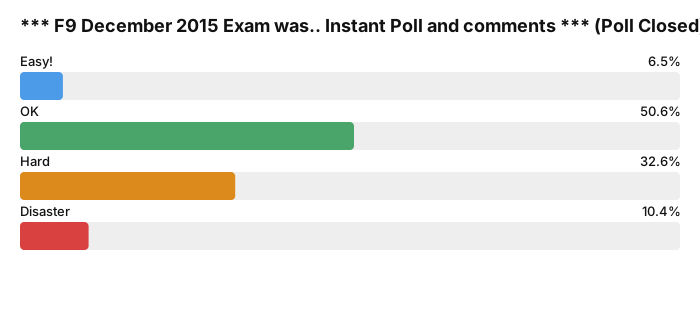
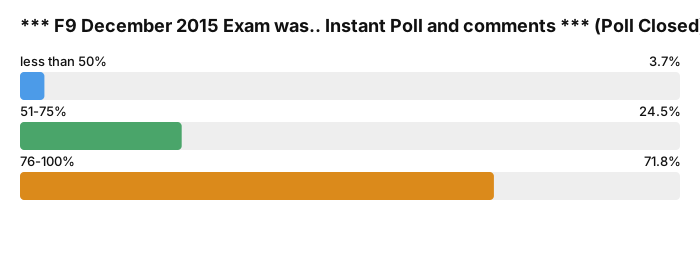
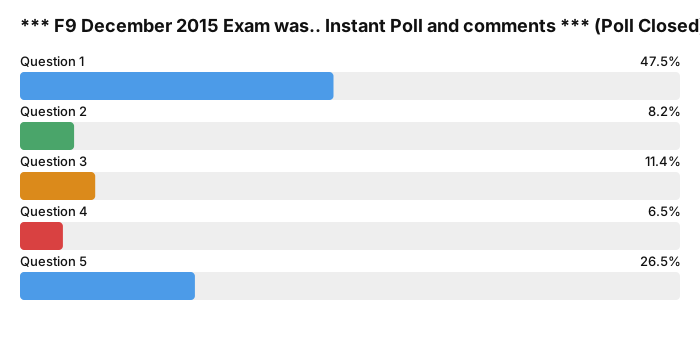
Please vote in our Instant Polls about the F9 December 2015 Exam.
 Post your comments about F9 exam below
ACCA Forums
Post your comments about F9 exam below@misschile100 said: Yes I did inflate themJust for clarifying. I hadn't known there were two ways of doing this one, one of them is the one you mentioned. The other one, the one that I'm familiar with is to calculate contribution without inflation, then discount the cash flows for each year using real rates. It's a win win situation for us. Yipeee!! After reading your comments I was afraid that I might be wrong so I confirmed with dec 2011 paper.
@ehsanshah said: You need to take assumption here... 75% will take discount and pay in 30 days.. + rest 25% will pay normal.. soo these two add up make receivables after discount...This sounds correct. Adjusting the days is something I forgot on the 75% uptake. Rookie mistake. I know my adjusted AR is wrong anyway yippee. Lol.
@ehsanshah said: Credit discount will decrease Days to 30 for 75% customers.. and overall affect decrease in ReceivableExactly what i did, assuming that 75% of customers taking up the discount will mean that 75% of customers will pay in 30 days. 2880 x 0.75 x 30/360 and the rest remained at 51 days. 2880 x 0.25 x 51/360
@genty said: There was an Mcq where equity beta of one company was 1.2 the target company's beta was also given so did you take 1.2 while calculating Ke??Proxy company's debt/debt+equity ratio was 0.25 so i assumed that debt is 25 and equity is 100 - 25 = 75. you have to ungear the proxy company's equity beta to get the asset beta so 2.0(75/75+25) = 1.5 (Tax is ignored on this question) And regear it with the capital structure of the investing company (100% equity financed so no debt here) 1.5(100/100) = 1.5 and use CAPM to calculate the discount rate with equity beta of 1.5
@dreamscars said: Proxy company's debt/debt+equity ratio was 0.25 so i assumed that debt is 25 and equity is 100 - 25 = 75. you have to ungear the proxy company's equity beta to get the asset beta so 2.0(75/75+25) = 1.5 (Tax is ignored on this question) And regear it with the capital structure of the investing company (100% equity financed so no debt here) 1.5(100/100) = 1.5 and use CAPM to calculate the discount rate with equity beta of 1.5I thought they had given the target beta as 1.2 :/
@alexanderrobert1989 said: How did people calculate the Debt to Equity in MV terms in the first question along with profit? If reserves were included it massively reduced the any levels of gearing?We got the share price, so I times that by the number of shares. Then calculated the MV of Debt from holders perspective. My DE ratio was like 0.10...
@alexanderrobert1989 said: How did people calculate the Debt to Equity in MV terms in the first question along with profit? If reserves were included it massively reduced the any levels of gearing?In terms of profit, you have the interest gearing which is profit before Interest and Tax over interest paid. So you can workout the profit levels. For part b, i wrote that the interest gearing level was low, loan note was high-interest, even though d/e ratio was low compared to the market, it was a lower-quality loan note given that there is a risk that the interest will not be payable.
@alexanderrobert1989 said: Exactly, Equity: Ordinary x Mv shares and Reserves Debt: MV of debt and New debt Yeah I did the same, gearing levels were low against the market average but interest cover went down so they were below market value. Everyone seems to have ignored reserves?I didn't add reserves as the market value of shares should already have it in consideration. But unsure lol.
@farhantahir786 said: I didn't add reserves as the market value of shares should already have it in consideration. But unsure lol.Only ordinary shares are included when using MV. If using BV, reserves will be added too.
@chris165 said: True but to calculate the finance cost you need to know the number of receiveables days before and after. Just because 75% of customers pay in 30 days doesn't mean average receiveables days cannot remain at 51.Of course it does!!! It means the remaining 25% of customers remain at 51 days and the 75% take up the 30 days!!!
@shayanacca said: I got debt/equity around 40%. Interest cover of the conpany was 6 times. So, 6= PBIT/ 0.84+ 0.60 PBIT would be 8.64 But after new investment, PBIT would increase by 20% which means 10.368 (8.64*120%) Hence it would decrease interest cover ratio which was already below average sector. Revised interest cover= 10.368/ 0.84+ 0.60 + 0.80 4.63 times. The interest cover falls from 6 to 4.63 timesAgree entirely - just what I did!!!
@sams1987 said: Hi does anyone know when ACCA will release results? Or if open tuition will be doing there own answers? TIA18th Jan. Details are on ACCA website along with policy of publishing only part of previous papers and no MCQ,s. OT can't answer what they can't get hold of.
@chris1975z said: 18th Jan. Details are on ACCA website along with policy of publishing only part of previous papers and no MCQ,s. OT can't answer what they can't get hold of.Hey did you get 40% gearing? i didnt include reserves