
Post your comments about June 2013 F7 exam.
How did you do? How did this paper compare to previous exams?
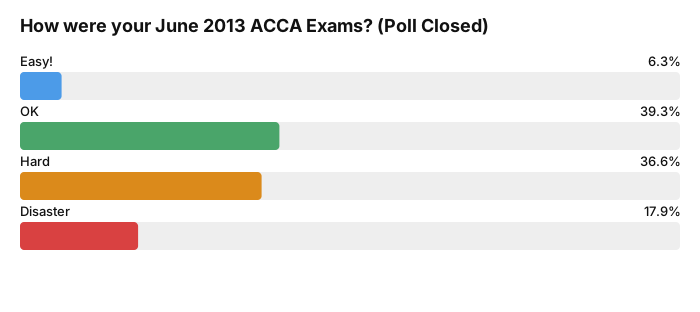
Vote in our Instant Poll

<cite>@gospelqueen said:</cite> Consideration 12000 Loan note 1500 NCI 6000 TOTAL 19500 FV of N/A @ DOA SC 20000 RE (2000) FV adj: ( 3000) Total (15000) Goodwill 4500 This was what i get. Did any one get thisYou forgot the post-aqcn retained earnings of 4,000 (8,000/2), therefore 4,000 + (2,000) = 2,000 (positive value). If this is not the way u look at it, remember that the exam paper says that the directors accepted the (2,000) loss as the basis for the pre- and post-aqcn retained earnings value. This means IGNORE the (4,000) at 1 April 2012. Also, all fair value adjustments except for plant of (3,000) were not at acqn date but existed at consolidation date.
<cite>@danf1981 said:</cite> No the amount was given in the question as they agreed on the date they purchased the sub that the loss was 2000. Thats the acquistion figure then the figure on the balance sheet showed the retained earnings for the year end. They like to trick you in these exams esp in question 1 as its the firstU r very right. I agree with you and i applied it in the exam.
 Former user13y ago#244
<cite>@abolaji said:</cite> if you all got about (11,000) as the net asset, deducting it from the cost of investment and fair value of subsidiary should push the good will higher than even the cost of investment. i.e. shouldn't the negative net asset of subsidiary have been added to the cost of investment??? Not quite sure though,but the goodwill value was quite higher than the figure you guys are quoting.Nope. You are wrong
Former user13y ago#246Former user13y ago#251Former user13y ago#254<cite>@umerazizch123 said:</cite> Yeah I hope that is right...I also got 11000 NET assets at Acq....Thank GOD:)Dear All, fist of all why we are adjusting FAIR VALUE in good will? if you think on question then you will never treat it wrongly. ist u should understand on which stander, principal we have required adjustment for fair value. in simple words CASE1: lets suppose you buy some thing from some one for $120 but the market value of this item in current condition (is the fair value in the current market) is $100, so what you have gained / loss. the good will is in actually loss for the buyer because the seller have received more than his expectation. so think if the buyer wants to resell it in current market then he will loss of $-20 (100-120). CASE2: IF THE BUYER BUY IT ON $90 SO THEN THE BUYER COULD ACHIEVED PROFIT OF $10 (100 FV- 90COST TO BUYER ) SO i think you should understand that it is an extra payment to seller (subsidary) so, the positive GOOD WILL =(PAYMENT TO SUBSIDIARY) LESS (SUBSIDIARY NET ASSET VALUE AT CURRENT MARKET MEAN'S AT FAIR VALUE). it is gained on acquiring subsidiary on lower than its fair value. So negative GOOD WILL =(PAYMENT TO SUBSIDIARY) LESS (SUBSIDARY NET ASSET VALUE AT CURRENT MARKET MEAN'S AT FAIR VALUE).
Former user13y ago#255Former user13y ago#256<cite>@shahzad1986 said:</cite> What did u get as pre acq for the subsidiary uk variant ??
<cite>@umerazizch123 said:</cite> Yeah I hope that is right...I also got 11000 NET assets at Acq....Thank GOD:)Dear All, fist of all why we are adjusting FAIR VALUE in good will? if you think on question then you will never treat it wrongly. ist u should understand on which stander, principal we have required adjustment for fair value. in simple words CASE1: lets suppose you buy some thing from some one for $120 but the market value of this item in current condition (is the fair value in the current market) is $100, so what you have gained / loss. the good will is in actually loss for the buyer because the seller have received more than his expectation. so think if the buyer wants to resell it in current market then he will loss of $-20 (100-120). CASE2: IF THE BUYER BUY IT ON $90 SO THEN THE BUYER COULD ACHIEVED PROFIT OF $10 (100 FV- 90COST TO BUYER ) SO i think you should understand that it is an extra payment to seller (subsidary) so, the positive GOOD WILL =(PAYMENT TO SUBSIDIARY) LESS (SUBSIDIARY NET ASSET VALUE AT CURRENT MARKET MEAN'S AT FAIR VALUE). it is gained on acquiring subsidiary on lower than its fair value. So negative GOOD WILL =(PAYMENT TO SUBSIDIARY) LESS (SUBSIDARY NET ASSET VALUE AT CURRENT MARKET MEAN'S AT FAIR VALUE).
Former user13y ago#258Former user13y ago#260Former user13y ago#261